Binance APAC Head: India Needs INR Stablecoins To Reduce Dollar Risk


Binance News Highlights INR Stablecoins and RWA Tokenization for India
India's crypto market continues to lean heavily on dollar-pegged tokens like USDT and USDC, leaving traders exposed to currency swings beyond their control. Binance's APAC leadership argues that a rupee-backed stablecoin could change that equation. As the exchange pushes toward a multi-asset "super app" vision, its India remarks spotlight both an unmet regulatory gap and a growing opportunity for domestic digital settlement tools.
Why SB Seker Says India Needs INR-Backed Stablecoins
Binance's Asia-Pacific head, SB Seker (also referred to as Leon Foong in earlier reporting), has been vocal about the need for rupee-denominated stablecoins in India's digital asset ecosystem. Speaking to Moneycontrol, Seker described INR stablecoins as essential for helping users and institutions manage foreign-exchange exposure tied to crypto holdings.
His central argument is straightforward: India's crypto users overwhelmingly trade against dollar-backed assets, even though their income, expenses, and savings are denominated in rupees. That mismatch, he suggests, introduces an avoidable layer of risk into everyday crypto activity — one a domestically issued stablecoin could resolve.
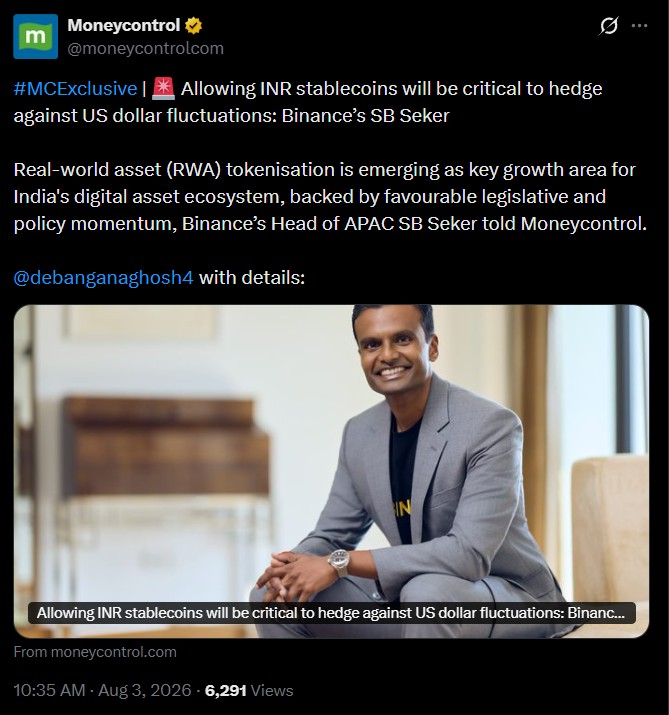
How INR Stablecoins Can Protect Indians From US Dollar Fluctuations
The mechanics of currency risk are often overlooked. When an Indian investor buys a dollar-pegged stablecoin, their exposure isn't limited to the crypto asset itself — it also includes movement in the USD/INR exchange rate. Even if a token's dollar value stays flat, a weakening or strengthening rupee can quietly erode or inflate returns once converted back to local currency.
A rupee-backed stablecoin would remove that extra variable. Traders could settle transactions, park funds, or move between assets without an implicit dollar bet layered on top of their actual investment decision.
For businesses using crypto rails for remittances or cross-border settlement, this matters even more — pricing, invoicing, and payouts could stay anchored in rupee terms throughout the transaction lifecycle.
Seker framed this as a hedging tool rather than a replacement for existing payment rails, positioning INR stablecoins as a complement to India's broader digital finance infrastructure.
INR Stablecoins vs USD Stablecoins
Feature | INR Stablecoin | USD Stablecoin (USDT/USDC) |
Pegged Currency | Indian Rupee (INR) | US Dollar (USD) |
Currency Risk | Minimal for Indian users | Exposed to USD/INR fluctuations |
Primary Use | Domestic payments, settlements, tokenized assets | Global trading and liquidity |
Cross-Border Utility | Regional and India-focused | Global adoption |
Regulatory Status in India | Not yet approved | Widely used but not locally regulated |
Key Benefit | Helps hedge forex risk | High liquidity and international access |
India's Crypto Regulations and the Current Stablecoin Landscape
India's regulatory posture toward digital assets remains a patchwork rather than a comprehensive framework. Crypto gains are taxed at a flat 30%, alongside a 1% tax deducted at source (TDS) applied to many transactions — rules that have shaped trading behavior without addressing deeper questions of asset classification or stablecoin issuance.
The Reserve Bank of India has continued to champion its central bank digital currency, the digital rupee, while staying cautious on privately issued cryptocurrencies.
Unlike jurisdictions such as Japan, Singapore, and Hong Kong — which have introduced or proposed frameworks for fiat-backed tokens — India has not yet formed a clear policy on whether, or how, private stablecoins might be permitted to operate domestically.
Industry voices argue that a CBDC and privately issued stablecoins could coexist, since one represents a direct central bank liability while the other typically operates under reserve-backed, regulator-supervised models.
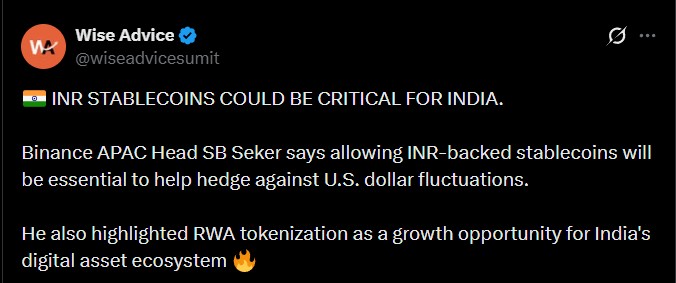
RWA Tokenization Emerges as India's Next Crypto Growth Opportunity
While stablecoin policy remains undecided, Seker pointed to real-world asset (RWA) tokenization as an area where India has already shown clear direction. He noted that of the two major growth drivers he identified for cryptocurrencies broadly — stablecoin adoption and RWA tokenization — India has moved decisively only on the latter.
State-level momentum is part of that picture, with Seker citing initiatives in Maharashtra as an example of local government engagement with tokenized assets. Combined with what he described as supportive legislative and policy signals, RWA tokenization is emerging as a distinct growth lane for India's digital asset sector, separate from the unresolved stablecoin debate.
Binance's Super App Vision: AI, Multi-Asset Investing and 3 Billion Users
Binance's India commentary sits inside a much larger ambition: transforming from a cryptocurrency exchange into a multi-asset financial super app. The platform already offers exposure to roughly 7,000 US stocks and ETFs alongside trading, and stablecoins serve as the settlement layer tying these asset classes together.
Seker described plans to expand from roughly 320 million users globally to 3 billion within five years, powered partly by deeper AI integration. Binance is already using AI for customer support, fraud detection, and compliance, and Seker pointed to agent-to-agent crypto payments — where AI systems transact autonomously on users' behalf — as the next frontier. The super app rollout, however, remains contingent on local regulatory approval in each market, including India.
Binance's Engagement With Indian Regulators and SRO Proposal
Seker acknowledged that Binance has not held direct talks with the RBI, despite stablecoins being central to the exchange's circulatory infrastructure. The company has engaged with other regulatory bodies and participated in parliamentary subcommittee hearings, though Seker noted a need for clearer, more globally informed dialogue on how other jurisdictions handle similar frameworks.
On the parliamentary standing committee's recent recommendation for self-regulatory organizations (SROs) under a designated regulator as an interim measure, Seker was cautiously supportive, drawing on Binance's experience with similar structures in Indonesia, Korea, and Japan. He suggested that well-constructed SROs, with meaningful industry participation, tend to produce more commercially grounded regulation.
Timeline: India's Stablecoin & Crypto Policy Journey
Date | Development |
2022 | India introduces a 30% tax on crypto gains and 1% TDS on transactions. |
2023–2025 | RBI continues promoting the Digital Rupee (CBDC) while remaining cautious on private cryptocurrencies. |
2026 (Ongoing) | Government continues consultations on a comprehensive crypto regulatory framework. |
July 2026 | Parliamentary Standing Committee recommends a self-regulatory organization (SRO) as an interim framework. |
August 3, 2026 | Binance APAC Head SB Seker says INR-backed stablecoins are critical to reduce USD exchange-rate risk and support India's crypto ecosystem. |
What's Next | India is expected to decide whether regulated INR-backed stablecoins can coexist with the Digital Rupee under future crypto legislation. |
Conclusion: Will India Approve INR Stablecoins in the Future?
India's market is expanding, but its stablecoin policy remains an open question. Binance news sees INR-backed tokens as a practical hedge against dollar exposure and a natural complement to RWA tokenization momentum already underway.
Whether regulators embrace that vision — through an SRO model, direct legislation, or continued caution — will shape how India's digital asset ecosystem evolves. Investors should watch upcoming policy signals from the RBI and parliamentary committees closely.
Disclaimer: This article is for informational purposes only and does not constitute financial, investment, or legal advice. Cryptocurrency investments carry risk; conduct independent research before making decisions.









