RWA Tokenization 2026: Where Is the $29B Onchain Money Going

RWA Tokenization 2026: Why DeFi Active TVL Matters More Than Marketcap
Onchain real-world asset tokenization just crossed $29B, and DefiLlama highlights exactly where that money sits. The platform breakdowns for Decentralized Finance Active TVL (Total Value Locked), a metric that tracks how much of an RWA's market cap actually gets put to work inside DeFi.
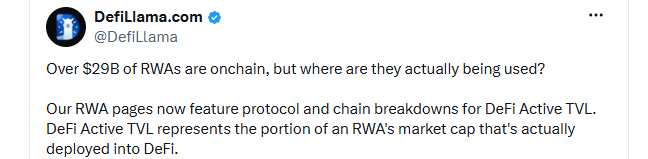
The DefiLlama update today unfolds a money flow pattern in the RWA tokenization 2026 story.
RWA Tokenization 2026 Update: Onchain Assets Now Pass $29 Billion
DefiLlama reports over $29B in onchain RWAs, with new tools that break down DeFi Active TVL by protocol and by blockchain. This matters because market cap alone never tells the full story.
Take Tether Gold. The token carries a $2.83B onchain market cap, but only $222.56M of that sits in DeFi Active TVL. LayerZero V2 holds $118.83M of it, and AAVE V3 holds $59.03M, with the rest spread across smaller lending and DEX platforms.
That gap points to a bigger pattern across the tokenized assets sector. Overall utilization sits around 9-10%, which means most tokenized value stays parked instead of earning through lending, trading, or collateral use, according to data published on DefiLlama's RWA dashboard.
Top RWA Tokenization 2026 Chains: Which Blockchain Networks Lead Real World Asset Tokenization Today
Ethereum still rules the market, holding more than half of the total onchain RWA share, almost 55.6%, worth roughly $14.8 billion out of total $29 billion. Institutions treat the ETH network as the settlement layer of choice for regulated products.
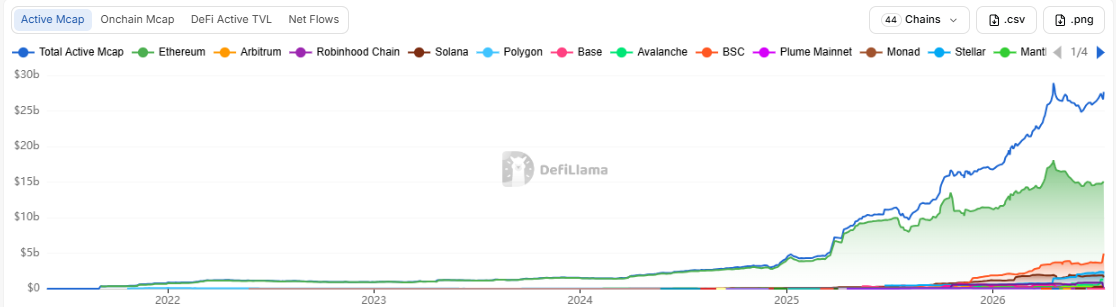
Source: DefiLlama Official
Behind Ethereum, a few networks stand out for different reasons:
-
BNB Chain (BSC) and Avalanche keep growing their RWA listings steadily.
-
Solana moves fast on tokenized equities and trading products, built for speed and liquidity.
-
Stellar focuses on cross-border payment rails.
-
Arbitrum and newer chains like Monad are starting to carve out their own niches.
A joint report by RedStone , Gauntlet, and RWA.xyz projects the total market could reach up to 30 trillion by the 2034, pushed forward by tokenized Treasuries, private credit, and equities.
Why Low DeFi Active TVL Numbers Matters for Everyday Investors
What This Data Means for Users Holding or Considering RWAs
A low utilization rate does not mean RWAs lack value. It means a large share of holders treat these tokens as stable, low-volatility positions rather than active DeFi tools.
The upside for users is real. Tokenized Treasuries like BlackRock BUIDL and Ondo Finance’s USDY, and private credit products often pay yields in the 4-6% range as per RWA.xyz, come with fractional ownership so someone does not need large capital to participate, and settle faster than traditional TradFi products that can take days to clear.
RWA tokens today are held for stability, not for DeFi farming, and the data now provide measurable evidence rather than assumptions.
There are limits too, and users should know them before buying in:
-
Many products require KYC checks or sit behind allowlists, so access is not fully open like a typical crypto token.
-
Custody depends on the issuer, meaning trust in companies like BlackRock, Ondo, or Securitize matters as much as the blockchain itself.
-
Secondary market liquidity for some RWA categories, like real estate or private credit, stays thin compared to Treasuries or gold-backed tokens.
-
Redemption terms vary by product, so exit speed is not guaranteed to match onchain trading speed.
Despite these limits, RWAs give retail and institutional users a way to hold TradFi-grade products onchain, with 24/7 access and lower volatility than most native crypto assets.
That combination is why inflows keep climbing even while DeFi usage stays low.
RWA Tokenization Versus Native Cryptocurrency
Bitcoin and Ethereum move on sentiment, adoption cycles, and supply mechanics. Their price swings fast in both directions, and nothing backs that value beyond market demand.
RWAs work differently. A token like Tether Gold or a tokenized Treasury bill carries value tied to a physical or financial asset, with a redemption path back to that underlying asset. This gives RWAs steadier price behavior and makes them attractive to users who want exposure to blockchain rails without crypto-level volatility.
The tradeoff lies in composability. Native crypto assets move freely across DeFi with no restrictions, while RWAs often carry permissioned access that limits how they plug into lending markets, DEXs, or collateral pools.
Regulatory Landscape Shaping RWA Growth in 2026
Regulation remains the biggest factor deciding how fast RWA tokenization scales. In the United States, the SEC has taken a "same rules, new plumbing" approach. This approach applies existing securities law to tokenized products rather than writing a separate tokenization statute.
In the European Union, MiCA now covers stablecoins and crypto-asset services, though tokenized securities still fall under MiFID II, with regulators actively working on updates to close that gap. The UK's regulatory sandbox continues testing tokenized product frameworks before wider rollout.
These differences create real friction. Issuers face separate KYC and AML requirements in each region, along with the Travel Rule. In some cases, volume caps during pilot programs also matter. That fragmented approach slows how quickly RWA products can scale across borders, even as demand keeps rising.
Why RWA Tokenization Matters in 2026
Real-World Asset (RWA) tokenization has matured into a $29 billion onchain reality, shifting the focus from raw market cap to DeFi Active TVL—how much of this capital actually gets put to work. It matters now for three key reasons:
- Democratized Yield: Fractional ownership gives everyday investors access to stable, institutional-grade returns (like Treasuries paying 4–6%) without needing millions in capital.
- Capital Efficiency: Instead of sitting idle, tokenized gold and bonds are increasingly plugging into DeFi as reliable, 24/7 collateral for lending and trading.
Instant Settlement: Moving TradFi products onto blockchain rails eliminates days of clearing friction, cutting transaction times down to minutes.
In short, they offer the speed and accessibility of crypto, without the extreme volatility.
A Future Outlook
Tokenization in 2026 is shifting away from a race for bigger market cap numbers toward a race for real usage. As DeFi deposits linked to RWAs keep climbing and platforms like BlackRock, and Securitize build deeper DeFi hooks, the sector looks set to close the gap between assets that sit idle and assets that actually work onchain.
Disclaimer: This article is for informational purposes only and does not constitute financial or investment advice. Crypto markets carry significant risk. Always do your own research before making any investment decisions.
Also read:






