Binance Proof of Reserves 44: BTC Rises, US Targets 20% Back


Binance Proof of Reserves 44: What the July 1 Numbers Show
Two pieces of Binance news landed on the same day — and together they tell a bigger story than either one alone.
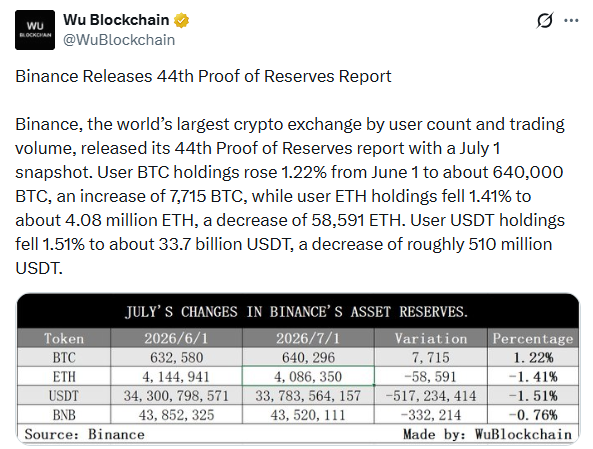
The 44th Binance Proof of Reserves report dropped with a July 1 snapshot date, showing BTC user holdings climbing for the second consecutive month while ETH and USDT balances fell. On the same day, Binance US CEO Stephen Gregory sat down to announce the platform is ending two years of regulatory dormancy and targeting 20% of the US crypto trading market — the share it held before the 2023 SEC lawsuit nearly shut it down.
 Source: X(formerly Twitter)
One story is about custody transparency. The other is about a comeback. Read together, they tell you where the world's largest crypto exchange is heading.
Binance Proof of Reserves 44: What the July 1 Numbers Show
The 44th Binance Proof of Reserves report is part of a monthly transparency initiative the exchange launched in late 2022 following the collapse of FTX. Every report uses a Merkle tree construction combined with zk-SNARKs — a cryptographic method that lets users verify their individual balance is included in the total without exposing anyone else's holdings.
The July 1 snapshot shows four assets moving in different directions:
BTC: 640,296 — up 7,715 from June 1, a 1.22% increase
ETH: 4,086,350 — down 58,591 from June 1, a 1.41% decrease
USDT: 33,783,564,157 — down 517,234,414 from June 1, a 1.51% decrease
BNB: 43,520,111 — down 332,214 from June 1, a 0.76% decrease
The BTC trend is the headline number. User Bitcoin balances on the exchange have now grown consistently for several consecutive months. Starting from approximately 591,000 BTC as of August 2025, user holdings have climbed to 640,296 as of July 1, 2026 — an increase of nearly 50,000 BTC over roughly eleven months. The exchange reported an over-collateralization ratio of 100.20% for BTC — for every Bitcoin users have deposited, The exchange holds slightly more than one in reserve.
The USDT decline is the more complex signal. A $517 million drop in user stablecoin holdings in a single month could reflect users converting stablecoins into crypto — a risk-on rotation consistent with improving market sentiment. It could also reflect withdrawals. The Proof of Reserves report captures the snapshot, not the behavior behind it — the methodology does not separate deposits, withdrawals, purchases, or internal transfers.
These are self-reported figures. No independent third-party audit accompanies the monthly snapshot. The Merkle tree construction allows individual verification, but the overall reliability depends on Binance's own cryptographic infrastructure rather than an external auditor's sign-off.
Binance US CEO Stephen Gregory: The 20% Market Share Plan
While the 44th Binance Proof of Reserves report covered the global platform, the US story is entirely domestic — and significantly more aggressive in tone.
CEO Stephen Gregory told on July 13 that the company is focused on growth after roughly two years in what he described as a "hibernation" tied to regulatory issues surrounding the broader brand. The company previously held roughly 20% of the US crypto exchange market. That number is currently near zero, per CoinDesk Indices data. Gregory is targeting a return to that 20% level.
The mechanics of the comeback plan are specific. Gregory said the exchange has reduced fees to "essentially almost a no-fee exchange," with 0% maker fees and 2-basis-point taker fees. The platform is rebuilding liquidity through direct incentives and personal outreach — Gregory confirmed he has been contacting top users directly for feedback, an unusual approach for a CEO of a platform this size.
Three product categories sit at the center of the expansion roadmap:
Derivatives trading — a direct challenge to CME and the futures-focused products Coinbase and Kraken have been expanding
Perpetual futures — high-frequency, no-expiry contracts that dominate global crypto trading volume but have been restricted for US retail users
Prediction markets — which Gregory specifically named, saying "prediction markets are super hot. Everybody's talking about that," adding it directly to the list of areas US is evaluating
Gregory noted that Binance.US is a separate US-only entity with its own governance structure, though it shares a common beneficial owner and brand name with Binance.com. That structural point matters for regulatory positioning — every interaction between the exchange US and its customers runs through a US-licensed, US-governed entity, not the global platform.
Before Binance US, Gregory served as US CEO of Currency.com, where he led the company through its 2025 acquisition. Prior to that, he held compliance leadership roles at Gemini and CEX.io. The pattern is consistent: he is a compliance-first executive being put in front of a platform that spent two years managing regulatory risk rather than growth.
Binance Proof of Reserves Outlook: What Both Updates Mean
The 44th Binance Proof of Reserves report and the US comeback announcement paint two complementary pictures of where Binance sits in mid-2026.
Globally, BTC accumulation on the platform is running consistently positive — nearly 50,000 BTC added in under a year. That trajectory, if it continues, signals growing confidence in centralized custody at exactly the moment the exchange is trying to restore its US standing.
In the US, the exchange is starting from near-zero market share with a CEO who built his career on compliance and regulatory navigation. Zero maker fees and a product expansion roadmap into derivatives, perpetuals, and prediction markets puts Binance US in direct competition with Coinbase — which has been working on becoming an "everything exchange" — and Kraken, which secured derivatives licenses earlier in 2026.
Three things to watch following both updates, based on public market sources and assumption basis only — no guaranteed outcomes:
Whether the BTC accumulation trend holds in the 45th report. A third consecutive monthly BTC increase at this scale would confirm a multi-month structural shift, not a single-month blip.
Whether Binance US secures derivatives and perpetual futures licenses. Gregory confirmed the company expects to pursue additional licenses — the timeline for those approvals depends on the regulatory environment, not the CEO.
How Coinbase and Kraken respond. Both are watching US re-enter the fee competition with a zero-maker model. Fee compression at scale changes how every exchange in the US market generates revenue.
Conclusion
The 44th Binance Proof of Reserves confirms BTC accumulation continues. The exchange US is ending its two-year hibernation with zero fees, a compliance-first CEO, and a 20% market share target. Two very different reports, published on the same day, both pointing in the same direction: Binance is rebuilding its presence from global custody to domestic competition, simultaneously. The 45th report and the first US license application will be the next tests.
YMYL Disclaimer
This article is for informational and educational purposes only. It does not constitute financial or investment advice. All Proof of Reserves figures are from Binance's official 44th report based on a July 1, 2026 snapshot. These are self-reported figures using Binance's own cryptographic infrastructure — no independent third-party audit accompanies the report. All US statements are sourced from CEO Stephen Gregory's July 13, 2026. Market share targets, fee structures, and product expansion plans are stated intentions subject to regulatory approval and may change. Digital asset markets carry significant risk including total loss of capital. Always conduct your own independent research before making any investment or exchange decision.
Also read:









