BitPay MiCA License Approved: Is It Ahead of Ripple and Binance in EU?

BitPay MiCA License Approved: How It Expand Crypto Services in Europe?
The Dutch arm just cleared one of the toughest regulatory bars in crypto, with a full BitPay MiCA license approved by the AFM. For merchants and traders eyeing stablecoin payments in Europe, this single approval could reshape who they trust with their money. Here's what most reports aren't telling you about why this license matters more than the headline suggests.
What Happened With BitPay MiCA License?
BitPay announced that its Dutch entity received authorization from the Netherlands Authority for the Financial Markets (AFM) to operate as a Crypto-Asset Service Provider (CASP). The news broke on Thursday, July 17, 2026, confirming MiCA license-approved status just weeks after the EU's hard compliance deadline.
The timing matters. Bitpay MiCA full transition window closed on July 1, 2026, meaning every crypto firm serving EU customers now needs a CASP license or equivalent registration to operate legally.
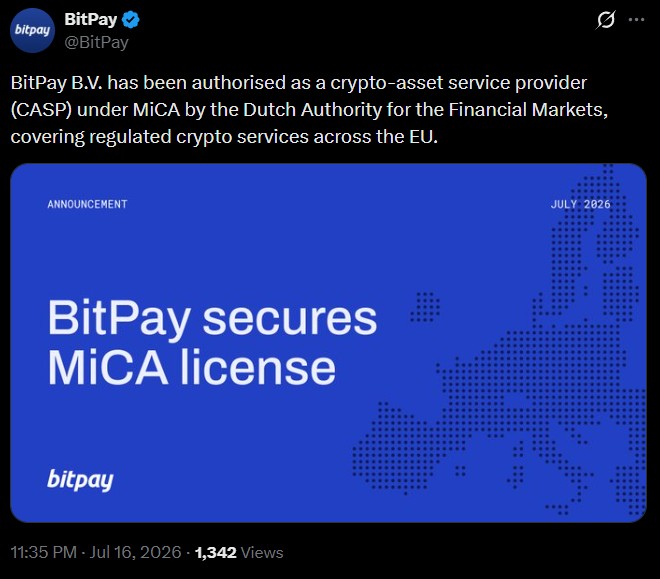
Source: Official Bitpay X
What Is BitPay?
Founded in 2011, the company is one of the longest-running payment processors in the industry. Over 15 years, the company has built a track record spanning merchant payment tools, stablecoin settlement, and consumer-facing crypto spending products, alongside money transmitter licenses in multiple jurisdictions.
What Is the MiCA CASP License?
Markets in Crypto-Assets Regulation is the European Union's unified rulebook for digital asset businesses. A CASP authorization confirms that a company meets EU-wide standards for consumer protection, operational resilience, and financial oversight — replacing the old patchwork of country-by-country registrations.
For a company the size isn't a minor formality. It's the regulatory foundation needed to serve millions of users across nearly 30 European countries under one framework.
Why Did BitPay Choose the Netherlands?
The company routed its EU application through the Dutch AFM, positioning its regional headquarters in Amsterdam. The Netherlands has emerged as a preferred MiCA entry point for several crypto firms thanks to the AFM's structured review process and the country's established fintech ecosystem.
Thom de Jong, BitPay's chief compliance officer for Europe, framed the approval as validation of the company's compliance-first approach to expansion, noting that gives the industry a shared framework for responsible growth.

Source: Wu Blockchain X
What Crypto Services Can BitPay Now Offer Across the EU?
With CASP status confirmed, the platform can now offer:
-
Regulated crypto payment processing for merchants
-
Cross-border crypto and stablecoin transfers
-
Consumer spending tools tied to digital assets
-
Partner-supported buying, selling, and swapping of crypto
This turns BitPay MiCA license approval into more than a compliance headline — it's an operational unlock for real payment flows.
How the MiCA License Expands BitPay's Business
The biggest structural advantage here is passporting. Once authorized in one EU member state, a CASP license lets a company offer services across all EEA countries without separate national approvals. The platform no longer needs to navigate fragmented rules market by market.
BitPay's European head, Jonathan Arler, said the company sees the region as central to where payments are heading, adding that Europe is one of the most important regions for the future of payments. The company has signaled plans to deepen stablecoin-based merchant payments and cross-border commerce tools as part of its next growth phase.
Why This Approval Matters for Businesses, Consumers, and the European Crypto Market
For merchants, a single MiCA-licensed provider means simpler onboarding for cryptocurrency and stablecoin acceptance without juggling multiple regulators. For consumers, it potentially widens access to regulated tools for spending, buying, and swapping digital assets through BitPay's partner network.
For the broader market, this approval adds to a growing list of MiCA-authorized players, reinforcing the EU's push toward a harmonized digital asset ecosystem. It doesn't remove price or technical risk from crypto assets themselves, but it does give businesses a regulated counterparty to build compliance and treasury policies around.
BitPay vs Other Crypto Companies Under MiCA
The race for licensing hasn't gone the same way for every firm. Ripple recently secured its own CASP license through Luxembourg's regulator, while some major exchanges notably Binance exit from earlier EU licensing efforts entirely.
This approval places it among the payment-focused firms that chose full MiCA compliance over workarounds, a distinction that could matter to merchants weighing long-term regulatory stability over short-term convenience.
What's Next for BitPay?
It plans to keep investing in European operations, partnerships, and regulated payment infrastructure from its new Amsterdam base. The real test now shifts from paperwork to adoption — how many merchants and consumers actually put the license to use.
Ongoing compliance obligations remain, and the platform's next moves on stablecoin partnerships could determine how much of this authorization translates into real transaction volume.
Conclusion
Eu license approval gives the payments company a single regulatory passport, right as the compliance deadline reshapes who gets to operate. Whether this converts into real merchant and consumer adoption is the next storyline to watch.
Disclaimer: This article is for informational purposes only and does not constitute financial, investment, or legal advice. Cryptocurrency markets are volatile and carry risk. Readers should conduct their own research before making any financial decisions.






