BNB Chain Update: Private Payments Launch With Hinkal Protocol

BNB Chain Update: Private Payments Live, $BNB At #2 in Pantera Index
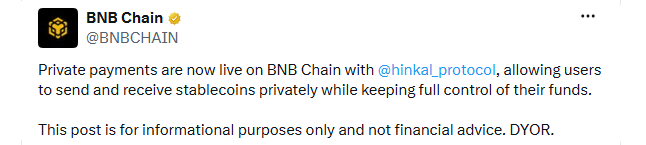
BNB chain update today marks a major shift for everyday payments on the network. Hinkal Protocol has switched on private payments for stablecoins and $BNB coins, letting users send funds without exposing balances or transaction history on-chain.
Source: Official Announcement
This BNB chain private payments rollout adds a new layer of confidentiality to one of crypto's busiest payment networks.
How BNB Chain Update Brings Private Stablecoin Payments to Life
Hinkal Protocol announced the rollout first, and the official @BNBCHAIN account confirmed the news today.
Payments through Hinkal Pay hide the sender, the recipient, and the transaction amount, while the user keeps full control of funds at every step.
The launch brings several features live at once:
Shielded balances that sit on top of an existing wallet, with no new wallet or token required
Private sends to another shielded balance or to any public address
Payment requests shared through a link or QR code
Multisend for paying several recipients in a single transaction
Unshielding, which moves funds back to a public balance at any time
Inside the Technology Powering Hinkal's Zero-Knowledge Privacy Tool
Hinkal relies on ZK proofs to shield balances without hiding the underlying math from validators. The system uses cryptographic commitments and nullifiers to stop double-spending, and stealth addresses keep individual transfers from linking back to a single wallet.
Anyone checking a block explorer mostly sees calls to the Hinkal smart contract rather than a clear map of who paid whom.
Every deposit passes through screening tools before entering the private pool, and viewing keys let a user share transaction history with an auditor or regulator when required.
Hinkal never holds custody of user funds at any point in the process, as stated at hinkal.io.
What This BNB Chain Update Means for Everyday Users and Businesses
For an individual, private payments mean a salary or a personal transfer no longer sits in plain view for anyone to search. For a business, hidden treasury flows and payroll amounts remove a real edge that competitors could otherwise track.
Confidential stablecoin and $BNB coin transfers between shielded balances
Multisend for payroll, vendor payouts, and contributor payments
Selective disclosure through viewing keys for compliance needs
The BNB Smart Chain (BSC) already carries a heavy load of stablecoin activity. Tens of millions of holders and monthly transfer volume that has reached past $100 billion during busy periods.
Fees stay low and blocks confirm in under a second following the Fermi upgrade, so private payments settle at the same speed anyone following BNB chain news each month has come to expect.
BNB Price Today: Market Cap, Volume, and Supply Numbers
$BNB price today sits at $594.56, down 1.06% over the past 24 hours as per CoinMarketCap data. Other key figures from current market data show:
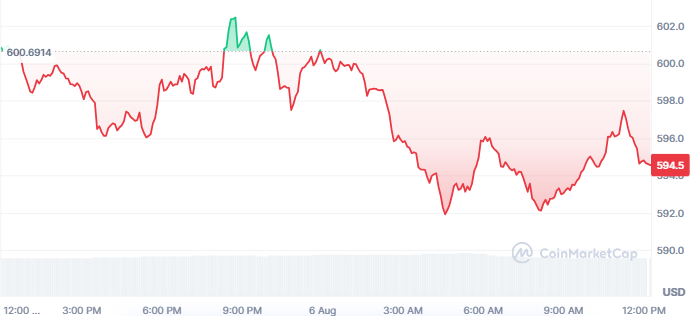
Market cap: $79.17B, down 1.06%
24-hour volume: $1.15 billion
Fully diluted valuation: $79.16 billion
Total supply: 133.16M $BNB
Circulating supply: 133.16M $BNB
Treasury holdings: 686.07K $BNB
How BNB Chain's Privacy Tools Compare With Other Market Options Today
Hinkal is not the only project working on private payments, and each competing approach picks a different trade-off between privacy, speed, and ease of use.
Railgun runs mature shielded pools built for private DeFi activity on EVM networks, with strong ties to decentralized exchanges and lending markets, though it stays lighter on multi-chain payment tooling than Hinkal.
Aztec Network offers a privacy-focused layer-2 on Ethereum with a programmable language for custom confidential applications, which suits developers more than a drop-in payment tool for existing wallets.
Privacy Pools applies an association-set model that leans on selective disclosure, aiming for a compliance-friendly middle ground on Ethereum.
Hinkal sets itself apart with coverage across the $BNB chain, Ethereum, and several EVM layer-2 networks, paired with a direct focus on payroll, settlement, and everyday payment flows.
Ecosystem Grows With Developments: BNB Chain Ranks No. 2 in Pantera Index
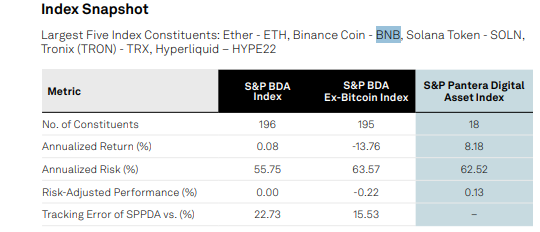
Alongside this BNB ecosystem update, $BNB coin took second place in the new S&P Pantera Index. S&P Dow Jones Indices built the benchmark together with Pantera Capital, and the index launched in July 2026 to screen 18 digital assets mainly by protocol revenue rather than price alone
Source: S&P Dow Jones
The index leaves out Bitcoin and meme coins, and it applies strict tests for liquidity, market size, and real revenue.
The BNB chain averaged close to 4.5 million daily active users in the first quarter of 2026, a figure that supports its No. 2 spot on the list and points to a wider shift toward judging networks by actual usage instead of hype.
What Comes Next for BNB Chain After This Privacy and Ranking Update
Adoption from here depends on how much liquidity moves into the shielded pools and how smoothly payroll operators, merchants, and OTC desks fold private transfers into existing workflows.
On the ranking side, the S&P Pantera Index plans to review its 18-asset list on a regular basis as revenue and usage figures shift. A stronger showing next cycle would likely hinge on continued growth in daily active users and transaction volume across the blockchain, rather than short-term price moves.
Both threads point toward the same test: whether real usage keeps expanding at the pace recent numbers suggest.
Note: This article covers publicly announced protocol updates and market data. It is for informational purposes only and does not constitute financial advice.