Cardano ADA News: Dijkstra Upgrade Sets Two-Phase Roadmap 2026

Cardano ADA News: 2026 Ecosystem Upgrades Shaping ADA Price Structure
Cardano ADA News today covers the newly detailed Dijkstra upgrade, a governance tool called CIP-179 that could change how proposals get shaped. At the same time, founder Charles Hoskinson made comments on a private DeFi bridge through Midnight. Together, they point toward a busy stretch ahead for the $ADA ecosystem 2026.
Source: Official Hard Fork Plan
Following the update, Cardano ADA price today, trading near $0.175, down 1.32% over the past day, while the network prepares for one of its biggest technical shifts yet.
Cardano ADA News: How the Dijkstra Upgrade Splits Into Two Phases
The Cardano Dijkstra upgrade is arriving in two separate phases, laid out through Cardano's public roadmap.
Phase one targets code completion by the fourth quarter of 2026. It centers on Ouroboros Linear Leios, tracked as CIP-164, which adds supplementary Endorser Blocks to move more transactions through the network at once.
Phase one also bundles several smaller, practical upgrades:
CIP-118 – nested transactions, letting apps cover network fees for users
CIP-112 – guard scripts, separating validation logic that previously needed a minted token just to run
CIP-159 – improves account-address
CIP-181 – makes staking-reward withdrawals simpler
Phase two lands in the second quarter of 2027. It brings Ouroboros Peras, listed as CIP-140. Peras adds a stake-pool voting layer built to speed up settlement, addressing the finality delays that have followed the $ADA blockchain since its early design.
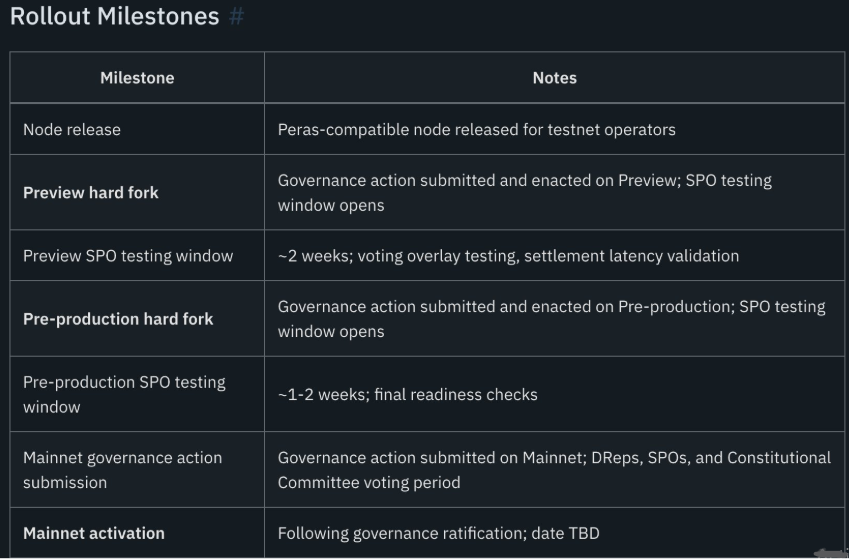
Both phases follow the same rollout path before touching mainnet:
First, a compatible node ships for testnet operators
Then a governance vote runs on Preview
Next a two-week testing window
The same steps repeat on Pre-production, with a shorter one-to-two-week check. After that, a final governance vote opens on mainnet for DReps, stake-pool operators, and the Constitutional Committee. Activation follows once that vote passes.
Under the Cardano Roadmap 2026, the Preview hard fork is the first real milestone, since it marks the first live governance test of this $ADA network upgrade 2026 cycle.
CIP-179 Brings On-Chain Surveys and Polls to Cardano Governance Voting
Governance is getting an upgrade too, and it connects directly to everything above. Cardano CIP-179 introduces an on-chain system for structured surveys and polls, filed under metadata label 17.
Instead of a simple yes-or-no vote, it supports ranked choices, point allocation across priorities, numerical ranges, and side-by-side comparisons.
DRep Will Norris explained why this matters, arguing that Cardano governance has long lacked a real step between an idea and a formal proposal.
Under the current setup, a concept often moves straight from debate to a written proposal to a submitted vote, without a clear read on what the wider community actually wants first.
CIP-179 fills that gap and is now live. It runs with client-side tallies, both public and sealed response options, and tools such as Tessera already use it.
The idea is a coordination layer sitting ahead of formal governance: raise a topic, gather structured preferences, refine the proposal, then move to an official vote under the existing CIP-1694 framework.
Cardano ADA Price Holds Near $0.17 as Upgrade News Builds Momentum
Instead of Cardano ADA news today talking about growth, the token price is sliding.
Based on the latest CoinMarketCap data, as of August 17 2026, the ADA price snapshot looks like this:
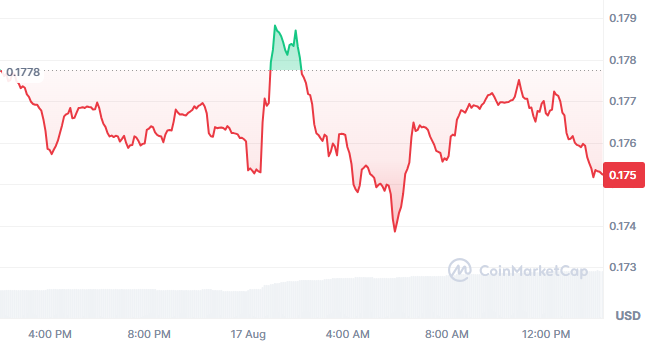
Price: $0.175, down 1.32% over 24 hours
Market cap: $6.44 billion, down 0.03%
24-hour volume: $187.5 million, up 69.79%
Fully diluted valuation: $7.95 billion
Circulating supply: 36.55 billion ADA of a 45 billion max supply
The jump in daily volume against a nearly flat price often points to positioning around news rather than a clean directional move. ADA currently ranks 15th by market capitalization on CoinMarketCap, a spot it has held through a stretch of range-bound trading this year.
Charles Hoskinson Outlines Cardano Privacy Layer Cross-Chain Plans
Founder Charles Hoskinson added another angle during a recent discussion, describing a path for private decentralized finance built through Midnight, the $ADA network's dedicated privacy sidechain.
Under the model, ADA gets locked in a Cardano smart contract, and a private stablecoin gets generated through Midnight. Those shielded assets could then move into other ecosystems, including Ethereum, Solana, and Hyperliquid, without exposing the original transaction trail.
It is the clearest public description yet of how the Cardano privacy layer is meant to connect outward rather than stay contained to one chain.
That fits a broader point circulating around the network right now: steady, multi-year infrastructure work tends to draw less attention than newer projects with fresh token launches, even when the underlying upgrades solve real bottlenecks.
What Ahead For Cardano ADA News
One DRep shared post made this point well. Dijkstra is the first upgrade tackling both speed and finality at the same time, alongside a wider batch of CIPs aimed at smoother developer and user experience.
A new project's whitepaper takes weeks to write. Upgrades like Leios and Peras take years to build and are just as hard to reverse once live, which is part of why testnet runs and governance approval sit ahead of every phase.
So what comes next. Phase one code should wrap by the end of 2026, followed by testnet checks and a mainnet vote. Phase two, carrying Peras, sits about six months further out.
In between, CIP-179 gives DReps and stake-pool operators a live way to shape those votes before they happen, instead of reacting after the fact. Dijkstra isn't one single event. It's a chain of testnet checkpoints, votes, and code merges stretched across roughly eighteen months.
The real test won't show up on a price chart first. It'll show up in whether DReps and stake-pool operators actually use CIP-179 to shape Peras before the formal vote lands.
Disclaimer: This article is for informational purposes only and does not constitute financial or investment advice. Crypto markets carry significant risk. Always do your own research before making any investment decisions.
Also read:













