Hyperliquid News Today: HIP-3 Sets $4.3B Record as Vaults 2.0 Go Live


Hyperliquid News Today: Products, HIP-3 Milestone, Buoy Finance Vaults
Hyperliquid has rolled out fresh product and ecosystem updates spanning protocol changes, infrastructure access, and a record trading milestone. This roundup covers the HIP-1 and HIP-4 specification updates, the Foundation's new node policy, a $4.3 billion open interest high on HIP-3 markets, and Buoy Finance's new vault system for HyperCore.
Hyperliquid News Today: Latest Product and Ecosystem Updates
The newest announcement bundles several updates together. The Hyperliquid Improvement Proposal 1 token specification is set for further expansion, HIP-4 has picked up new features, and the Hyper Foundation is opening its non-validating nodes to outside infrastructure providers. On the trading side, HIP-3 markets just posted a record $4.3 billion in open interest. Rounding things out, Buoy Finance has launched a vault system built on HyperEVM that plugs directly into HyperCore trading.
Hyperliquid Update | Key Detail | Why It Matters |
HIP-1 | Specification to expand on feedback | Supports further ecosystem development |
HIP-4 | New features added | Expands outcome-market functionality |
Non-validating nodes | Open to infrastructure providers | Strengthens network infrastructure |
HIP-3 | $4.3B all-time-high open interest | Shows strong trading activity |
Buoy Finance | Vaults 2.0 launched | Gives users access to managed HyperCore strategies |
Hyperliquid Expands HIP-1 and HIP-4 Specifications
The Proposal 1 token standard will keep evolving as the team gathers community input. Deployers and teams already working with HIP-1, or considering a deployment, are encouraged to share feedback through official channels. Proposal 4 has also received several new features, shaped the same way. The pattern reflects an iterative approach to core specifications, adjusting based on how builders actually use them rather than locking features in permanently.
Hyper Foundation Opens Non-Validating Nodes to Infrastructure Providers
The Hyperliquid today is now allowing qualified infrastructure providers to run non-validating nodes as peer nodes. These nodes don't participate in validation directly, but they help distribute network load and improve data availability. Opening this role to outside providers is a step toward decentralizing the infrastructure layer behind the trading engine, which matters as transaction volume and market complexity keep growing.
HIP-3 Open Interest Hits New All-Time High of $4.3 Billion
The markets, which extend the trading engine to permissionless, builder-deployed markets covering assets like stocks and commodities, just hit a record $4.3 billion in open interest. The milestone points to growing trader appetite for markets beyond standard crypto perpetuals, and signals that the permissionless deployment model is gaining real traction rather than staying a niche feature.
Buoy Finance Launches Vaults 2.0 on Hyperliquid
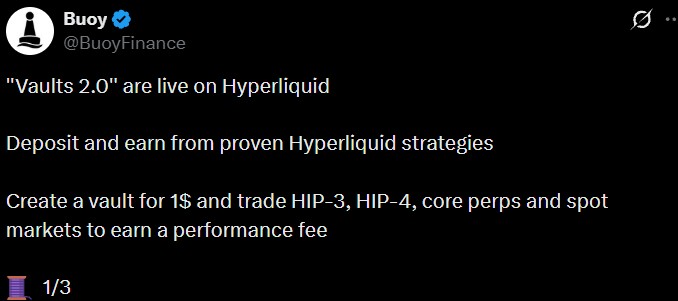
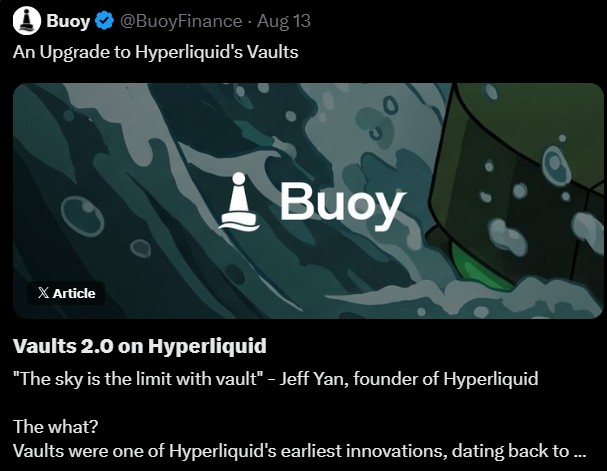
Buoy Finance has deployed "Vaults 2.0," a vault system built for HyperCore trading using HyperEVM-customized smart contracts. Anyone can spin up a vault for as little as 1 USDC, and deployment is fully permissionless with no builder fees. Once live, a vault can trade across core perpetual markets, HIP-3 markets, spot markets, and outcome markets, giving managers a wide surface to build strategies on.
How Buoy Finance Vaults Work on HyperCore
Each vault is an isolated smart contract with its own ERC-20 share token, so deposits and risk never mix across vaults. Managers can trade the pooled capital but cannot withdraw or redirect it, since fund destinations are fixed at the contract level and trading runs through a restricted agent wallet. Deposits and withdrawals settle at live NAV rather than as instant swaps, with a slippage floor shown before confirmation. The only protocol charge is a flat 0.01 HYPE fee per request. Managers earn a performance fee, set by themselves, that only applies to new profits above a high-water mark — no gains, no fee.

Hyperliquid Vaults Expand Trading and Yield Opportunities
Vaults give users a way to access an expanding market lineup without trading themselves actively, a meaningful option given that most active traders don't consistently turn a profit. Depositors can gain exposure to strategies spanning core perpetuals, Proposal 3 equities and commodities, Hyperliquid Improvement Proposal 4 outcome market, and spot trading, managed by someone with a public, verifiable track record. For managers, it's a way to monetize skill through fees rather than raising capital through traditional channels.
What's Next for the Ecosystem?
Expect continued iteration on both HIP1 and 4 as community feedback rolls in, along with further growth in HIP-3 market activity following its record open interest. Expanded non-validating node access could bring more infrastructure providers into the network over the coming months. On the ecosystem side, adoption of Buoy's vault system will be worth watching as a signal of demand for passive, strategy-based exposure.
Timeline
2023 Hyperliquid's original vault system emerged, helping provide liquidity through strategies such as HLP.
HIP3 Launch Builder-deployed markets expanded Hyperliquid beyond crypto perpetuals into areas such as equities and commodities.
HIP4 Expansion Outcome markets added another trading category to Hyperliquid.
Aug. 13, 2026 Buoy Finance announced Vaults 2.0 on Hyperliquid.
Aug. 17, 2026 Hyperliquid announced its latest product and ecosystem developments, including the $4.3B open-interest ATH and Buoy Finance's vault deployment.
CoinGecko Data
Conclusion
This update shows a platform expanding on multiple fronts at once: protocol specifications, infrastructure access, trading volume, and ecosystem tooling. The $4.3 billion milestone and Buoy Finance's new vault system are the most concrete signs of momentum, giving both active traders and passive depositors more ways to participate.
Disclaimer: This article is for informational purposes only and does not constitute financial, investment, or trading advice. Cryptocurrency markets are volatile and carry risk. Always conduct your own research and consult a qualified financial advisor before making investment decisions.
Also read:











