Cardano Ecosystem News: Wanchain Offers White-Hat Bridge Deal


Cardano Ecosystem News: Wanchain Bridge Exploit Settlement Update
Wanchain, the cross-chain infrastructure project, confirmed that its Cardano bridge suffered an exploit on July 20, 2026, resulting in a large theft of NIGHT tokens. This Cardano Ecosystem News update centers on the project's response: a formal white-hat settlement offer aimed at recovering the stolen funds before a tight deadline.
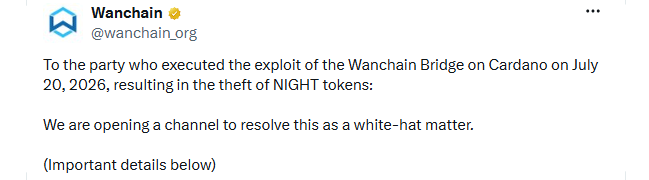
Source: Official Announcement
How the Cardano Wanchain Bridge Exploit Unfolded Today
The attacker targeted Cardano-Wanchain bridge connecting to many chains on July 20, 2026. Roughly 515 million NIGHT tokens left the network in unauthorized transfers, an amount worth an estimated $9 million to $13 million at the time.
Wanchain took the bridge offline shortly after detecting the breach. The team also reached out to blockchain analysis firms and several exchanges, asking them to flag and monitor wallet addresses tied to the incident.
This response in Cardano ecosystem news today mirrors standard incident protocol at major DeFi protocols.
Inside the Vulnerability That Let the Attacker Drain NIGHT Tokens Fast
Wanchain’s postmortem report reveals that the root cause traces back to a signature reuse flaw inside the bridge's TreasuryCheck validator. Missing delimiters in concatenated data fields allowed a signature meant for a small, legitimate withdrawal to authorize far larger transfers instead.
That kind of validation gap is a known risk in cross-chain bridge design. Attackers often look for exactly this type of shortcut, where one valid signature ends up covering far more than it should.
Wanchain Sets an August 6 Deadline for the Bridge White-Hat Settlement
Wanchain published its crypto fund recovery proposal directly to the individual behind the exploit. The offer asks for 90% of the stolen NIGHT tokens back, with the remaining 10% kept as a white-hat bounty for returning the funds.
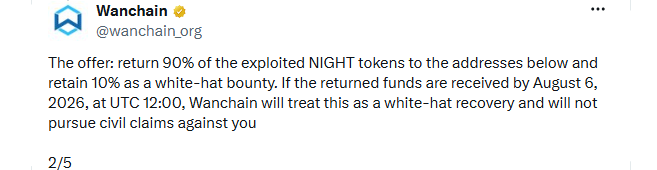
The deadline sits at 12:00 UTC on August 6, 2026. Key terms of the offer include:
Return 90% of the stolen NIGHT tokens by the deadline
Keep 10% as a bounty for cooperation
No civil litigation if funds arrive on time
Cardano and Ethereum addresses provided for the transfer
Wanchain listed a Cardano address and an Ethereum address as return destinations. The team also opened a direct line of contact, accepting either an on-chain message from the exploit address or an email to its white-hat inbox.
This Cardano Ecosystem News today matters for broader DeFi space as a successful return would mark one of the larger bridge recoveries this year.
NIGHT Price and the ADA Market Today
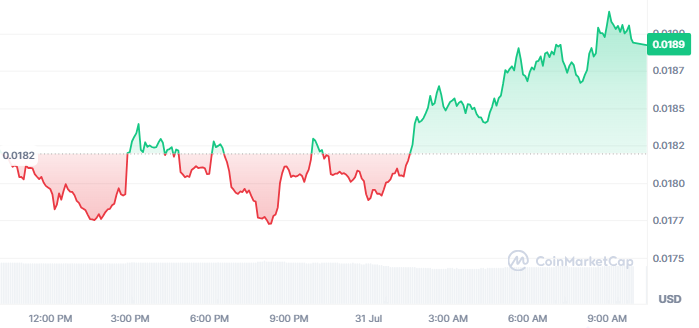
NIGHT token price dropped by more than 30% on the hacking news. However, as of today, the token has recovered steadily and is currently trading at $0.01892, up 4.1% as per CoinMarketCap data. Market cap sits at $314.19 million, with fully diluted valuation sits at $457.23 million against a fixed max supply of 24 billion NIGHT.
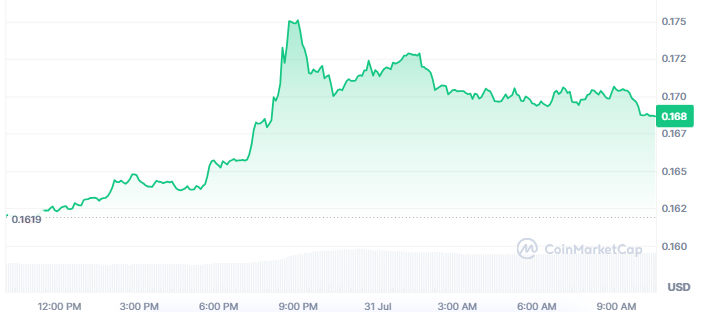
ADA price itself has held up better, a detail worth noting in this Cardano ecosystem news today. CoinMarketCap data shows $ADA trading at $0.1687, up 4.14% over 24 hours, with a market cap of $6.15 billion and 24-hour volume near $399 million, up 33.69%.
In the broader context of Cardano Ecosystem News, this kind of settlement offer is common after major bridge exploits.
How Wanchain's Offer Compares to Past White-Hat Recovery Cases
This pattern is a recurring theme across the wider industry, where post-exploit settlement offers follow a familiar structure. Protocols usually message the attacker directly, either through an on-chain note or a public statement, and propose keeping a slice of the funds in exchange for a fast return.
Several past cases show how these numbers tend to land:
Nomad Bridge (2022): $190 million stolen, a 10% bounty offered, with white hats and copycat returns bringing back roughly 19% of the total.
Verus Bridge: the attacker sent back 75% of the funds and kept 25% as a bounty.
AFX Trade (2026): a $24 million exploit ended with a negotiated 70/30 split.
Euler Finance (2023): direct talks led to a full return of recoverable funds.
Allbridge, Poly Network, and GMX: each saw similar deals, with attackers keeping between 10% and 25% of the haul.
In a wider Cardano Ecosystem News and DeFi security context, CertiK's review of 25 protocols between 2020 and 2023 found that about 73% of stolen funds came back overall, with recovery rates near 85% in early 2023 cases and a handful of full returns.
More recent figures from GlobalLedger show recovery in roughly 7% of incidents during the first half of 2026, though those cases covered about 11% of the total value stolen.
What’s Next?
For Cardano bridge hack recovery, Wanchain's 90/10 split sits on the generous end of this range for the attacker, offering a larger bounty share than many prior deals.
Whether this particular case ends in a full return remains an open question. What is clear: the August 6 deadline will decide how this chapter of Cardano Ecosystem News closes, and whether Wanchain's network security holds up to scrutiny going forward.
Disclaimer: This article is for informational purposes only and does not constitute financial or investment advice. Crypto markets carry significant risk. Always do your own research before making any investment decisions.