Aave Winds Down Chains: Six Blockchains Could Soon Be Gone

Aave Winds Down Chains: Inside the Six-Network Exit Plan
Aave winds down chains in its largest reserve cleanup to date. Aave founder Stani Kulechov confirmed on July 30 that following a comprehensive review, the protocol is deprecating 50 low-adoption asset reserves across multiple deployments and orderly winding down its full presence on six blockchains: Sonic, Scroll, zkSync, Metis, Soneium, and Aptos. In total, the changes affect $98.1M in supplied assets and $15.6 million in outstanding debt.
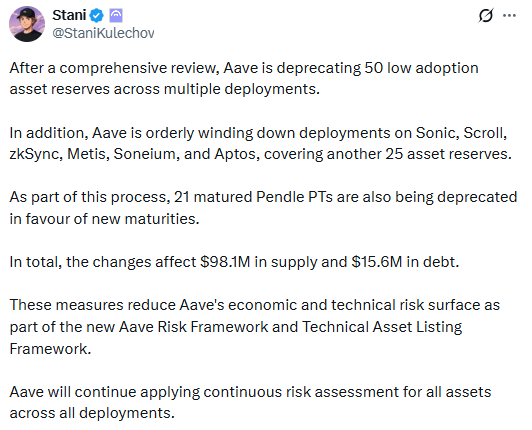 Source: X(formerly Twitter)
Aave Winds Down Chains: What the Proposal Covers
Per the governance proposal, prepared by risk adviser LlamaRisk under Aave's newly established Risk Framework and Technical Asset Listing Framework, the cleanup splits into two tracks. The first covers 50 individual reserve removals plus 21 matured Pendle Principal Tokens spread across 11 Aave V3 deployments, together holding roughly $85.3 million in supply and $11.5M in debt. The second track is the complete wind-down of six smaller deployments — Sonic, Scroll, zkSync, Metis, Soneium, and Aptos — covering another 25 reserves with about $12.8 million supplied and $4.1 million borrowed.
Kulechov framed the move as reducing Aave's economic and technical risk surface, stating the protocol will continue applying continuous risk assessment across all deployments going forward. The proposal is not yet a finalized DAO decision — it still needs to move through Aave's governance process before taking effect.
The Economics Behind the Decision
The numbers behind the decision are stark. Per LlamaRisk's proposal, each of the six affected chains now generates less than $5,000 per quarter in protocol revenue, with Metis, Soneium, and Aptos each bringing in under $1,000 — nowhere near enough to cover the operational cost of maintaining price feeds, liquidation systems, and ongoing monitoring for each market. For comparison, Aave's Ethereum mainnet deployment generates more than $142 million annually, and Base produces roughly $4.7M.
Deposits across the six chains have collapsed over the past six months: Soneium fell 95%, Aptos liquidity dropped 94%, zkSync declined 88% to about $844,000, Scroll fell 86% to roughly $2.2M, Metis dropped 79%, and Sonic — the largest of the group — fell 74% to just under $8 million. Combined, the six chains hold roughly $13 million against Aave's approximately $14 billion in assets across 23 chains, according to DefiLlama — under 1% of the protocol's total footprint.
The timing lines up with Aave's broader revenue picture. Gross revenue dropped from $198 million in the first quarter of 2026 to $156 million in the second, with third-quarter figures reportedly running below that pace so far. Aave itself keeps roughly 13% of the interest borrowers pay, per DefiLlama data, with the rest flowing back to depositors — a split that makes chains generating a few hundred dollars a quarter for the protocol effectively not worth the operational overhead.
How the Process Actually Works
Existing positions on the affected chains won't be forcibly closed. Instead, per the proposal, markets will be frozen to new deposits, borrowing, and collateral use, supply and borrowing caps will be cut to a single token, 99% of borrower interest will route to Aave's treasury, and a 5% base borrowing rate will be introduced — a structure designed to make staying expensive enough that remaining users exit on their own over time.
This proposal builds on a direction Aave signaled months earlier. In December 2025, the Aave Chan Initiative first proposed rolling back zkSync, Metis, and Soneium specifically, describing them as having "proven to lack product market fit," and pushed a rule requiring any future deployment to commit to at least $2M in annual revenue. Today's broader six-chain proposal reads as the logical extension of that earlier push.
AAVE, the protocol's governance token, is trading at approximately $99.54 today, up 4.58% over the past week, with a market cap near $1.53 billion and total value locked around $14.59 billion.
Conclusion
Aave winds down chains where the math simply doesn't work anymore — six deployments generating a combined few thousand dollars a quarter, against a protocol earning over $142 million annually on Ethereum alone. The proposal still needs to clear Aave's governance process, but it marks a clear pivot toward concentration over expansion.
Disclaimer
This article is for informational purposes only and does not constitute financial or investment advice. All details are based on Aave's official governance proposal, statements from founder Stani Kulechov, and publicly available DefiLlama data as of July 31, 2026. This proposal has not yet been finalized through Aave's governance process and is subject to change. Always conduct independent research before making any investment decision.










