Chainlink News: Nethermind Joins, Nazarov Speaks at White House

Chainlink News: Nethermind Moves From LayerZero to Chainlink
Today's Chainlink news covers three separate developments landing within about 24 hours of each other: Ethereum infrastructure firm Nethermind confirmed it's leaving LayerZero to join Chainlink as a node operator, Chainlink co-founder Sergey Nazarov spoke at the White House on tokenization, and spot LINK ETFs extended a rare inflow streak.
Nethermind Leaves LayerZero, Joins as Node Operator
Nethermind — the development firm behind one of Ethereum's most widely used execution clients, reportedly powering 25-30% of all Ethereum nodes — announced it is migrating away from its role as a LayerZero verifier and joining the Chainlink Network as a node operator and strategic technology provider. Per both companies' statements, the move covers:
Nethermind's Decentralized Verifier Network (DVN) operations — the verifier role it had run on LayerZero since December 2023
Node operation supporting CCIP (Chainlink's Cross-Chain Interoperability Protocol) and Data Feeds, Chainlink's price oracle system
Additional engineering contributions, including tooling, infrastructure operations, and integration support for teams building on Chainlink
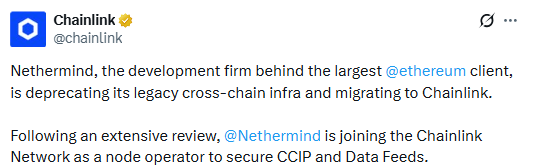
Notably, neither company named LayerZero directly in its own announcement, and no financial terms or migration timeline were disclosed. Nethermind CEO Daniel Celeda described the move as a long-term bet, stating the firm has "always made deliberate, long-term bets on the infrastructure we believe will define the next era of onchain finance." Chainlink Labs Chief Business Officer Johann Eid called it "a strong signal when an operator of Nethermind's caliber brings its engineering reputation to the Chainlink Network."
Why This Migration Wave Started
Today's Chainlink news doesn't happen in isolation — it's the latest entry in a migration trend that's been building since April 2026. That's when a $292 million exploit drained 116,500 rsETH from Kelp DAO's LayerZero-powered bridge, an attack linked to North Korea's Lazarus Group. The exploit exposed a specific weakness: some applications, including Kelp's, relied on a single verifier (a "1-of-1" DVN setup) rather than multiple independent verifiers, meaning one compromised verifier could authorize fraudulent transfers. LayerZero has since banned 1-of-1 configurations and pushed remaining routes toward stricter multi-verifier setups.
In the months since, a growing list of protocols has migrated cross-chain infrastructure from LayerZero to Chainlink's CCIP, including:
Protocol | Migrated Value |
Kelp DAO | ~$1.5 billion |
Solv Protocol | ~$700 million (tokenized Bitcoin) |
Re Protocol | ~$475 million (reinsurance TVL) |
Virtuals Protocol | $700 million-plus |
BitGo (Wrapped Bitcoin) | ~$7.3 billion |
Wyoming's Frontier Stable Token | State-issued stablecoin |
Chainlink has stated cumulative assets migrated to CCIP from former LayerZero clients now approach $5 billion, though these figures reflect announced commitments rather than independently audited on-chain flows. Nethermind's move is notable less for the dollar value involved and more for its symbolic weight — it's a core Ethereum infrastructure provider, not a single DeFi protocol, choosing Chainlink's security model.
Nazarov Speaks at the White House
Separately, Chainlink co-founder Sergey Nazarov spoke at the White House on tokenization's impact on the American economy, part of a broader White House meeting with crypto industry figures reportedly held August 19. Nazarov stated: "There's a very real and tangible outcome that's benefiting the adoption of U.S.-issued assets and the U.S. dollar."
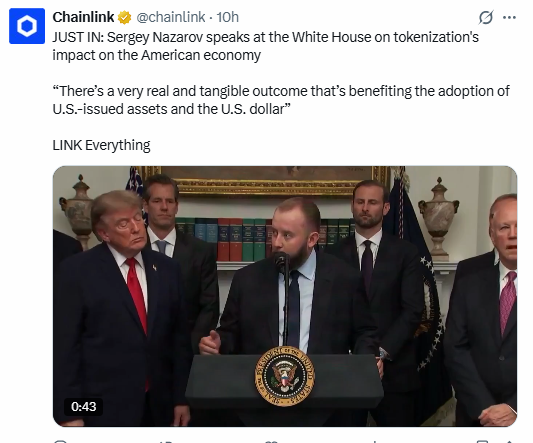
The appearance continues a pattern of Chainlink's growing presence in Washington policy discussions throughout 2026, alongside the company's ongoing engagement with regulators including the SEC on how tokenized assets fit within existing securities frameworks. The timing also lines up with the SEC's proposed "Regulation Crypto Assets" framework, published the day before, on August 18.
LINK ETFs Post a Three-Day Inflow Streak
Spot LINK ETFs recorded net inflows for three consecutive days, the first such streak since July. Per available flow data, LINK ETFs have pulled in more than $4 million in net inflows during August, with holdings now controlling nearly 2% of LINK's total circulating supply.
That said, the streak should be read against a weaker recent backdrop: spot LINK ETFs attracted just $150,307 in a prior week, following two weeks of zero inflows, leaving cumulative net inflows around $128.29 million — modest relative to LINK's roughly $8 billion-plus market capitalization.
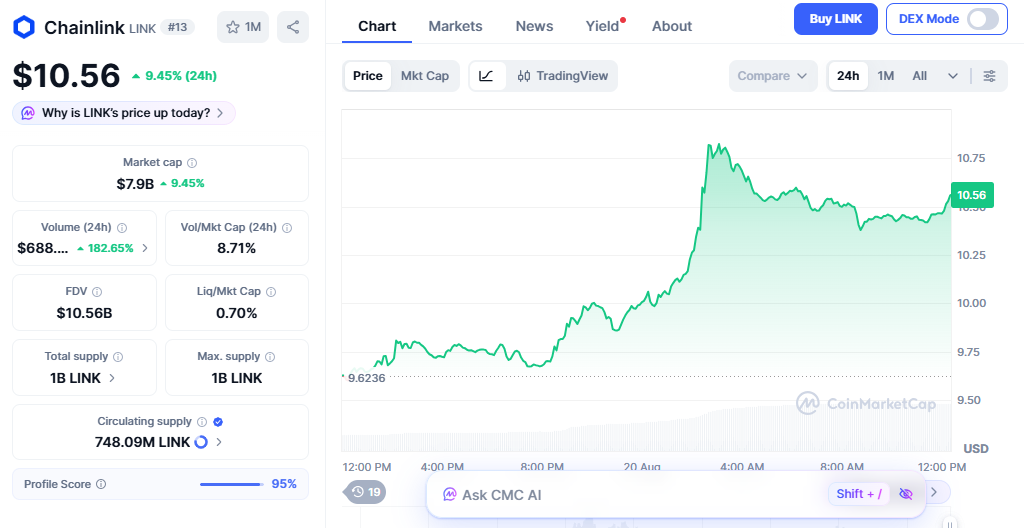
As of this writing, LINK trades at $10.56, up 9.45% over the past 24 hours, with a market cap of approximately $7.9 billion. Trading volume over the past 24 hours sits at roughly $688 million, up 182.65% from the prior day. Fully diluted valuation stands at $10.56 billion, with circulating supply at approximately 748.09 million LINK against a 1 billion total and max supply.
Conclusion
Today's Chainlink news ties together three threads pointing the same direction: deepening institutional and infrastructure trust (Nethermind), direct engagement at the highest levels of U.S. policy (Nazarov's White House appearance), and early signs of renewed institutional investment demand (the ETF inflow streak). None of these alone explains LINK's sharp 24-hour move, but together they form a coherent backdrop for the token's current strength.
Disclaimer
This article is for informational purposes only and does not constitute financial or investment advice. Details are based on official statements from Chainlink Labs and Nethermind, publicly available ETF flow data, and market price data, current as of August 20, 2026. Migration timelines, partnership terms, and flow figures are subject to change and, where noted, represent announced commitments rather than independently audited figures. Cryptocurrency markets are volatile. Always conduct independent research before making any investment decision.






