Chainlink News: Wyoming Migrates FRNT From LayerZero to CCIP


Chainlink News: Wyoming Moves FRNT From LayerZero To CCIP
In the biggest chainlink news, the Wyoming Stable Token Commission confirmed on August 18, 2026 that it has fully moved its Frontier Stable Token off LayerZero and onto Chainlink's Cross-Chain Interoperability Protocol (CCIP).
Under a multi-year contract, CCIP now handles all cross-chain functions for FRNT, while the Commission winds down its LayerZero setup for good.
The Wyoming Stable Token Commission also announced the migration through its official X account, confirming that the LayerZero bridge was deprecated and FRNT's cross-chain infrastructure was moved to CCIP.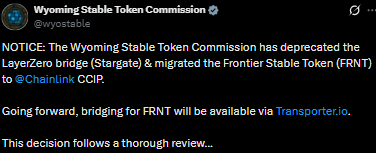
WuBlockchain also covered the development, highlighting Wyoming's migration of FRNT from LayerZero to Chainlink CCIP following the security review.
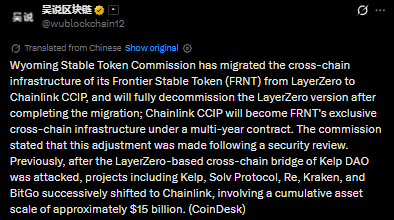
Source: WuBlockchain Official X Post
So What Exactly Did The Commission Say?
The Commission's statement points to a security review as the reason behind the switch. Anthony Apollo, who serves as Executive Director, said the review turned up concerns about LayerZero's disclosure practices and how it handled operational security.
Chainlink, in his words, was the only option that checked every box on reliability and security.
FRNT is not a new project it is the first fiat-backed, fully reserved stable token issued by a U.S. public entity.
FRNT's reserves include cash and short-duration U.S. Treasuries, with a statutory requirement for 102% overcollateralization. The reserves are managed by Franklin Advisers, while investment income beyond the required reserve is directed to Wyoming's School Foundation Program.
Wyoming's multi-chain approach dates back to the state's early planning for the stable token. In a November 2023 letter, Wyoming's Select Committee on Blockchain, Financial Technology, and Digital Innovation Technology encouraged the Stable Token Commission to pursue a multi-chain, technology-neutral approach rather than launch the token on a single blockchain
Detail | Before | After |
Cross-chain layer | LayerZero (OFT standard) | Chainlink CCIP (exclusive) |
Agreement type | Vendor partnership | Multi-year contract |
Chains covered | 7 to 8 | Same chains, now CCIP-routed |
Bridging tool | LayerZero/Stargate | Transporter.io |
The token now spans eight networks: Arbitrum, Avalanche, Base, Ethereum, Hedera, Optimism, Polygon, and Solana.
Why This Particular Move Matters
Here's the thing that sets it apart. This is the first time a U.S. government body has publicly swapped out its blockchain infrastructure and named security as the reason.
That alone makes it stand out in chainlink news today, well beyond the usual crypto-industry migrations. For Chainlink News, the Wyoming move is particularly significant because it puts CCIP's role in government-backed infrastructure under the spotlight.
And it didn't happen in a vacuum. Earlier this year, Kelp DAO's LayerZero-based bridge got hit for roughly $292 million.
That exploit set off a chain reaction, with projects and platforms rethinking their cross-chain setups almost immediately. Since then, several names have made the jump to Chainlink:
Kelp DAO
Solv Protocol
Re
Kraken
BitGo, which shifted $7.7 billion in Wrapped Bitcoin to CCIP in early August 2026
Add it all up, and roughly $15 billion in assets has now migrated toward Chainlink's infrastructure, according to Chainlink's own migration overview.
What Analysts Are Saying
Some market watchers think this could become a notable development in broader crypto news, potentially nudging other states toward rethinking how they approach digital-dollar infrastructure and regulation.
It could shape how other public-sector issuers evaluate cross-chain security going forward, especially with bridge exploits continuing to rattle confidence across the industry.
This makes the Wyoming decision an important development to watch in Chainlink News as institutional and government adoption of cross-chain infrastructure evolves.
Whether other states actually follow Wyoming's lead is a different question, one that will likely play out over the coming months rather than weeks.
The development also adds another important angle to crypto news today, as governments increasingly evaluate blockchain infrastructure through the lens of security and reliability.
Disclaimer: This article is for informational purposes only and isn't financial or investment advice. The infrastructure switch doesn't guarantee anything about FRNT's future price, adoption, or security. Do your own research before making decisions involving stablecoins or cross-chain protocols.






