Chainlink News Today: 47-bank collaboration for FX settlement

Chainlink News Today: Project Pangea drives instant FX settlement
Cross-border payments between Europe and South Korea take up to two business days to settle. Banks spend that time sitting on locked capital, hoping the other side does not default before the transaction closes. Project Pangea wants to fix that and it wants to do it in 12 months.
Chainlink launched the initiative on June 23, 2026, alongside a consortium of 47 European and South Korean banks managing a combined $10 trillion in assets. The target is simple: compress the standard T+2 settlement window down to T+0 meaning trades settle the same moment they execute, with no waiting period and no counterparty exposure.
Who Is Behind It
The project brings together four organisations. Qivalis represents 37 European banks. UniKA covers more than 10 South Korean banks, including Shinhan. Fairsquarelab handles fintech infrastructure. Chainlink sits at the centre, providing the technical layer that connects all of them.
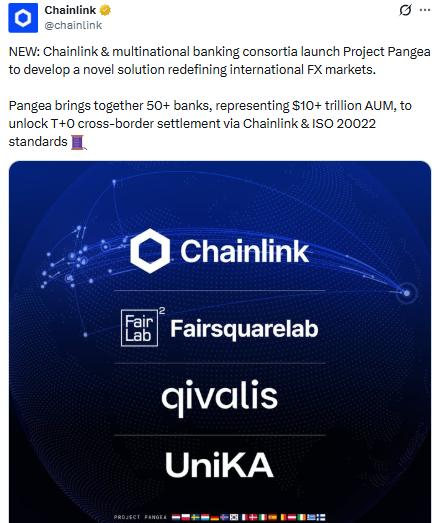
Source: Official X Account
The corridor they are targeting first is EUR/KRW euros and Korean won. It is one of the busiest trade finance lanes between Europe and Asia, and currently one of the most inefficient when it comes to settlement.
What Chainlink Actually Does Here
Chainlink is not a bank, and it is not issuing currency. Its role is to act as the middleware between the traditional banking system and the blockchain settlement layer.
Here is how it works. When a bank sends a Swift message the standard instruction format used across global finance Chainlink converts that instruction into an atomic Payment-versus-Payment swap on a dedicated Layer 1 blockchain network. An atomic swap means both sides of the trade either settle simultaneously or not at all. There is no window where one bank has paid and the other has not.
The project runs on ISO 20022 standards, the same messaging framework that central banks and major payment systems worldwide are already adopting. That matters because it means this is not a parallel system it plugs directly into existing financial infrastructure.
The Stablecoin Layer
Settlement happens through regulated euro and Korean won stablecoins. These are not speculative crypto tokens. They are fully regulated digital versions of fiat currencies, designed to move on-chain in real time while staying within existing compliance frameworks.
This design eliminates the need for pre-funded nostro accounts the large pools of capital that banks currently park in foreign countries to cover settlement risk. That trapped liquidity is one of the most expensive parts of running cross-border FX operations today.
What This Means for the Market
The global FX market processes roughly $7.5 trillion in transactions every single day. Even a small shift toward instant settlement frees up enormous amounts of locked capital across the system and cuts counterparty risk at an industry level.
For Chainlink specifically, this is the clearest institutional signal yet that its infrastructure has moved beyond crypto-native applications. The LINK token powers the node operators and data feeds that make the middleware function. A live, production-scale deployment with 47 banks directly drives on-chain demand for that infrastructure.
For the banks, the incentive is cost. T+0 settlement means less capital sitting idle, lower collateral requirements, and a significant reduction in settlement risk. For institutions managing trillions in assets, even marginal improvements in capital efficiency translate into hundreds of millions of dollars.
The current price of the LINK token is $7.62 with a current market cap of 4.99% and it has dropped by 3% within 24 hours after the announcement, the lowest price within 24 hours was $7.5075 with a volume of $252.11M and then it rose by $7.6465 with a volume of $277.3M. (Source: CoinMarketCap)
The 12-Month Timeline
The consortium has committed to achieving live T+0 settlement on the Europe–Korea corridor within 12 months. The EUR/KRW lane is the test case. If it works, the model can expand to other corridors and other currencies.
That is the real ambition behind Project Pangea. Not one corridor. Not one currency pair. The broader FX market rebuilt around instant, atomic, blockchain-settled transactions.
Forty-seven banks and $10 trillion in assets are betting it is possible.
Disclaimer
This article is for informational purposes only and does not constitute financial or investment advice. Cryptocurrency and blockchain-related assets carry significant risk. Project timelines, partnerships, and outcomes mentioned here are based on publicly available announcements and may change. Always do your own research before making any financial decisions.










