CLARITY Act News: Senate Sets September 15 Vote as Passage Raise Doubt


CLARITY Act News: Why Grayscale Sees Low Chance of Crypto Bill 2026?
The biggest CLARITY Act news today is procedural: Senate Majority Leader John Thune has filed cloture on the motion to proceed, setting up a floor vote for September 15 at 2:15 p.m. ET. The filing gives the crypto market structure bill a formal path forward once lawmakers return from the August recess, but it's far from a guarantee of passage.
A cloture vote only limits debate on whether to take up the legislation — it is not a vote on the bill itself. With Republicans holding 53 seats, at least seven Democrats or independents must join for the motion to clear the 60-vote threshold. The Senate calendar, combined with midterm election politics, is now the biggest variable shaping whether it moves at all this year.
CLARITY Act Heads for September 15 Senate Showdown
Once the Senate returns from its August break, the September 15 cloture vote becomes the next real test. Clearing it would open the bill to formal debate and amendments, but a final passage vote would still lie further down the road.
Falling short of seven crossover votes would stall things for now, pushing any resolution deeper into an already crowded election-year calendar.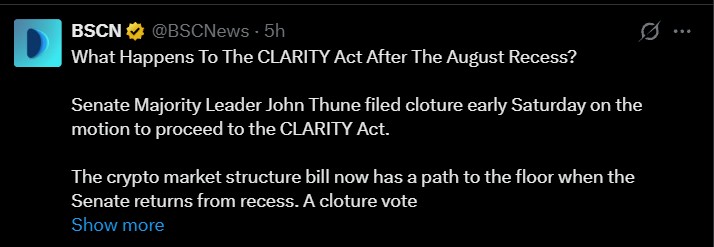
Timeline: CLARITY Act Senate Developments
-
August 10, 2026: Senate begins August recess; the bill remains pending.
-
August 2026: Thune files cloture on the motion to proceed.
-
September 15, 2026: Scheduled cloture vote on the motion to proceed.
-
After cloture: Senate debate and potential amendments could determine the next stage.
-
Final passage: Requires further Senate action before the bill can move forward.
Mark Esper Calls CLARITY Act a National Security Priority
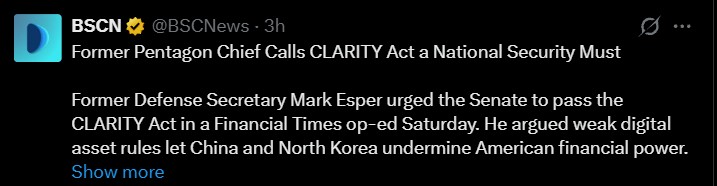
Former Defense Secretary Mark Esper, now a member of Coinbase's Global Advisory Council, has framed the legislation as more than a financial rulebook.
Writing in the Financial Times, he argued that weak digital asset oversight gives rival states room to chip away at America's financial standing, pointing to state-directed payment infrastructure being built in China as a way to bypass U.S. oversight and erode the dollar's global role.
He also linked the bill to Treasury's expanded Section 311 authority, arguing it would help close crypto loopholes used by North Korea-linked groups such as Lazarus. In his framing, passage is less about market convenience and more about protecting U.S. strategic leverage.
BSCNews
Grayscale Says CLARITY Act Passage Chances Are Falling
Grayscale's Head of Research, Zach Pandl, takes a far more cautious view. He expects the odds of Senate passage this year to keep shrinking given the packed legislative calendar and the caution that typically accompanies an election year.
Importantly, Pandl doesn't expect a stalled bill to shake core crypto markets — he sees no immediate disruption to Bitcoin, major blockchains, or the ongoing growth of stablecoin payments if lawmakers fail to finish the job in 2026.

Five Major Loopholes Raise New Concerns Over CLARITY Act
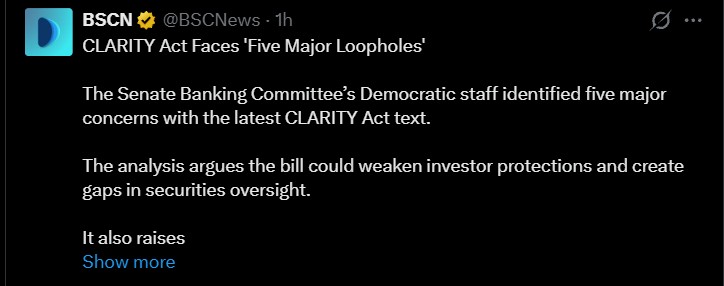
Opposition to the current text is also building. Democratic staff on the Senate Banking Committee, working under Senator Elizabeth Warren's minority office, flagged five areas of concern with the latest draft.
Their review points to weakened investor protections, gaps in securities oversight, exposure to illicit finance, taxpayer risk, and possible conflicts of interest tied to the presidency.
Pension fund exposure to affected digital assets was singled out as a specific worry, adding fresh friction just as the bill heads toward its September test.
What Happens to Crypto Regulation If CLARITY Act Fails?
Even without new legislation, Pandl argues regulators can keep the industry moving. He expects the SEC and other agencies to keep addressing open questions through rulemaking, particularly around tokenized securities.
Recent regulatory steps — covering institutional custody, banking access, staking policy, and the growth of crypto ETPs — are likely to continue regardless of what happens on Capitol Hill.
CLARITY Act Failure Could Push Crypto Development Overseas
The bigger risk, in Pandl's view, isn't a sudden market shock — it's a slower drift of capital and talent abroad. Without a comprehensive federal framework, the U.S. could see less new investment and fewer developers building domestically, a trend already visible before the current administration's policy shifts.
Friendlier token issuance rules and clearer developer protections elsewhere could make overseas jurisdictions increasingly attractive on the margin.
CLARITY Act — Latest Positions and Developments
| Development | Latest Position | Why It Matters |
| Cloture vote scheduled on motion to proceed | Determines whether the Senate can advance the bill | |
| John Thune | Filed cloture | Provides a procedural path after the August recess |
| Mark Esper | Supports passage | Frames the bill as a national security priority |
| Grayscale's Zach Pandl | Says 2026 passage chances are low | Highlights Senate calendar and election-year obstacles |
| Senate Democratic staff | Identified five major concerns | Adds opposition to the latest bill text |
| SEC and regulators | Expected to continue rulemaking | Could address some regulatory gaps without new legislation |
| Crypto industry | Can continue operating without the bill | But long-term U.S. investment and development could suffer |
What to Watch Before September 15?
The next several weeks hinge on Thune's floor strategy, whether Democratic holdouts can be persuaded, and how an ethics compromise from Senators Ruben Gallego and Thom Tillis factors in.
That proposal would let state attorneys general enforce a ban on officials issuing digital assets and would require the president to divest from crypto holdings — but the White House has not yet signed off. Any bipartisan movement on that front before September 15 could meaningfully shift the bill's prospects.
Disclaimer: This article is for informational purposes only and does not constitute financial, legal, or investment advice. Cryptocurrency markets are volatile and legislative outcomes are uncertain; readers should conduct their own research and consult a qualified professional before making financial decisions.