Kalshi Market News: CLARITY Act Vote Odds Fall Before Recess


Kalshi Market News Signals Low Chances for Senate Vote
This week's Kalshi Market News centers on a single, closely watched question: will the Senate vote on the CLARITY Act before the August recess?
According to kalshi, which resolves before August 8, 2026, traders are now pricing this as unlikely, with the No side firmly in control heading into the deadline.
Kalshi's page renders odds dynamically, so the specific pricing and volume figures below reflect a live snapshot of the market rather than a fixed, citable number.
What Is the CLARITY Act, and Why Does It Matter?
The CLARITY Act , formally H.R. 3633, is a crypto market structure bill meant to give U.S. digital asset firms clear legal rules instead of the current mix of case-by-case regulation and enforcement.
It mainly names the CFTC as the primary regulator for spot crypto markets, while clarifying when the SEC's securities rules apply. The House passed its version in July, and the Senate Banking Committee advanced its own version in May.
Supporters say it would keep crypto business onshore with clear rules; without it, oversight stays uncertain and enforcement-driven.
What the Kalshi Market Shows Right Now
As of the latest snapshot from Kalshi's market, it gives just a 9% chance of a Senate vote before recess, down sharply, a drop of 46.2 percentage points from its recent level. Breaking down the current pricing:
-
Yes: 9% implied probability, priced at 11.7x payout
-
No: 91% implied probability, priced at 1.07x payout
-
Total volume: $686,368 across a single market
This is a steep shift in sentiment. A markets that not long ago treated a pre-recess vote as a real possibility has moved decisively toward "No."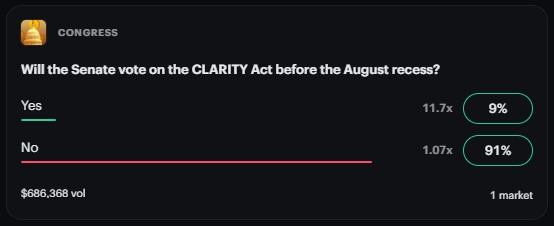
A Volatile Week: How the Odds Moved
This part of the Kalshi Market News picture is where things get interesting. The one-week chart tells a choppy story rather than a smooth decline.
Odds bounced repeatedly between roughly 30% and 45% for much of the week, with a sharp spike toward 60% around August 4, before falling off a cliff in the final days. 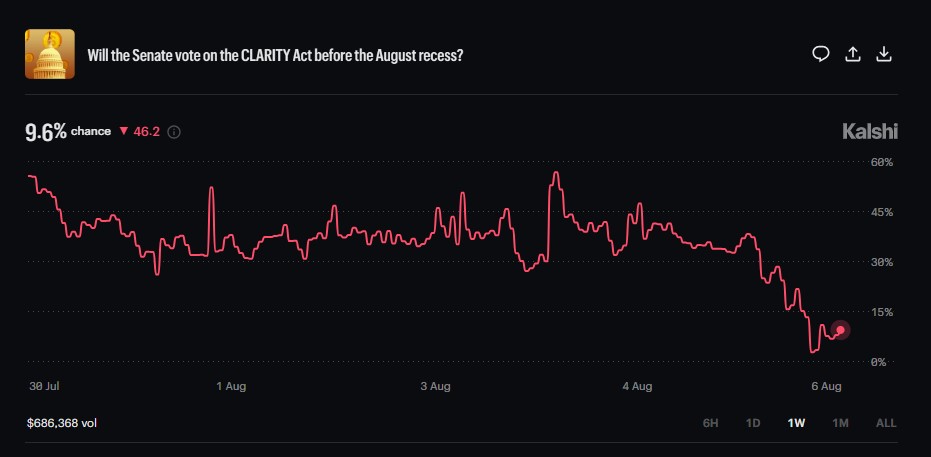
By August 6, the probability had crashed into single digits, touching lows near 5% before ticking back up slightly to the current 9.6%.
That pattern, a spike followed by a fast collapse, often reflects a specific piece of news moving rather than a gradual shift in sentiment.
In this case, the timing lines up with public remarks from Senate Majority Leader John Thune, who told reporters he did not expect the CLARITY Act to pass the Senate before recess, a comment widely reported around July 24 and echoed again as the recess deadline approached.
What's Driving the "No" Sentiment
With 91% of the markets now betting against a vote, the pricing implies traders see the legislative calendar and procedural hurdles as the bigger obstacle, not a lack of political will.
The August recess creates a hard deadline: if the Senate doesn't act before senators leave Washington, the CLARITY Act news path forward gets pushed into the fall session at the earliest.
Congress Pressure: A Push From Inside the Senate
Not everyone in the Senate is content to let the deadline pass quietly. Senator Dave McCormick: It's time to bring the CLARITY Act to the Senate floor for a vote. Enough of the obstruction and let's pass this bill. 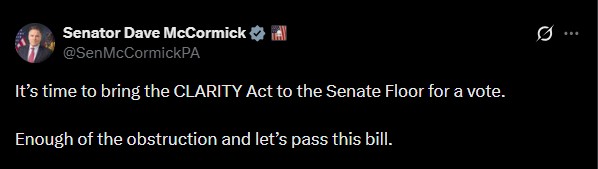
Public pressure like this from sitting senators is exactly the kind of signal prediction markets try to price in, though McCormick's post alone hasn't been enough to move the odds back toward "Yes" in this.
What This Prediction Means Going Forward
Prediction like Kalshi aren't a guarantee of the outcome, but they aggregate real-money bets on how insiders and close observers expect events to unfold. At 91% "No" with meaningful volume behind it, this Kalshi Market News snapshot suggests the smart money currently expects the CLARITY Act delay to miss the August recess deadline entirely.
Whether that holds will depend on whether Senate leadership finds floor time in the remaining pre-recess days, something this will keep pricing in real time.
Conclusion
This week's Kalshi Market News shows a dramatic swing on the CLARITY Act's Senate timeline, from a once split closer to a coin flip to one now leaning heavily toward "No" at 91%.
With volume near $686,000 backing that view and pressure from senators like McCormick still on the table, this is a worth watching closely as the recess deadline approaches.
Disclaimer
This article is for educational and informational purposes only and should not be considered financial or investment advice. Always conduct your own research before making investment decisions.