CLARITY Act News: Trump, SEC, CFTC to Discuss Crypto Bill On August 19


CLARITY Act News: Trump to Host Meeting at White House on August 19
Washington's crypto policy debate is heating up again. On August 19, 2026, President Trump is expected to convene a White House meeting bringing together top crypto executives and leading financial regulators, centered on the fate of a stalled digital-asset bill. The gathering could be a turning point — or just another headline in a long, uncertain legislative fight.
CLARITY Act News: Trump White House Meeting Set for August 19
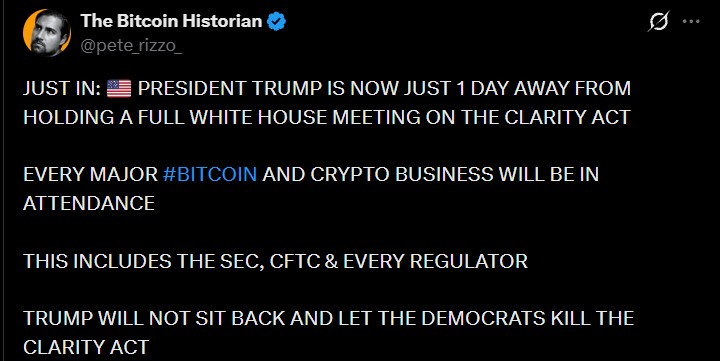
Reports indicate Trump will personally chair a gathering at the White House on Wednesday, August 19, bringing together crypto industry leaders, prediction-market executives, and top U.S. regulators.
The meeting arrives at a pivotal moment: the bill, formally the Digital Asset Market Clarity Act, has cleared the House and advanced through a Senate committee, but a floor vote remains elusive.
The gathering signals the administration wants to keep momentum behind digital-asset policy even as Congress remains gridlocked, and it comes just one day before the CFTC's first Innovation Advisory Committee meeting, where crypto regulation is also on the agenda.
Timeline: August 19 Meeting to September 15 Senate Vote
Development | Current Status | Why It Matters |
House passage | Completed | Moves the bill toward a federal regulatory framework |
Senate progress | Delayed | Bipartisan negotiations remain unresolved |
White House meeting | August 19, 2026 | Brings Trump, regulators, and crypto leaders together |
SEC/CFTC involvement | Expected | Could shape future regulatory jurisdiction |
Passage odds | Roughly 10–21% trackers | Shows high uncertainty among market participants |
Senate vote | September 15 | Key procedural hurdle requiring 60 votes |
Who Will Attend the White House CLARITY Act Meeting?
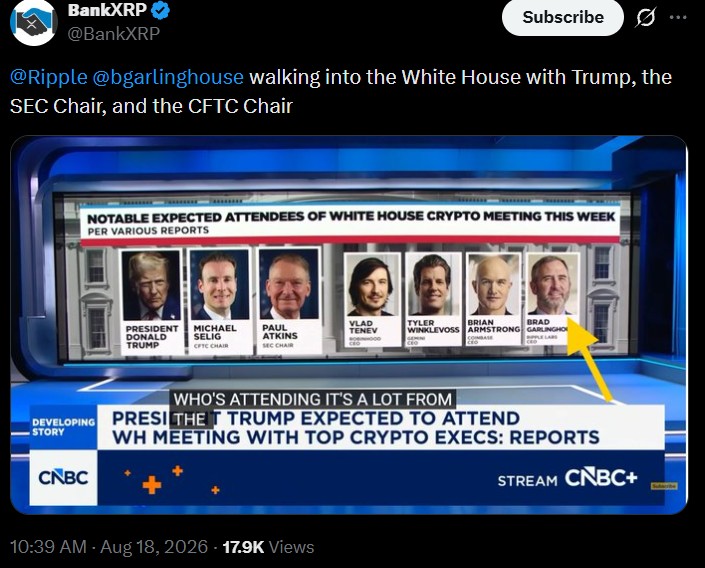
A full attendee list hasn't been officially confirmed, but multiple reports point to a similar roster. SEC Chair Paul Atkins and CFTC Chair Michael Selig are both expected alongside Trump.
On the industry side, executives from Coinbase, Ripple, Gemini, Kalshi, Robinhood, and Polymarket are anticipated to attend. Traditional finance heavyweights — including Nasdaq, NYSE, CME Group, and DTCC — may also send representatives, underscoring how closely digital-asset market structure is now tied to mainstream finance.
CLARITY Act Explained: What the Crypto Market Bill Would Change
At its core, the bill aims to end years of regulatory ambiguity by dividing oversight between the SEC and CFTC. Digital commodities would fall under CFTC jurisdiction, while tokens deemed securities would remain under SEC supervision.
For exchanges, issuers, and institutional investors, this distinction matters enormously — it determines registration and disclosure obligations. Supporters argue a defined framework would unlock institutional capital that has stayed on the sidelines due to legal uncertainty.
CLARITY Act Senate Status: Why the Bill Is Facing Delays
The legislation passed the House by a wide margin in July 2025, and the Senate Banking Committee advanced its version in May 2026. Since then, progress has slowed. Senate leadership has acknowledged there wasn't enough floor time to finish debate and amendments before the August recess.
Sticking points reportedly include an ethics provision tied to a bipartisan proposal and unresolved questions around stablecoin yields, which banking groups have flagged as a concern. The Senate returns from recess in mid-September, leaving a narrow window before a scheduled procedural vote.
White House Meeting Could Change the CLARITY Act's Next Step
ETF Store President Nate Geraci has suggested the White House appears ready to push digital-asset policy forward regardless of the legislative deadlock, framing the meeting as evidence the administration may not wait on Congress.
If lawmakers remain stuck, regulators like the SEC and CFTC could move independently to provide interim clarity through rulemaking, even as the broader legislative push continues in parallel.
CLARITY Act Passage Odds Fall as Political Debate Intensifies
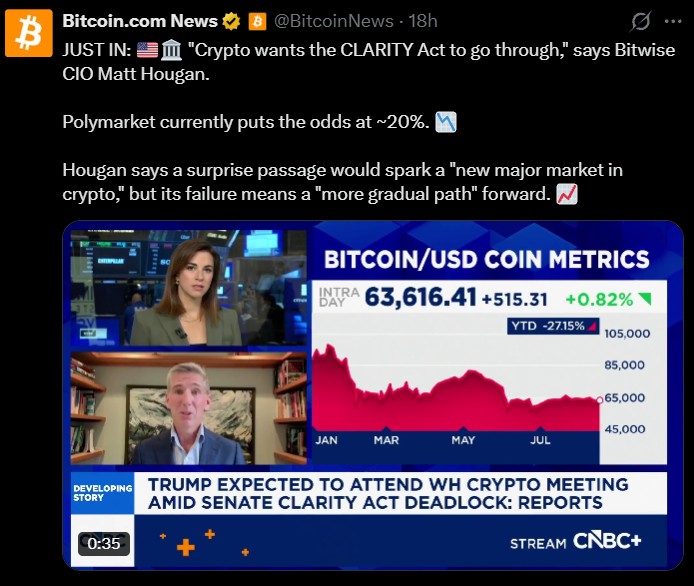
Prediction markets have grown increasingly skeptical. Polymarket odds for 2026 passage have hovered in the high teens to low 20s, and Galaxy Digital recently cut its estimate to just 10%, down from 75% after the May committee markup. Views on the bill remain split: Bitwise CIO Matt Hougan says the industry wants it to pass and a surprise approval could spark a major new market phase.
Mike Novogratz has floated that Trump may not actually want a deal, since a stalled bill lets him blame Democrats. Macro strategist Jim Bianco is skeptical of the bill altogether, arguing tighter regulation runs counter to crypto's decentralized ethos.
What This Could Mean for Bitcoin and Crypto Prices
A clear regulatory framework is widely viewed as bullish — potentially boosting institutional participation, exchange listings, and liquidity. Tokenization and the convergence of crypto with traditional market infrastructure could expand the addressable market well beyond crypto's roughly $2 trillion valuation. Conversely, continued delays or an outright failure to pass the legislation could prolong uncertainty and keep institutional capital on the sidelines.

Key dates:
August 19 — Trump expected to meet crypto executives and regulators at the White House
August 20 — CFTC's first Innovation Advisory Committee meeting on US crypto regulation 2026
Late August–early September — Continued Senate negotiations
September 15 — Senate procedural cloture vote, requiring 60 votes to advance
After Senate action — If cloture succeeds, the crypto bill 2026 moves toward final steps
Conclusion
The August 19 White House meeting won't single-handedly resolve the Senate standoff, but it signals the administration intends to keep digital-asset market structure on the agenda. Whether Congress delivers by September 15 or regulators chart their own path, the coming weeks will shape how crypto is overseen in the U.S. for years to come.
Disclaimer: This article is for informational purposes only and does not constitute financial, investment, or legal advice. Cryptocurrency markets are highly volatile, and regulatory developments such as the CLARITY Act remain uncertain and subject to change. Readers should conduct their own research and consult a qualified professional before making any financial decisions.
Also read:






