DxSale Hack Impacts 1,400 Liquidity Pools Across BNB Chain

DxSale Exploit: $7.3M Drained — Is Your Money Safe?
What Just Happened?
A serious security breach hit the crypto space. A hacker exploited a vulnerability in the DxSale ecosystem and drained approximately $7.3 million from nearly 1,400 liquidity pools on BNB Chain. Blockchain security firm PeckShield flagged the attack, and on-chain data confirmed the damage was already done before most users even knew something was wrong.
This is a DxSale security breach that every BNB Chain investor needs to know about right now.
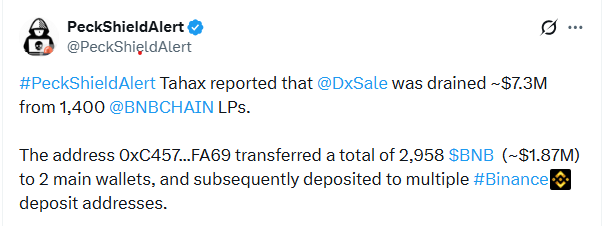
Source: PeckShield X official
How the Attack Went Down?
Here's what the attacker actually did:
Identified and exploited a smart contract vulnerability linked to DxSale's liquidity management system
Drained LP tokens across nearly 1,400 separate liquidity pools on BNB Chain
Quickly converted stolen assets into BNB to make tracing harder
Moved roughly 2,958 BNB (around $1.87M) across multiple wallets to split the trail
Sent portions of those funds directly to Binance deposit addresses — a move investigators watch closely
The speed of the conversion shows this wasn't random. Someone knew exactly where the weakness was.
What Investors Need to Check Right Now?
If you've ever used DxSale for liquidity pool creation, token launches, or LP locking — act now:
Check your LP positions on BNB Chain immediately via BscScan
Look for unexpected withdrawals or zero-balance LP tokens in your wallet
Do not add new liquidity to platform-connected pools until the vulnerability is confirmed patched
Watch official channels for a response or compensation announcement
This liquidity pool attack hit projects broadly — not just one token. If your project launched or locked liquidity through the platform, it may be in the affected batch.
Has DxSale Responded?
At the time of writing, no official statement from DxSale Network has confirmed the exploit or outlined a recovery plan. That silence is itself a concern.
In past crypto security incidents, projects that respond fast — freezing contracts, contacting exchanges, publishing post-mortems — tend to recover user trust. Delays usually mean more panic selling and deeper price crashes across affected tokens.
Binance has been notified through on-chain trails. Exchanges often cooperate with blockchain security researchers to freeze suspicious deposits — similar to how Binance helped in previous BNB Chain exploits. Whether that leads to fund recovery here depends on how fast coordination moves.
Can the Money Be Recovered?
Realistically, partial recovery is possible; full recovery is unlikely. Here's why:
Funds moved to centralized exchanges like Binance can potentially be frozen
But funds already routed through mixing or multiple wallets become extremely hard to trace
No smart contract exploit in recent history has seen 100% recovery without the attacker voluntarily returning funds
The blockchain security community is actively monitoring wallet movements. Any further transfers will be visible on-chain.
Disclaimer: This article is for informational purposes only and does not constitute financial or investment advice. If you believe your funds were affected, do not interact with suspicious contracts and monitor official project channels.


4 months ago
Hire a Recovery Expert to Recover Your Scammed or Stolen Bitcoin Contact META TECH RECOVERY PRO To victims of romance or crypto scams, this is great news I want to share. Earlier on, I fell victim to a scam disguised as a safe investment option while chatting with a Marine sailor via Tinder. I invested in crypto trading platforms, thinking I was securing a retirement income after being advised by my online partner. Only to find that all my assets were frozen. I believed my assets were secure — until I discovered that my BTC funds had been frozen and withdrawals were impossible. It was a devastating moment when I realized I had been scammed, and I thought my Bitcoin was gone forever. Everything changed when a close friend recommended the MetaTech Recovery Pro. Their professionalism, expertise, and dedication enabled me to recover my lost Bitcoin funds — more than €320.000 to my Trust wallet. What once felt impossible became a reality thanks to their support. If you have lost Bitcoin through scams, hacking, failed withdrawals, or similar challenges, don’t lose hope. I strongly recommend MetaTech Recovery Pro to anyone seeking a reliable and effective solution for recovering any wallet assets. They have a proven track record of successfully recovering lost password assets for their clients and can help you navigate the process of recovering your funds. Don’t let scammers get away with your hard-earned money. contact them via https://metatechrecoverypro.com. Telegram:@metatechrecoveryproteam. WHATSAPP +1 4 6 9 6 9 2 8 0 4 9. support@metatechrecoverypro.com. Metatech@Writeme.Com.

4 months ago
How to hire a hacker to help me recover my lost funds META TECH RECOVERY PRO I successfully recovered $493,450.00 in Ethereum, thanks to META TECH RECOVERY PRO. This recovery represents a substantial reclamation of digital assets denominated in Ether (ETH), the native cryptocurrency of the Ethereum blockchain. It underscores the practical importance of employing professional recovery services when access to private keys, wallets, or accounts is compromised. The term “META TECH RECOVERY PRO” refers here to a specialized recovery service or expert team that applies technical forensics, cryptographic knowledge, and procedural best practices to identify, trace, and recover lost or misappropriated cryptocurrency funds; such teams typically combine blockchain analysis, wallet restoration techniques, secure key-reconstruction methods, and coordination with relevant exchanges and legal authorities when appropriate. Consider that Ethereum remains one of the largest and most actively transacted blockchain ecosystems, with market capitalization and daily transaction volumes that make timely and accurate intervention critical when assets are at risk. Effective recovery efforts often begin with a comprehensive assessment of the incident: determining whether the loss resulted from forgotten credentials, corrupted wallet files, hardware failure, phishing or social-engineering attacks, or unauthorized transfers. For example, in cases of forgotten wallet credentials, structured mnemonic-recovery and deterministic-wallet reconstruction can restore access; in cases of theft, blockchain tracing can reveal the flow of funds to exchange wallets, where coordinated legal requests or escrow holds may enable partial or full restitution. Supporting evidence from industry practice indicates that multidisciplinary teams—combining cybersecurity experts, blockchain analysts, and legal counsel—achieve higher recovery rates than ad hoc attempts by individual users. Empirical reports from recovery firms and law-enforcement collaborations show that timely reporting and preservation of forensic evidence (logs, transaction hashes, wallet snapshots) increase the likelihood of successful intervention. Nevertheless, recovery is not guaranteed: sophisticated attackers may rapidly launder funds through mixers and cross-chain swaps, and jurisdictions differ in their capacity or willingness to compel exchanges to freeze assets. Therefore, a balanced appraisal must acknowledge both the success exemplified by the $493,450.00 retrieval and the structural limitations that can impede other recoveries. First, users should maintain secure backups of seed phrases and private keys in multiple, geographically separated, and tamper-evident formats; hardware wallets and cold-storage practices substantially reduce exposure. Second, enable multi-factor authentication and adhere to phishing-resistant communication habits. Third, when a loss occurs, document all relevant details (timestamps, transaction IDs, device states) and engage qualified recovery professionals promptly; early engagement facilitates chain-of-custody preservation and improves the prospects of legal or custodial remedies. Finally, consider engaging with reputable recovery services like META TECH RECOVERY PRO that publish transparent methodologies, verifiable case histories, and clear fee structures to ensure alignment of incentives. The recovery of my $493,450.00 in Ethereum by META TECH RECOVERY PRO illustrates both the recoverability of significant cryptocurrency holdings under skilled intervention and the necessity of proactive security and forensic practices. The case serves as a concrete example and a reminder that combining technical expertise, timely action, and appropriate legal coordination yields the best outcome when confronting digital-asset loss. Ask META TECH RECOVERY PRO for help via: Telegram:@metatechrecoveryproteam metatech-recoverypro.com https://metatechrecoverypro.com W/S +1 (469) 692‑8049.







