Sui Network Stall: 6-Hour Mainnet Outage Fixed, SUI Drops 8%

Sui Network Stall Price Damage: 8% Drop, $3.7B Market Cap
Block production stopped. Transactions froze. And $3.67 billion in market cap evaporated in hours.
The Sui network stall hit on May 28, 2026, at approximately 21:48 UTC+8 — shutting down block production across the entire mainnet. The blockchain only came back online at 04:32 UTC+8 on May 29 — an outage of 6 hours and 44 minutes, confirmed by Wu Blockchain. Official block explorer SuiScan showed no new checkpoints or blocks during that entire window.
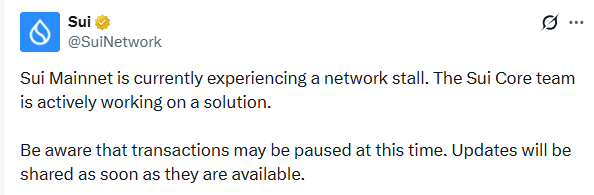 Source: X(formerly Twitter)
The root cause is now confirmed: a crash bug in the gas charging logic introduced in version 1.72. The Core team deployed a fix, with more than two-thirds of stake upgrading before the chain came back online. A full incident review will be published in the coming days.
What Happened During the Sui Network Stall on May 28
The Sui network stall began with validators stopping the finalisation of new transactions — the process that confirms activity is permanently recorded on-chain. SuiScan showed a freeze starting at 13:48 UTC on May 28. Every block listed "56m 40s" in age, confirming no new activity had processed during that window.
The official status page flagged a major outage for mainnet validators starting around 07:15 PDT. The formal statement posted on X read: "The Core team is actively working on a solution. Updates will be shared as soon as they are available."
The root cause on May 29: a crash bug in the gas charging logic introduced in version 1.72. The fix required coordinated validator upgrades across the mainnet. More than two-thirds of stake completed the upgrade before block production resumed at 04:32 UTC+8 on May 29 — giving a total outage of 6 hours and 44 minutes.
The Sui network stall did not affect public RPC nodes — the access points that let wallets and applications connect. Users could see their balances. They just couldn't move anything. Walrus, a storage protocol on the blockchain, paused activity during the disruption and confirmed funds were safe. No forks occurred. No user funds were lost.
They confirmed a full incident review will be shared in the coming days.
Sui Network Stall Price Impact: SUI Drops 8% in Hours
Markets responded immediately to the Sui network stall news.
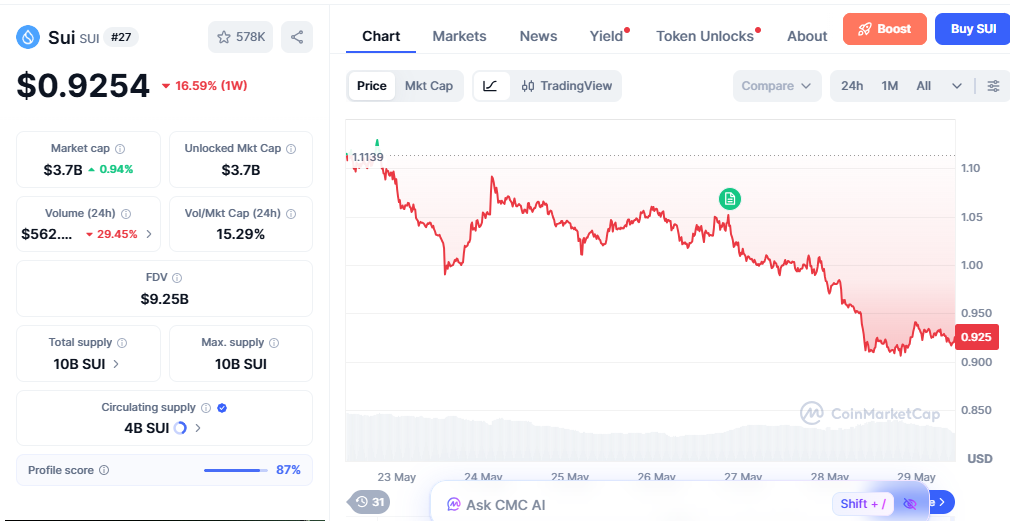
It is traded near $0.91 — down approximately 8% from pre-stall levels. Coinmarketcap showed token at $0.9248, down 7.1% in 24 hours and 16.36% over the past week. Market cap dropped 5% to $3.67 billion during peak disruption. Trading volume reached roughly $725 million on the day.
The broader market added pressure. Bitcoin was down approximately 2.06% on the same day — risk appetite was already weak before the Sui network stall news spread. That combination pushed it harder than it might have fallen in isolation.
One technical pattern worth noting: the $1.00 level — which acted as support throughout SUI's entire 2024 base phase — broke during the outage-driven selloff. CaptainAltcoin identifies $1.05–$1.10 as the key resistance level that needs reclaiming for trend recovery. It is currently down approximately 77% from its $4.00 highs in early 2025.
 Source: CoinMarketCap Data
As of May 29, 2026 at time of writing, The token trades at $0.9254 — down 16.59% over the past week, with a market cap of $3.7B and 24-hour trading volume of approximately $562 million, per CoinMarketCap.
Sui Network Stall Pattern: Third Outage Since 2024
The May 28 Sui network stall is not an isolated event. Decrypt reported directly: "Built to compete with other speedy layer-1 blockchains, the mainnet has once more suffered from the same ills that rival Solana once faced: downtime."
Three documented outages define The platform's reliability record:
November 2024: A 2-hour scheduling bug halted transactions. Blockchain recovered via coordinated validator upgrades. Post-mortem published.
January 2026: A 6-hour consensus divergence outage — previously Sui's longest. Engineers issued a post-mortem focused on enhanced testing.
May 28–29, 2026: Today's network stall — 6 hours and 44 minutes. Root cause: gas charging logic bug in version 1.72. It restored at 04:32 UTC+8. Full incident review pending.
The blockchain launched its mainnet in May 2023 — developed by Mysten Labs, originally a team of former Meta engineers. Its object-centric architecture prevents forks and protects funds during outages. But it has not prevented the outages themselves from recurring.
What the Sui Network Stall Means for Investors Now
The Sui network outage raises a direct question for token holders: is a version update bug a fixable growing pain — or a sign of deeper infrastructure risk?
Three facts support the recovery case. First, user funds were never at risk — no outage has caused fund loss. Second, more than two-thirds of validators upgraded to the fix in a coordinated response. Third, previous outages saw short-term selling followed by recoveries. After the January 2026 stall, They posted a 37% weekly surge on May 11, 2026 — just 17 days before this event.
Two concerns remain. First, three outages in 18 months now matches the worst reliability records of comparable Layer 1 networks. Second, the root cause — a version update bug — means every future upgrade carries the same risk until the team's testing and deployment process improves. The upcoming full incident review is the most important document It will publish this month. It will tell investors whether version 1.72 was a one-off error or a systemic testing gap.
The first ETFs launched earlier in 2026 — products from Canary and Grayscale both offering exposure and staking rewards to traditional investors. Institutional money now holds direct exposure. A pattern of repeated version-update outages creates a specific reputational risk for that audience.
Based on public analyst reports and assumption basis only — no guaranteed outcomes — recovery targets of $1.05–$1.10 are cited near-term if the post-mortem confirms the bug is fully resolved. All projections are speculative.
Conclusion
The Sui network stall on May 28–29, 2026 lasted 6 hours and 44 minutes — Sui's longest recorded outage. A gas charging bug in version 1.72 caused it. More than two-thirds of validators upgraded to the fix before block production resumed. Funds are safe. Now watch for the full incident review. That document tells you whether this version of it is stronger — or still fragile.
YMYL Disclaimer
This article is for informational purposes only and does not constitute financial or investment advice. Crypto presales are high-risk and readers should verify all information independently before making any financial decision.
Also read:









