EU MiCA Regulation News: Circle Seeks Changes to Stablecoin Rule

EU MiCA Regulation News: Circle Seeks Changes in Regulation
A senior executive at Circle has proposed changes to the European Union's MiCA, calling for changes to the European Union's MiCA framework, highlighting a wide gap between the stablecoins that dominate global trading and those actually compliant with European Union rules.
The comments add to growing EU MiCA regulation news as Brussels prepares to review the two-year-old regulatory framework.
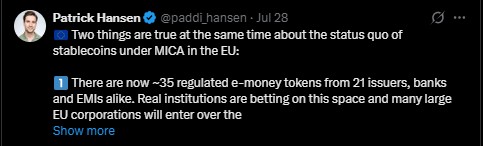
Source: X paddi hansen
Official Information
As of July 2026, the EU has 21 authorized issuers offering 35 regulated e-money tokens (EMTs) across 12 countries, according to ESMA's interim MiCA register.
France leads with 6 authorized issuers, including Circle Internet Financial European Union SAS, which issues EURC and USDC.
Other authorized jurisdictions include the Netherlands, Malta, Lithuania, Luxembourg, Finland, Denmark, Latvia, Czech Republic, Germany, Iceland, and Poland.
Under MiCA's Article 109, ESMA is legally required to maintain a public register of e-money token issuers, asset-referenced token issuers, and crypto-asset service providers, updated on a regular basis.
Of the top 50 stablecoins by global market capitalization, only three are MiCA-compliant: USDC, USDG, and EURC.
Patrick Hansen, Circle's Senior Director of E-U Strategy and Policy, shared this data and analysis publicly on X.
What Happened?
An assessment of MiCA's current status noted that regulated e-money token adoption is growing steadily among EU-based issuers and banks.
While local implementation is working well, the framework covers only a small fraction of the stablecoins actually used worldwide.
The upcoming regulation review should focus on two goals: helping EU-issued tokens scale beyond European borders through a more competitive, globally aligned regime, and bringing more global stablecoin activity under MiCA's supervision through a recognition pathway for foreign-regulated issue.
This was described as a chance to make the framework more competitive rather than a sign that MiCA has failed. 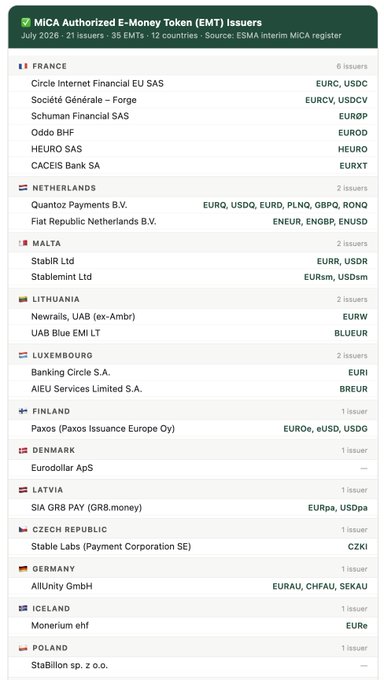
Executive Statement
According to the statement, regulation review is a chance to make the framework more competitive and globally aligned," adding that locally issued tokens need to scale beyond E-U borders to realize their real value proposition in cross-border payments and tokenized trade.
It also noted that the goal should be bringing more global stablecoin activity under MiCA's umbrella through recognition. regime for foreign-regulated tokens, rather than pushing that activity outside EU regulation oversight entirely.
Market Impact
This latest EU MiCA regulation news carries direct implications for stablecoin issuers, exchanges, and users across Europe.
With only USDC, USDG, and EURC meeting rule standards among the world's largest stablecoins, E-U users currently have limited access to widely used tokens that remain outside the regulatory perimeter.
A recognition regime, if adopted, could allow more global issuers to serve E-U customers without needing a separate EU-based entity, potentially increasing competition and options for European users.
For now, MiCA-compliant issuers like Circle continue to hold a structural advantage in the regulated E-U market.
Conclusion
The latest EU MiCA regulation news shows a functioning but narrow regulatory perimeter, with 35 e-money tokens authorized across 12 countries but only three of the world's top 50 stablecoins meeting compliance standards.
Circle's Patrick Hansen has called for the upcoming rule review to address this gap through a more globally aligned framework and a recognition pathway for foreign-regulated stablecoins, though any formal changes remain part of an ongoing regulatory discussion rather than a confirmed policy shift.
Disclaimer
This article is for educational and informational purposes only and should not be considered financial or investment advice. Always do your own research using official sources before making any decisions.










