EU MiCA Regulation 2026: New Challenges For Banks and Crypto Exchanges

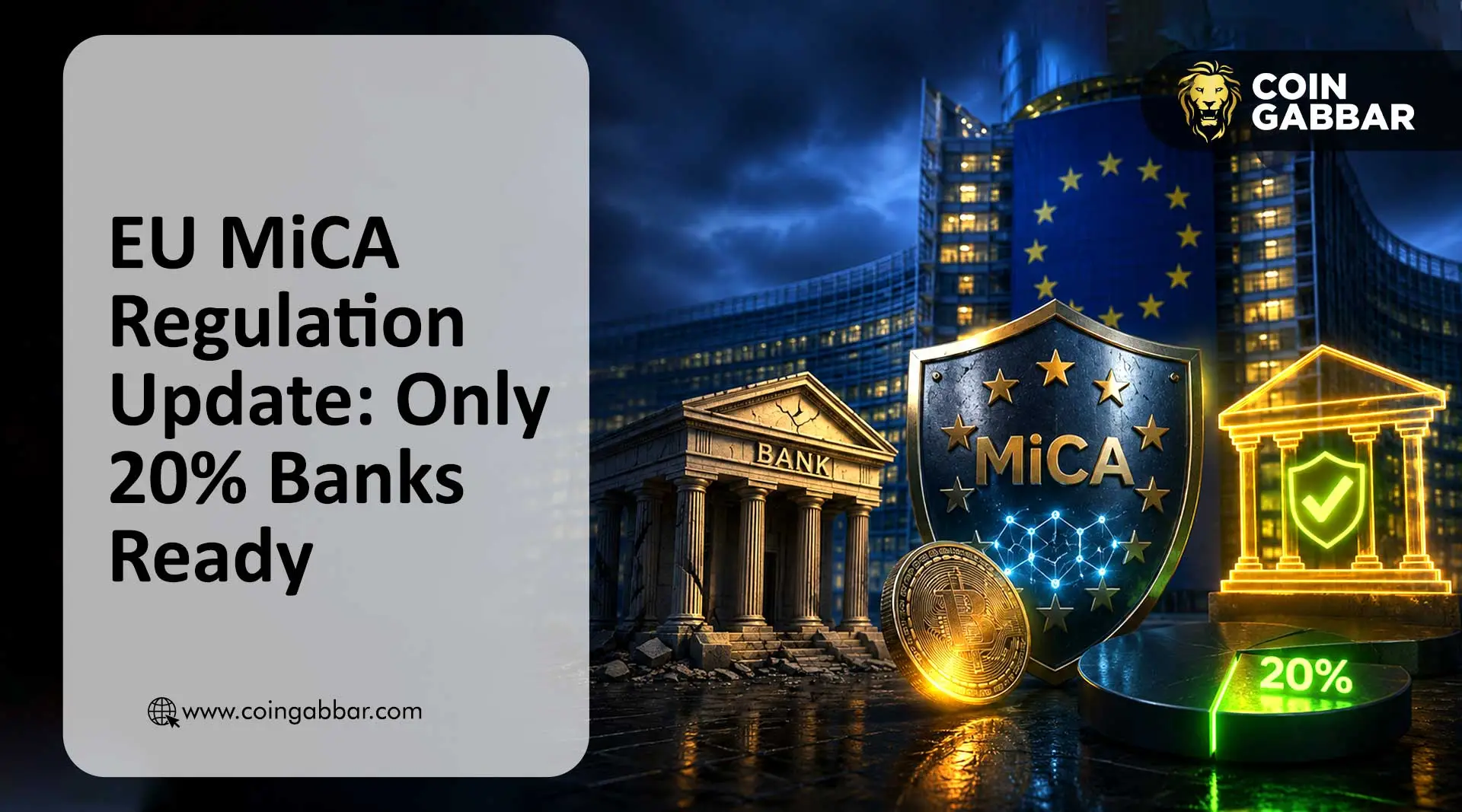
EU MiCA Regulation and UK FCA Rules May Spark Bank-Crypto Partnerships
Stricter cryptocurrency rules across the EU and UK are changing what it takes to survive as a crypto firm in Europe. Rapid expansion is no longer the main advantage — compliance strength, capital reserves, and the right partnerships now decide who stays in the game and who gets bought out.
Fewer than one in five European banks currently offer any service at all. That gap matters to you directly — it's the difference between which platforms survive the next 18 months and which get absorbed, and where your assets end up sitting.
Here's what most reports aren't telling you about who actually benefits when the compliance bill comes due.
MiCA Implementation Changes the Competitive Landscape for Crypto Firms
The EU's Markets in Crypto-Assets Regulation (MiCA) is moving out of its negotiation phase and into the harder part: staying compliant, year after year. Under the EU MiCA regulation update, firms no longer compete mainly on who can secure a license — they compete on who can afford to keep one.
Industry voices covering the shift say the real cost center going forward is operational: audits, reporting, capital buffers, and client-asset controls that don't stop once a license is granted.
Rising Compliance Requirements Put Pressure on Smaller Crypto Companies
MiCA layers on strict rules around capital adequacy, customer asset segregation, and day-to-day operational governance. For large exchanges with legal and finance teams already in place, this is manageable. For smaller or mid-sized crypto companies, it's a different story.
Many of these firms built their edge on speed and lean teams — not compliance departments. Carrying MiCA's ongoing costs alone, indefinitely, may simply not pencil out for them.
Regulatory Costs Could Trigger Crypto Industry Mergers and Acquisitions
This is where the EU MiCA regulation update starts reshaping ownership structures, not just rulebooks. Analysts following the space expect smaller firms to pursue mergers, acquisitions, joint ventures, or direct partnerships with banks rather than fight rising costs solo. That means the next wave of cryptocurrency headlines in Europe may be less about new coin listings and more about who bought whom.
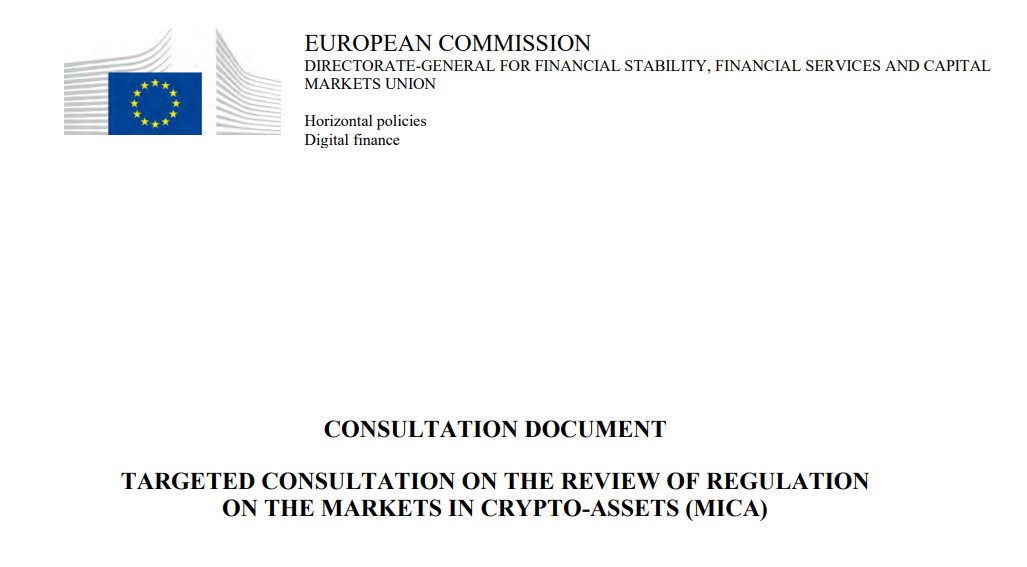
Source: Official Finance EU Website
UK Crypto Regulation May Accelerate Market Consolidation
Across the Channel, the UK's Financial Conduct Authority (FCA) is finalizing its own crypto framework — and it takes a different path than Brussels. Rather than building a standalone crypto rulebook like MiCA, the FCA is folding crypto oversight into the UK's existing financial regulatory system.
FCA Focuses on Consumer Protection and Market Stability
Steven Lightstone, a London-based fintech partner at Morgan Lewis, has noted that while the FCA wants to keep the door open for new entrants and competition, its consumer-protection bar will be high. Cryptocurrency firms operating in the UK should expect capital and operational standards that echo those already applied to traditional investment firms.
UK Rules Could Favor Larger and Better-Capitalized Players
The practical effect: companies with stronger balance sheets and mature compliance infrastructure are better positioned to absorb UK requirements — while thinly capitalized players face the same squeeze seen under MiCA.
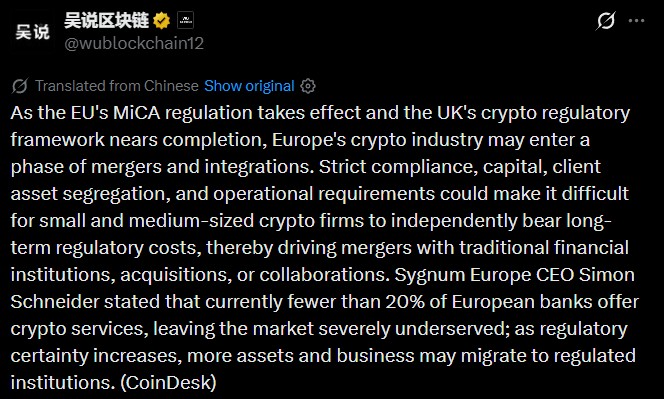
Source: Wu Blockchain X
EU vs. UK: How the Two Frameworks Compare
| Aspect | EU (MiCA) | UK (FCA Framework) |
| Regulatory model | Standalone, crypto-specific EU regulation | Crypto folded into the existing financial regulatory system |
| Licensing approach | New EU-wide licensing regime for crypto-asset service providers | No separate crypto license — existing FCA authorization categories extended |
| Consumer protection | Client-asset segregation and operational safeguards written into MiCA | High consumer-protection bar, modeled on standards used for investment firms |
| Capital requirements | Defined capital adequacy rules under MiCA | Capital and operational standards similar to traditional investment firms |
| Stated regulatory goal | Legal certainty and harmonized rules across EU member states | Balance competition and new entrants with strict consumer safeguards |
| Current status | Implementation phase, compliance costs now the focus | Framework nearing completion, not yet finalized |
Banks Prepare to Enter Europe's Digital Asset Market
Here's the number that actually matters more than any single price chart right now: fewer than 20% of banks in Europe currently offer crypto-related services, according to Sygnum Europe CEO Simon Schneider. That's a wide-open gap in a market of this size.
Fewer Than 20% of European Banks Currently Offer Crypto Services
Schneider frames this shortfall as an opportunity. As regulatory certainty firms up under MiCA, he expects more assets and business activity to migrate toward regulated institutions that can now enter the space with confidence.
MiCA Provides Legal Certainty for Traditional Financial Institutions
Schneider argues MiCA's biggest contribution isn't the licensing regime itself — it's the legal certainty it hands to banks deciding whether to enter digital assets at all.
He points to Switzerland's earlier rollout of distributed ledger technology rules, after which most major Swiss banks launched digital asset services, as a template other European markets may follow.
Europe's Regulation-to-Consolidation Timeline
-
Negotiation phase: MiCA rules debated and finalized at the EU level; UK FCA begins drafting its crypto framework
-
Early implementation: MiCA moves into force; firms secure licenses; UK framework nears completion
-
Compliance cost phase (current): Focus shifts from licensing to funding ongoing compliance — audits, capital buffers, reporting
-
Bank entry phase: More European banks begin offering services as legal certainty increases
-
Consolidation phase: Smaller firms pursue mergers, acquisitions, or partnerships; assets migrate to regulated entities
-
Coexistence phase (expected): Self-custody and institutional custody models settle into long-term coexistence
Crypto Firms and Banks May Build Partnerships Instead of Competing
Rather than banks displacing crypto-native firms outright, the more likely path is collaboration.
-
Infrastructure Providers Could Become Key Partners for Banks: Custody, brokerage, staking, and asset tokenization are the areas Schneider flags as the natural meeting ground — specialized infrastructure providers working alongside banks rather than against them.
-
Self-Custody and Institutional Custody Models Will Coexist: Schneider is clear on one point: self-custody isn't going away. He expects self-custody and institutional custody to run in parallel long-term, rather than one replacing the other.
-
Europe's Crypto Industry Moves Toward a New Consolidation Cycle: Compliance capability, capital scale, and integration with financial infrastructure are becoming the traits that separate firms that last from firms that don't, according to industry participants tracking the MiCA rollout.
-
Smaller Crypto Firms May Seek Strategic Partnerships or Exit Options: Firms that can't secure or sustain a MiCA license face a narrowing set of choices: seek a partner, get acquired, or wind down European operations. Assets held at those firms are likely to migrate toward regulated entities as this plays out.
What This Means for Crypto Investors and the Market
For traders and investors, this shift points toward fewer independent smaller platforms, more bank-backed and institutionally regulated options, and — at least in theory — stronger consumer protections around custody and asset segregation. Whether that trade-off benefits you depends heavily on which platforms you're currently using and how exposed they are to this compliance cost curve.
Conclusion
MiCA and the UK's incoming crypto framework are less about new rules on paper and more about who can afford to keep following them. The EU Official MiCA regulation website is pushing Europe's industry toward a consolidation cycle where compliance strength and capital scale — not just innovation speed — decide who's still standing next year, and where a more mature, partnership-driven ecosystem is likely to emerge.
Disclaimer: This article is for informational purposes only and does not constitute financial, investment, legal, or tax advice. Cryptocurrency markets are volatile and regulatory frameworks are subject to change. Readers should conduct their own research and consult a qualified professional before making any investment or compliance-related decisions. CoinGabbar is not responsible for any losses incurred based on the content of this article.
Also read:









