Hyperliquid News: HYPE Faces Pressure From Two Major Events
 Yash Shelke

Hyperliquid News: HYPE Price and the Selini Capital Transfer
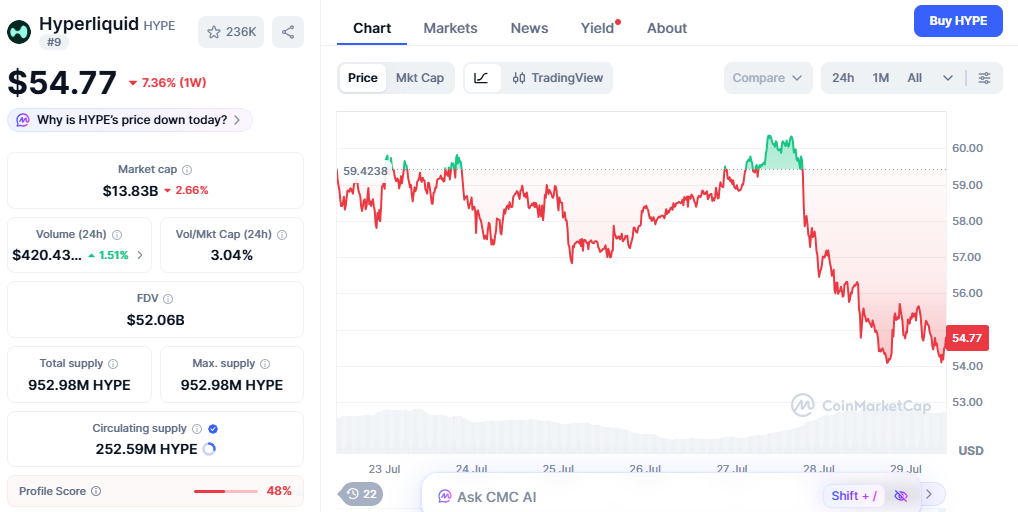
Today's Hyperliquid news covers a token under pressure from multiple directions at once. HYPE is trading at approximately $54.77, down 7.36% over the past week and roughly 10% over the past 24 hours at one point, according to CoinMarketCap data, with a market cap near $13.83 billion. The token became the top trending asset on CoinGecko this week — not for a rally, but in the aftermath of a flash crash in one of its platform's own derivatives markets.
 Source: CoinMarket Data
What Happened With the SK Hynix Perpetual
The trigger traces back to Hyperliquid's SK Hynix perpetual contract, officially listed as xyz:SKHX, which briefly fell approximately 17.9% on July 28. The contract tracks the U.S. dollar value of one SK Hynix common share and is deployed under Hyperliquid's HIP-3 framework by an independent team, Trade.xyz, which controls the market's oracle and pricing inputs.
The disruption began when South Korea's alternative exchange, NextTrade, opened its pre-market session and a single SK Hynix share traded at 1.272 million won — nearly 30% below the prior close — briefly hitting the stock's daily lower limit. That isolated, thin-liquidity print fed directly into the contract's oracle, and on-chain tracking showed the SKHX contract dropping from roughly $1,128 to around $900–$927 before recovering above $1,100. Later data put the contract near $1,067, down about 13.7% over 24 hours, with open interest near $406 million after falling roughly 20%, and daily volume exceeding $1 billion.
Under HIP-3, deployers like Trade.xyz are responsible for their own oracle design and must stake 500,000 HYPE, facing potential slashing for misconduct. Trade.xyz confirmed it is investigating the incident and has not yet published a final report. There is no verified evidence Hyperliquid's core blockchain or smart contracts were compromised — available information points to an external market print passing through Trade.xyz's own pricing methodology rather than a platform-wide failure.
HYPE Price and the Selini Capital Transfer
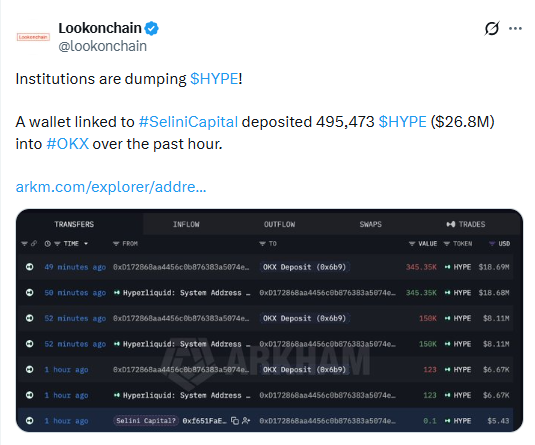
The token pressure hasn't come only from the SK Hynix incident. On-chain tracking shows a wallet linked to Selini Capital deposited 495,473 HYPE, worth approximately $26.8 million, into OKX within a roughly one-hour window, part of a broader pattern of transfers moving hundreds of thousands of HYPE tokens from a system-linked address toward exchange deposits in recent hours. Large transfers into exchange wallets are typically watched closely since they often precede potential selling, though a deposit alone doesn't confirm a sale has occurred.
 Source: X(formerly Twitter)
HYPE's total and max supply both sit at approximately 952.98 million tokens, with circulating supply around 252.59 million — meaning large single-wallet movements can carry outsized visibility relative to the token's still-developing float.
RWA Volume Milestone Gets Overshadowed
Largely lost in this week's volatility was a genuine structural milestone for the platform. During the week of July 13–19, 2026, Hyperliquid's real-world asset (RWA) trading volume reportedly surpassed its crypto-asset trading volume for the first time, with RWA activity generating $25.1 billion of a total $48.2 billion in weekly volume. Individual tokenized stocks accounted for roughly 61% of that RWA volume, driven largely by the same HIP-3 mechanism now under scrutiny following the SK Hynix incident — a reminder that the framework enabling Hyperliquid's fastest-growing segment is the same one responsible for this week's flash crash.
Conclusion
Today's Hyperliquid news shows a platform pulled in two directions: genuine growth in tokenized stock trading volume, and a fresh reminder of the risks built into how those markets are priced. HYPE remains under pressure, down double digits on the week, as the market watches for Trade.xyz's final incident report and whether more HYPE moves from large wallets toward exchanges.
Disclaimer
This article is for informational purposes only and does not constitute financial or investment advice. All price and volume data are based on CoinMarketCap, DefiLlama, and on-chain tracking data as of July 29, 2026, and are subject to change. Cryptocurrency prices are highly volatile. Always conduct independent research before making any investment decision.