Japan Crypto Adoption: Why Pension Funds and Bitcoin ATM In Headlines?


Japan Crypto News: Pension Fund Allocation and COINHUB Targets 3k ATMs
A Japanese pension fund managing ¥21.3 billion just did something no domestic pension has done before — it approved a live crypto allocation starting fiscal year 2026.
For traders watching institutional flows, this isn't just a headline: it's retirement money from 1,200 companies quietly positioning against dollar weakness using Bitcoin.
But the real story isn't the 1% figure — it's the reasoning behind the move, and what it signals for Japan's $3 trillion pension industry. Here's what most reports aren't telling you.
Japan Crypto Adoption Gets Its First Pension Fund Milestone
The National Business Corporate Pension Fund, based in Okayama, plans to allocate roughly 1% of its total assets to cryptocurrency through a passive fund holding multiple digital assets. With approximately ¥21.3 billion (around $136 million) under management, the initial cryptocurrency sleeve would equal roughly ¥213 million — about $1.36 million.
This marks a rare move for Japan's retirement sector. Pension funds in Japan have not been particularly active in the digital asset space, making this a notable step for institutional adoption.
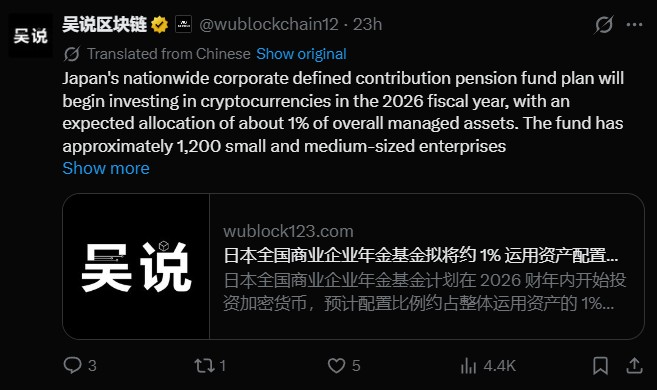
Source: Wu Blockchain
Why Bitcoin — and Why Now?
The fund's executive director of investment, Aiyu Kiguchi, said the US dollar may lose its global reserve status. The fund is treating Bitcoin as a hedge against a weakening dollar, not a bet on price gains.
Kiguchi also reportedly said the fund reached this view after about six years of research, concluding the market had "matured" as the investor base became deeper.
This is not speculative buying. The fund isn't chasing price. It's using Bitcoin the same way it uses gold — as a store of value outside fiat currency systems.
How the Allocation Is Structured?
In fiscal year 2025, the fund held 80% in yen, 15% in dollars, and 5% in other currencies. For FY2026, it will cut yen exposure to 70%, allocate 10% to developed-market currencies, and place the remaining 5% across emerging-market currencies, gold, and cryptos.
Exposure will be handled through a passive multi-crypto strategy managed by a major hedge fund, rather than direct coin custody by the pension plan itself.
The structure keeps operational risk low while giving the fund regulated, diversified crypto market exposure — a model other conservative institutions can replicate.
First Crypto ATMs Hit Western Japan Too
COINHUB Co. Ltd. signed a partnership agreement with JR West Japan SC Development on June 18, 2026, installing western Japan's first bidirectional cryptocurrency ATM at Tennoji MIO — a major commercial complex sitting directly above JR Tennoji Station in Osaka.
The machine is located on the second floor of the Plaza building and allows users to purchase cryptocurrency with cash or sell for immediate yen withdrawal on the spot, via a simple touchscreen interface requiring no prior exchange account.
COINHUB holds full FSA regulatory approval, meaning its machines comply with Japan's strict AML and KYC requirements — a bar that has kept most international ATM operators out of the Japanese market entirely.
The company initially launched 25 machines across six major cities in 2025 and is now targeting an ambitious nationwide network of 3,000 units — covering commercial facilities, transportation hubs, and tourist areas across Japan.
CEO Hiroshi Uehara stated that placing ATMs inside high-footfall daily destinations is a deliberate strategy to feel routine for ordinary users.

Source: WuBlockchain X
What to Watch Next: Japan's 2028 Crypto Roadmap
Japan's House of Representatives passed a law on June 11, 2026, integrating assets into the Financial Instruments and Exchange Act framework. The Japan Crypto bill still needs approval from the House of Councillors but would pave the way for crypto ETFs and a flat 20% tax on gains, down from the current maximum of 55%.
The Osaka Exchange, a subsidiary of Japan Exchange Group, plans to launch Bitcoin futures in 2028, timed to coincide with expected domestic approval of spot Bitcoin ETFs.
Nomura's 2026 institutional investor survey found 65% of respondents viewed assets as a portfolio-diversification opportunity, while 79% of those considering crypto exposure over the next three years said they planned to invest.
The 2028 timeline is the one to mark. Regulated ETFs, Bitcoin futures, and a 20% tax cap arriving together could unlock a wave of institutional capital.
Conclusion
Japan's National Business Corporate Pension isn't making a speculative bet — it's making a structural one, backed by six years of research and a clear thesis: dollar weakness makes Bitcoin useful. With a crypto ATM network expanding in Osaka, regulatory reform advancing in parliament, and Bitcoin futures targeted for 2028, Japan crypto adoption is moving from early signal to institutional infrastructure. The 1% allocation is small today. But it may look like the opening move of something much larger.
Disclaimer: This article is for informational purposes only and does not constitute financial or investment advice. Cryptocurrency investments carry significant risk. Always conduct your own research before making any investment decisions. CoinGabbar is not responsible for any financial losses.









