Kalshi Market News: CLARITY Act Delay Reshapes Predictions

Kalshi Market News: How Traders Repriced the Senate Vote
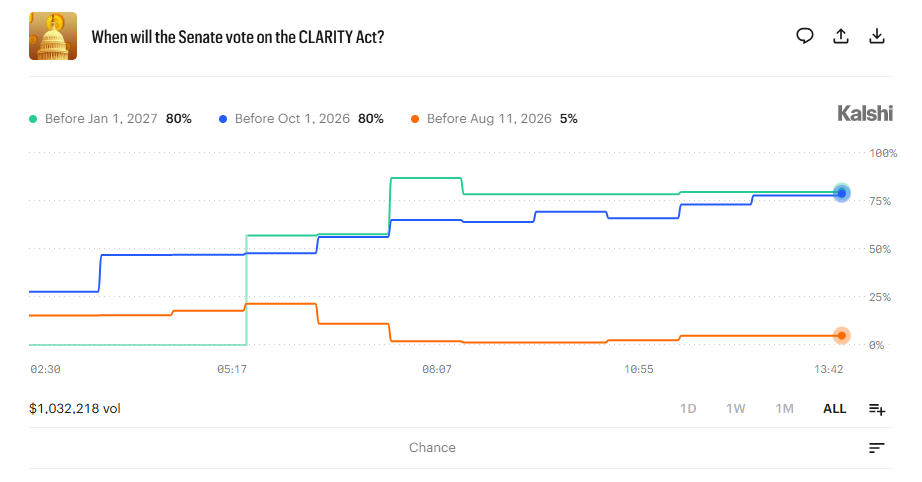
Today's Kalshi market news captures the moment the CLARITY Act's Senate timeline officially shifted. Late on August 6, Senate Majority Leader John Thune confirmed the bill would not get a pre-recess vote — and Kalshi's markets repriced almost immediately across four separate deadline contracts.
Kalshi Market News: The Four Contracts, Side by Side
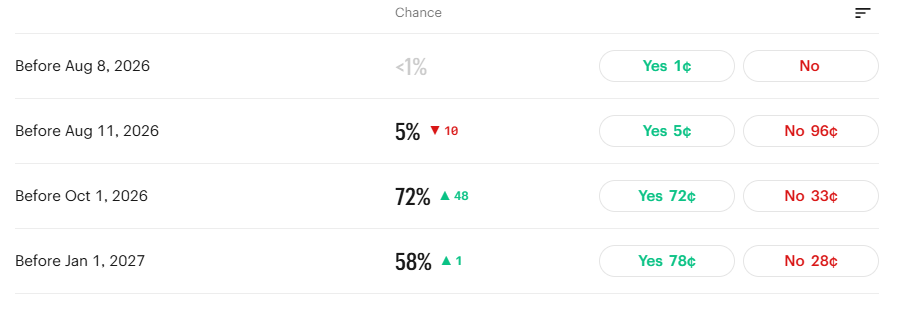
Kalshi runs separate markets for different deadlines on the same question — "When will the Senate vote on the CLARITY Act?" Here's where each stands:
Deadline | Chance | Yes Price | No Price | Move |
Before Aug 8, 2026 | <1% | 1¢ | — | Collapsed near zero |
Before Aug 11, 2026 | 5% | 5¢ | 96¢ | Down 10 points |
Before Oct 1, 2026 | 72% | 72¢ | 33¢ | Up 48 points |
Before Jan 1, 2027 | 58% | 78¢ | 28¢ | Up 1 point |
 Source: Kalshi Market Data
The pattern is clear:
Near-term odds have effectively hit zero.
Confidence has concentrated on the October 1 window.
The longer January window sits slightly lower than October — traders expect a vote to happen, if it happens, closer to the September return than to year-end.
Why Thune Confirmed the Delay
Thune said Democrats would not agree to bring the bill up before recess. He added the measure would be "queued" for when senators return in September — a reversal from Senate Banking Chair Tim Scott's earlier push for a pre-recess vote.
What actually blocked it:
Seven Democratic senators rejected the Republican draft on July 22.
That group included Angela Alsobrooks and Ruben Gallego — the two Democrats who had previously helped advance the bill through committee.
Objections centered on ethics rules, consumer protection, illicit finance, conflicts of interest, and market integrity.
Democrats also declined a time agreement that would have sped up other Lawmaker's business before recess, squeezing the floor calendar further.
The ethics dispute is the hardest sticking point. Democrats want tougher restrictions on elected officials' crypto holdings, including provisions tied to President Trump's family digital asset businesses. A proposed divestiture approach is reportedly still under negotiation with the White House — not yet agreed, not yet enacted.
Because Republicans need 60 votes to break a filibuster, Democratic support isn't optional here. That's the math the Kalshi odds are ultimately pricing.
What's Left Before September
The bill isn't dead. It's just delayed. Where things actually stand:
House: Passed 294-134 in July 2025.
Senate Banking Committee: Advanced 15-9 on May 14, 2026.
Merged text: Released by Senator Cynthia Lummis on July 22, combining Banking and Agriculture committee work.
What it does: Splits digital asset oversight between the SEC and CFTC, plus covers stablecoin rewards, AML controls, DeFi, and tokenized securities.
One procedural option remains before recess: Thune could file cloture now to help position the bill for a faster vote in September, though Politico reported he hadn't confirmed whether he'd do that.
Even a Senate "yes" wouldn't finish the job. Because the Lawmaker's has amended the House-passed text, both chambers would still need to reconcile differences before anything reaches President Trump's desk — a process that eats into an already tight fall calendar crowded by spending fights and the 2026 midterms.
Conclusion
Today's Kalshi market news shows traders reacting in real time to a confirmed delay, not a rumor. Near-zero odds on any pre-recess vote have flipped into a 72% bet on a Senate vote by October — a bet that now hinges entirely on whether Republicans and the seven holdout Democrats can close the ethics gap before the September return.
Disclaimer
This article is for informational purposes only and does not constitute financial, legal, or investment advice. Prediction market odds reflect trader sentiment, not confirmed outcomes, and are subject to change. All legislative details are based on publicly available reporting as of August 7, 2026. Always consult official congressional sources for the latest status on this legislation.