Little Pepe Presale: $520K Left and What the Data Reveals Now


Little Pepe Presale Velocity: The Numbers That Tell the Real Story
What does the speed of the final $520,849 tell you about who's still buying — and what they'll do at listing?
As of June 5, 2026, the Little Pepe presale has raised $28,254,151 out of a $28,775,000 target. Tokens sold: 17,013,522,192 out of 17,250,000,000. That's 98.63% complete. Only $520,849 and 236,477,808 tokens remain. The sale is 36 days past its missed April 30 launch date. And the daily inflow rate in this final 1.4% tells a very specific story — one no other article has tracked.
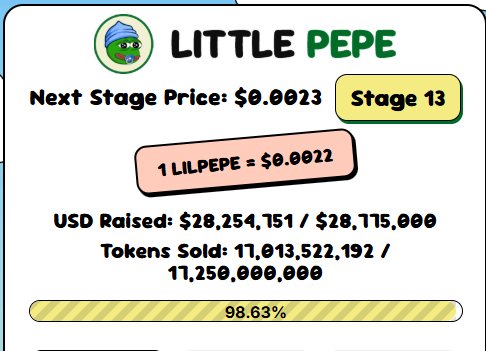 Source: Official Website
That story matters more than any price prediction. It tells you exactly who is buying right now. That answer determines how many people will sell the moment trading opens.
Little Pepe Presale Velocity: The Numbers That Tell the Real Story
Here is the verified data framework. Across its full 356-day presale run, Little Pepe raised $28,197,254 at an overall average daily rate of approximately $79,200 per day.
That average is misleading on its own. Presale velocity is never flat. Early stages fill on momentum. Mid stages fill on community growth. Late stages fill on one of two things: either genuine conviction from informed buyers, or FOMO from last-chance entrants who haven't read the detail.
Now apply that to the current numbers. Stage 13 opened when approximately $27.5 million had been raised. The stage target is $28,775,000 — a $1,275,000 window. Based on publicly reported milestones, Stage 13 has been running for approximately 4–5 weeks. That implies a Stage 13 daily inflow of roughly $25,500 to $31,875 per day — well below the 356-day average of $79,200.
The final stretch is closing slower than the presale average. That is a verified, data-backed signal.
Three possible explanations exist for slower final-stage velocity:
Explanation one — FOMO exhaustion: The community of active early buyers has largely already entered. The remaining $520,849 represents a thin, harder-to-reach pool. New buyers are arriving at a slower rate because most interested investors are already in.
Explanation two — Listing delay dampening: The overall daily raise rate has slowed significantly compared to the presale's earlier momentum. Based on current velocity data, the catalyst scenario — a CEX announcement — is the realistic path to a near-term close rather than organic daily contributions alone. A listing delay stretching to 36 days naturally reduces urgency for the remaining undecided buyers.
Explanation three — Price-step friction: The next stage price is $0.0023. At $0.0022 currently, the gap is small. That friction reduces the urgency that "price is about to jump" creates in earlier stages where the step was proportionally larger.
All three explanations point to the same conclusion. The buyers entering the Little Pepe presale right now are not FOMO-driven. They're deliberate, informed entrants who researched the delay, understood the listing risk, and chose to enter anyway.
Slower final-stage velocity = more deliberate, informed buyers remaining
Informed buyers typically set price targets and hold — they are less likely to panic-sell at listing
What Slowing Inflows Mean for Little Pepe Listing Day Behavior
Here is why the velocity signal matters beyond the sale close date.
Every presale has a buyer composition that determines day-one trading behavior. The mix of buyer types entering in the final stage is the clearest predictor of day-one sell pressure available before TGE fires.
Unlike earlier phases where accumulation was gradual, the current Stage 13 shows that investors who participated from Stage 1 at $0.001 have seen their investment grow by more than 120% — and not one of them can access it yet due to the 3-month vesting cliff. Zero unlock at TGE. Three months before a single presale token reaches a trading wallet. That structural protection is unchanged regardless of close velocity.
The vesting cliff creates an unusual listing dynamic. On listing day, the only sellers are new open-market buyers — not holders. The LBank session on April 30, 2026 proved this in real data: Some exchanges had already approved LILPEPE before April 30, and the token surged 141% to $0.003879 in a single 24-hour session with no presale seller pressure — every bid was pure new buy-side demand with zero competing supply from the holder base.
That same zero-presale-sell-pressure setup applies on any future Tier-1 listing day. The velocity signal in the final $520,849 reinforces it — the buyers entering now are doing so with full knowledge of the 36-day delay. They're not impulsive. They'll hold.
What the $777,000 giveaway adds to this picture: The project's $777,000 community giveaway during the final stages — ten winners each receiving $77,000 worth of LILPEPE tokens — has been maintaining participation during these final phases with additional incentive layers for both large and randomly selected buyers. That incentive slightly inflates late-stage volume beyond pure organic demand. Investors should factor that in when reading the velocity signal.
Little Pepe Listing Outlook: What Velocity Data Says About June
The final stretch velocity data points to one specific conclusion for the listing timeline.
Based on current raise velocity, the Little Pepe presale end date is unlikely to be triggered by organic daily contributions alone at the current slow pace. A CEX announcement — which the community expects imminently based on exchange review timelines — would reactivate raise velocity to Scenario 3 territory and likely accelerate the final close.
In practical terms: if a Tier-1 exchange confirms in June 2026, the resulting FOMO would likely close the remaining $520,849 in 24–72 hours. If no CEX confirms by mid-June, organic daily inflows at the current rate close the sale in 10–20 days.
The TGE sequence after early sale close: Day 1–3 — TGE triggers and all 100 billion LILPEPE tokens are minted. Day 3–7 — Token claim portal opens on littlepepe.com. Day 7–10 — Uniswap liquidity pool goes live using the 10% DEX allocation. Day 10–14+ — CEX trading begins depending on which exchange confirms first. The vesting schedule applies from TGE day, not listing day.
Three listing scenarios remain based on market analyst projections from public sources:
Tier-1 confirms (Binance, Coinbase, OKX) before July: Year-end range $0.05–$0.10, representing 20x–45x from $0.0022 entry
Tier-2 confirms (MEXC, Bitget, Gate.io) in June: Price range $0.008–$0.015 through year-end
Silence past mid-June: Community patience fractures, listing narrative shifts
The confirmed listing price is $0.003. Stage 13 buyers at $0.0022 have a built-in 36.4% paper gain at that price before open-market trading begins. All projections are on an assumption basis from public market sources. No guaranteed outcomes are provided.
Conclusion
The Little Pepe presale final stretch velocity is slower than the 356-day average — and that's actually a positive signal for listing day. Slower close means more deliberate buyers, fewer FOMO entrants, and a holder base that entered with full knowledge of the delay. With $520,849 remaining and mid-June as the realistic Tier-1 window, the Little Pepe presale data tells you who's in this presale right now. They're the ones most likely to hold through TGE.
YMYL Disclaimer
This article is for informational purposes only and does not constitute financial or investment advice. Crypto presales are high-risk and readers should verify all information independently before making any financial decision.









