Pepeto Was Hacked Three Times: What $10M Raised Tells Investors


Pepeto Presale Buyer Profile: Who Is Still Buying After Three Attacks
What kind of investor keeps buying into a project that gets attacked three times?
That question matters more than any price prediction for Pepeto right now. As of June 4, 2026, the Pepeto presale has raised $10,236,419.95 out of a $10,578,724 hard cap. Only $342,304 remains. The token price is $0.0000001874. The price rise timer shows 1 day and 10 hours. Three confirmed domain attacks hit the project between April 28 and May 27, 2026. The presale kept going through every single one.
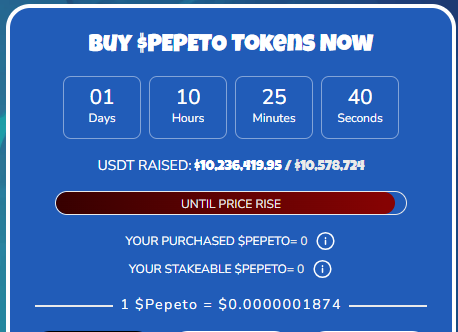 Source: Official Website
That pattern is data. And data tells you something specific about who is left in this presale — and what they'll do on launch day.
What Each Pepeto Hack Did to Fundraising Velocity
Here are the three confirmed attacks with their verified dates and what happened to fundraising immediately after each one.
Attack one — April 28, 2026: The original pepeto.io domain went dark. The team migrated to pepetoswap.com the same day and disclosed the attack publicly on X within hours. The presale continued without a confirmed funding slowdown. The project crossed $9.8 million raised in the days immediately following.
Attack two — Early May 2026: A second attack hit pepetoswap.com. The team migrated again — this time to pepetocoin.com by May 9. The official statement posted: "They came for us once and we stood. They came for us twice and we did not move." Fundraising continued. The presale moved from approximately $9.8 million to over $10 million through this period.
Attack three — May 27, 2026: A possible third outage hit pepetocoin.com. By June 4, the presale had reached $10,236,419.95 — meaning inflows continued even after the third disruption.
The pattern is consistent across all three events: attacks happened, the team disclosed publicly, migration followed within hours, and fundraising did not stop.
One important caveat: granular daily inflow data is not publicly available in a verifiable format. The pattern above is based on milestone fundraising figures reported by CoinGabbar and market sources across the timeline. All data is on assumption basis from public market sources. No exact daily inflow figures are confirmed.
Pepeto Three Hacks: Who Is Still Buying and Why It Matters
The sustained fundraising through three attacks tells you something specific about buyer psychology — and it matters for what happens on day one of trading.
Three buyer profiles are active in the current Pepeto presale. Understanding which one dominates changes the day-one selling picture entirely.
Profile one — High-conviction early holders adding more: Investors who entered at the lowest stages — some as far back as October 2024 — and continued buying through disruptions. These buyers have the longest time horizon. They are the least likely to sell on listing day because their paper gain from presale entry is already meaningful even at a base-case listing price.
Profile two — Post-hack new entrants: Investors who discovered Pepeto because of the hack news coverage — searching "Pepeto scam" and finding balanced analysis that concluded the funds were safe. These buyers entered knowing the risk picture. They are typically medium-conviction holders who set a target price and sell when it hits.
Profile three — Late-stage FOMO buyers: Investors entering in the final $400K of a $10.5M raise because the presale is "almost over." These buyers have the shortest holding horizon and the highest likelihood of selling on listing day — especially if the opening price disappoints versus the community's 269x bull case.
The critical question is which profile represents the largest share of the remaining $342,304. Based on presale behavioral patterns from comparable projects, late-stage FOMO buyers dominate the final 3–5% of any presale. That is a specific day-one risk signal.
What this means for Pepeto TGE day-one behavior:
High-conviction holders staking at 171% APY have a direct financial reason not to sell immediately
Post-hack new entrants bought with full risk knowledge — they're not panic sellers
FOMO final-stage buyers represent the highest day-one exit risk
The staking mechanic is the one structural factor that could offset late-stage FOMO selling. With 171% APY available at TGE, any buyer who stakes rather than sells extends their holding window and reduces available day-one supply.
What Pepeto Hack Data Means for Day-One Selling Behavior
Here is the honest analytical conclusion from the three-hack fundraising pattern.
Projects that raise $10M+ through sustained adversity — not despite it, but through visible, disclosed disruption — attract a specific type of holder. The buyers who continued after April 28 had already seen the hack news. They chose to buy anyway. That's a self-selected conviction signal that is structurally different from investors who bought before any disruption occurred.
Comparable presale analysis from market sources shows that projects with adversity-tested communities have consistently lower day-one sell rates than projects with purely momentum-driven presales. Pepeto's three-hack journey is unusual — but the fundraising data suggests it created a more informed, deliberate holder base than most meme coin presales produce.
The risk is the final $342,304. With only $342,304 remaining, most informed buyers are already in. The last buyers tend to be either the highest-conviction late entrants or the most impatient FOMO buyers — two very different day-one behavior profiles arriving in the same final batch.
Pepeto's launch date based on current velocity points to late June or July 2026 — with August 2026 cited as a broader estimate if inflows slow. No confirmed date exists. All projections are based on market analyst sources and are assumption-based. No guaranteed outcomes are provided.
Watch the staking participation rate at TGE. High staking in the first 24 hours signals conviction holders are in the majority. Low staking signals FOMO exit buyers — and that's the number that tells you more about day-one price than any analyst projection.
Conclusion
Pepeto raised $10.2 million through three domain attacks. That's not luck — it's a verified behavioral signal. The Pepeto presale has been stress-tested in a way most crypto projects never face. What comes next at launch day depends on which buyer profile — high-conviction staker, informed post-hack entrant, or FOMO final-stage buyer — dominates the remaining $342,304. Watch the staking rate at TGE. That number tells the real story.
YMYL Disclaimer
This article is for informational purposes only and does not constitute financial or investment advice. Crypto presales are high-risk and readers should verify all information independently before making any financial decision.
Also read:






