SEC Innovation Exemption to Allow 24/7 Stock Tokens

SEC Innovation Exemption to Allow 24/7 Stock Tokens
SEC Set to Unveil "Innovation Exemption" for Tokenized Stocks as Clarity Act Stalls
The U.S. Securities and Exchange Commission (Securities and Exchange Commission) is poised to roll out a pair of major initiatives that could further turbocharge the U.S. crypto industry and mark one of tokenisation's biggest catalysts yet.
SEC Innovation Exemption.
The Securities and Exchange Commission is holding an open meeting to consider whether to issue a release proposing new rules to create a tailored offering regime for certain investment contracts involving crypto assets.
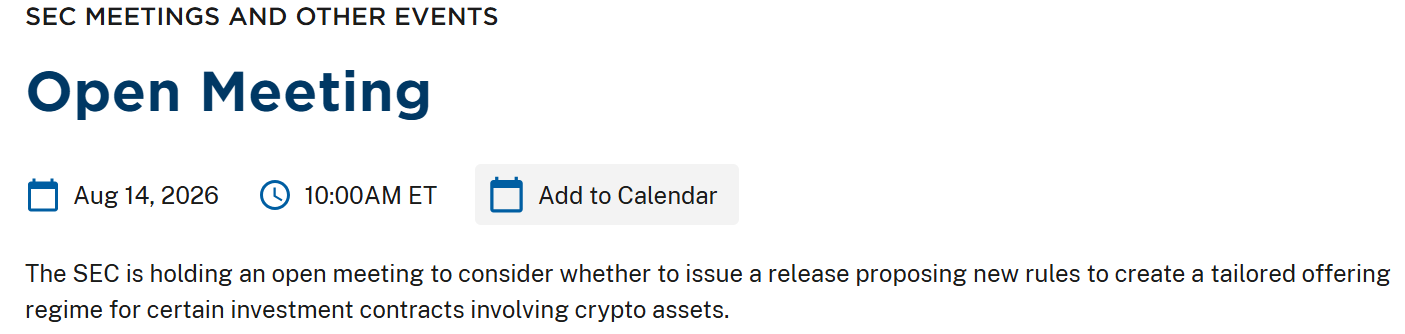
Sources : official website
As the landmark digital asset bill, the Clarity Act, stalls in Congress, the regulator announced it will hold an open meeting as soon as Friday to create a tailored offering regime for certain crypto asset investment contracts and introduce a long-awaited "innovation exemption".
Tokenomics & On-Chain Mechanics
The transition of traditional equities to blockchain rails introduces several fundamental tokenomic shifts for digital asset ecosystems and financial markets:
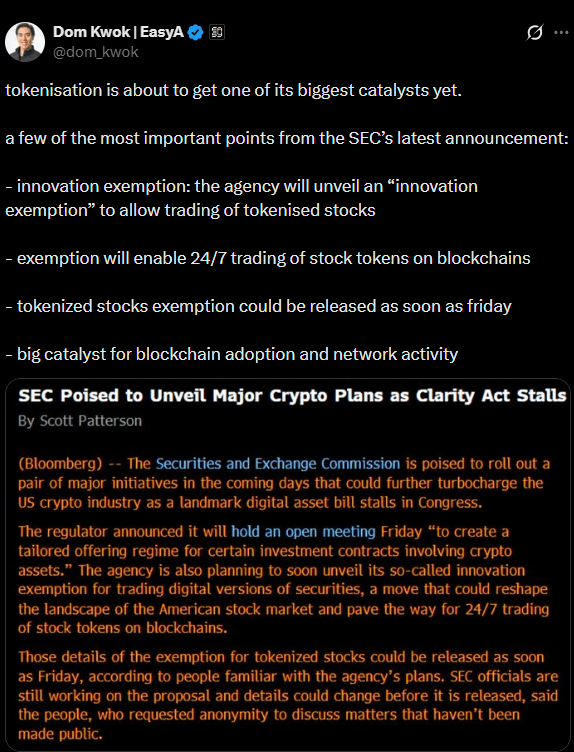
Sources : official twitter by Dom kwok
Increased Network Fee Burn & Activity: Round-the-clock trading, automated market maker (AMM) rebalancing, and instant settlement generate continuous transaction fees ($gas$) across underlying Layer 1 and Layer 2 blockchains, driving structural token burn and network usage.
1:1 Asset Backing & Minting: Under the tokenization framework, qualified custodians purchase physical underlying equity shares or cash equivalents, minting corresponding 1:1 tokenized claims on-chain to maintain collateral parity.
Intraday Yield & Collateral Velocity: Institutional products like Franklin Templeton’s $FOBXX enable hourly Net Asset Value (NAV) recalculations. This allows funds to seamlessly utilize yield-bearing money market tokens directly as real-time collateral for securities lending and DeFi positions without unstacking capital.
On-Chain Liquidity Pools: Fractional share minting lowers the capital threshold for participation, allowing retail and algorithmic market makers to seed global, continuous liquidity pools.
Key Takeaways from the SEC Announcement
The Innovation Exemption: The SEC is preparing to launch a new regulatory exemption designed specifically to allow the trading of digital versions of securities.
24/7 On-Chain Equity Trading: The Relief will enable continuous, 24/7 trading of stock tokens on blockchain infrastructure, removing traditional market closing hours.
Imminent Release: Details of the tokenized stock exemption could be released as early as Friday, according to sources familiar with the agency's plans, though SEC officials note proposal details could still evolve before public release.
Network & Adoption Catalyst: Market observers expect the move to serve as a massive catalyst for institutional blockchain adoption and overall network activity.
Regulatory Momentum: Franklin Templeton Wins SEC No-Action Relief
Adding further momentum to institutional on-chain finance, the SEC’s Division of Investment Management recently issued a no-action letter to Franklin Templeton (FTDA).
The relief clears the path for Franklin Templeton’s registered funds to utilize its on-chain money market fund ($FOBXX) to manage cash and collateral for securities lending. Under this decision:
Franklin Templeton can custody and record share ownership using its blockchain-integrated system rather than complying with legacy rules designed for physical securities.
The structure supports intraday trading, hourly Net Asset Value (NAV) calculations, and faster overall transaction processing.
What's Next?
If released this Friday, the SEC's innovation exemption could fundamentally reshape the landscape of the American stock market, bridging legacy finance with decentralized blockchain rails.
DISCLAIMER: This news report is intended solely for informational and educational purposes and does not constitute financial, investment, legal, or trading advice. Regulatory plans and SEC proposals discussed are subject to change, final public notice, and Securities and Exchange Commission voting approval. Readers should perform independent research or consult a licensed professional before making any financial decisions.









