Stablecoin Banking Trends 2026: What Wirex and WazirX Reveal

Stablecoin Banking Trends 2026: What Wirex and WazirX Are Saying
Stablecoin news has dominated this week's crypto headlines, and two stories stand out for very different reasons. Wirex, long known for its crypto debit card, has quietly rebuilt itself around stablecoin infrastructure for other businesses.
WazirX, meanwhile, just published fresh numbers on how Indian traders actually behavePut the two together and you get a clear snapshot of Stablecoin Banking Trends and crypto trading trends shaping the industry in 2026. , one from the infrastructure side, the other from the trading floor.
Why Wirex Shifted from Crypto Cards to Stablecoin Banking
Wirex news today. The company's evolution offers one of the clearest examples of stablecoin banking trends transforming crypto payment infrastructure.
It launched one of the first crypto debit cards back in 2015, at a time when most banks wouldn't even take the meeting. The team kept pushing until one partner finally said yes, and that's how the card came to be.
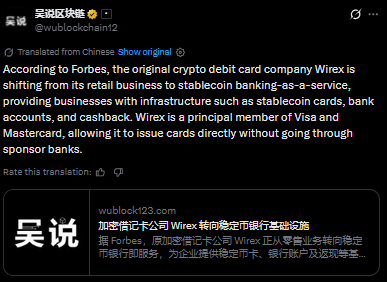
Sources : WuBlockChain Tweet
Fast forward to two years ago, and Wirex made a call that changed its whole direction. Rather than fight new crypto banks for the same retail customers, it decided to hand them the tools instead. In plain terms, the company packaged its card systems, bank account infrastructure, and cashback features, then started selling that whole stack to other businesses looking to issue their own cards.
A few things make this possible:
Wirex is a principal member of Visa and Mastercard, a status very few crypto firms hold
That membership means no sponsor bank sits between Wirex and the card networks
Direct access gives it more say over pricing, product design, and where it can operate
That last point matters more than it sounds. Without a middleman bank, Wirex keeps more control (and more margin) on every card it issues or helps issue.
Business demand for this setup hasn't been slow. Companies have been coming to Wirex asking for the exact systems it built for itself.
Its banking-as-a-service arm only launched at the end of 2025, yet it already hit $1 billion in annualized card volume within 131 days. That's a fast ramp for something so new, and it's a strong hint at why traditional banks are starting to take stablecoins seriously.
There's a phrase Wirex's leadership keeps coming back to: banking is becoming a stablecoin. Think about the first fintech wave, Revolut, Chime, that whole generation. They won on better design and lower fees, but the plumbing underneath was still the old banking system.
This next wave is different because the rails themselves are changing. Older, publicly listed fintechs can't just rip out their infrastructure overnight, and that gap is exactly where new stablecoin-based neobanks are stepping in.
A stablecoin neobank, put simply, is a digital bank that runs on these newer rails instead of legacy banking systems, handling cards and payments through digital asset custody rather than a traditional ledger.
Not everyone's convinced this counts as a real shift, though. Some in the industry point out that slapping a stablecoin card onto an existing app doesn't automatically rewrite the banking model underneath.
The harder question, one that's still unresolved, is whether real ownership lives at the card level or somewhere deeper, at the deposit and licensing layer. How that debate settles will probably decide which companies end up as the go-to infrastructure providers in this space.
WazirX H1 2026 Report: Key Crypto Trading Trends
Wirex is the infrastructure story. WazirX news today gives you the other half. Together, they provide a real-world view of stablecoin banking trends and how users are responding to the changing crypto market.
What's actually happening on the ground with Indian traders. Its H1 2026 report, covering January through June, lays out a few notable shifts.
Futures trading grew the fastest by far. In just five months, average trades per user jumped 11 times over, and total trading value climbed 300% between March and June. Both existing spot traders and a wave of new users piled into futures, which is a fairly dramatic jump for half a year.
The user base itself looks different too:
Metric | H1 2026 Figure |
Non-metro user share | 82%+ of verified users |
Typical investor profile | 34-year-old working professional |
Futures trade growth per user | 11x in five months |
Trading value growth (Mar–Jun) | 300% |
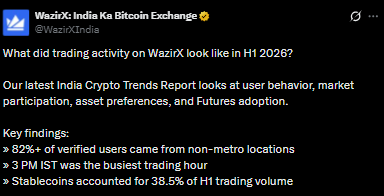
Sources : WazirX post
More than four out of five verified users now come from smaller towns rather than big metros, and the average investor isn't a young speculator but a working professional in their mid-30s.
That tracks with what's happening more broadly across India: better internet, UPI, and rising financial awareness are pulling crypto adoption well past the usual metro hubs.
Behavior is changing too, and arguably in a healthier direction. Deposits stayed ahead of withdrawals for the entire first half of the year, even through volatile stretches, and withdrawal activity kept trending down.
People seem to be treating crypto more like something to hold than something to react to every time the market swings.
Portfolios reflect that same shift: users have been spreading money beyond Bitcoin into AI tokens, gaming, DeFi, Layer-2s, and real-world assets, while BTC, ETH, and stablecoins still anchor most holdings.
WazirX has also been building out trust infrastructure alongside all this. It rolled out a transparency initiative called Guardians of Trust and brought in Fireblocks to strengthen custody.
What Wirex and WazirX Together Reveal About Crypto's Future
For anyone following crypto news today, these two developments highlight where the industry is heading, from stablecoin infrastructure to changing investor behavior.
The other is showing what that adoption looks like once it reaches actual traders, more futures activity, steadier deposit habits, broader portfolios.
Neither story makes sense fully on its own, but together they offer one of the clearest pictures of stablecoin banking trends in 2026.
From infrastructure providers like Wirex to trading platforms like WazirX, the industry is steadily moving toward broader stablecoin adoption.
WazirX, for its part, is still rebuilding user trust after a rough patch. So take this as an update on where things stand, not a signal to act on.
Disclaimer: This article is for educational and informational purposes only and should not be considered financial or investment advice. Always conduct your own research before making investment decisions.


2 months ago
After experiencing issues related to a cryptocurrency and online investment scam, I sought professional assistance. The team responded promptly, explained the recovery process clearly, and maintained consistent communication throughout. WhatsApp: +1 (343) 947-3496 support@mightyhackarrecovery.com https : // mightyhackarrecovery . com /news-articles/ While every case is different and no recovery can be guaranteed, I appreciated their professionalism, transparency, and responsiveness during the process. If you're considering seeking help after becoming the victim of an online scam, be sure to do your own research and carefully evaluate any recovery service before making a decision. It's also important to be aware of well-known investment and cryptocurrency schemes that have been associated with fraud allegations, regulatory enforcement, or Ponzi-style operations. Examples include: BitConnect, OneCoin, MMM, MMM Global, Zeek Rewards, TelexFree, AdSurfDaily, WCM777, Fortune Hi-Tech Marketing, Yilishen Tianxi Group, Ezubao, Fanya Metal Exchange, Mirror Trading International, Africrypt, BTC Global, Menzgold, Gold Coast Fund Management, DKM Diamond Microfinance, MBA Forex, Chinmark Group, Agridime, CryptoFX, HyperFund, HyperVerse, Mining Max, PlusToken, GainBitcoin, SpeakAsia, Saradha Group, Rose Valley Group, PACL Limited (Pearls Agrotech Corporation Limited), Stock Guru India, I Monetary Advisory (IMA), Heera Gold, Royal Twinkle Star Club, City Limouzines, Stock Generation, USI Tech, Juicy Fields, Arbistar, AIDA Marketing, Mining City, OmegaPro, CashFX Group, GSPartners, NovaTech FX, Torque Trading, Banners Broker, Traffic Monsoon, My Big Coin, BitClub Network, Coin.mx, AirBit Club, Meta 1 Coin, Profit Connect Wealth Services, Fortress Real Developments, London Capital & Finance, Blackmore Bond, Basset & Gold, Ethical Forestry, Harlequin Property, Axiom Legal Financing Fund, Brite Advisors, Trio Capital, Storm Financial, Westpoint Corporation, Banksia Securities, Bridgecorp, Ross Asset Management, Blue Chip Group, Hanover Finance, Dominion Finance, Crown Forex, Forex Trend, Panteon Finance, Finiko, Mutual Benefits Corporation, Equity Funding Corporation of America, Towers Financial Corporation, National Heritage Life Insurance Company, Reed Slatkin Investment Club, DBSI Inc., Petters Company Inc., Petters Group Worldwide, Agape World Inc., International Loan Network, Rex Venture Group, Secure Investment, SwissCash, Dunamis Online, Karatbars International, iComTech, Trade Coin Club, WealthBoss, Crypto888 Club, and Beurax. Always verify whether an investment opportunity is registered with the appropriate financial regulator, be cautious of promises of guaranteed or unusually high returns, and remember that legitimate investments carry risk and do not require recruiting others or making rushed decisions.








