Tether Freezes USDT Iran: $131M Frozen in 4 TRON Wallets
 Yash Shelke
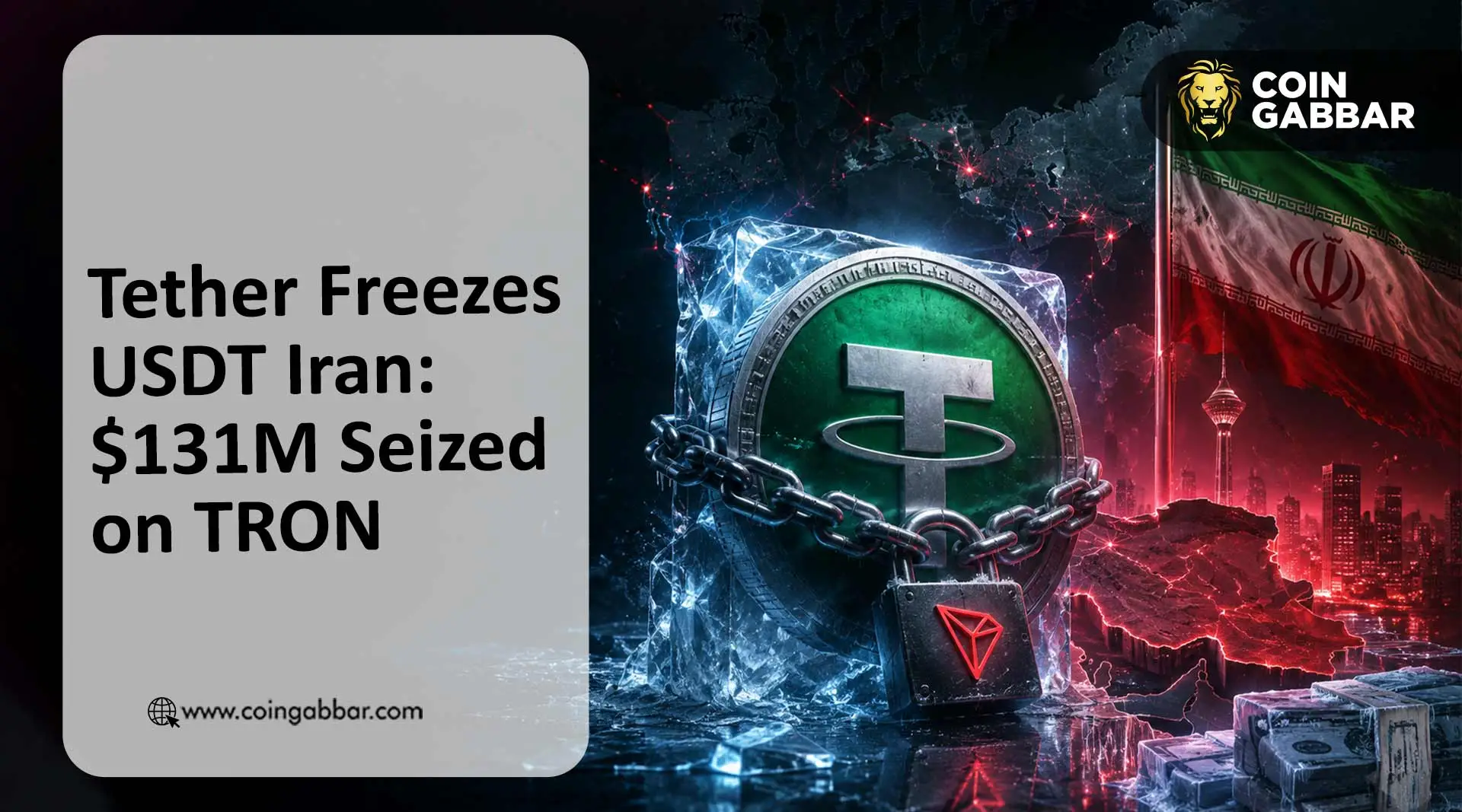
How Tether Freezes USDT Iran Funds Across Four TRON Wallets
Tether just activated its freeze capability against Iran-linked funds for the second major time in three months.
On-chain analyst Specter identified four TRON wallet addresses holding approximately $131 million in USDT that Tether has frozen — and the action has since been confirmed by US Treasury Secretary Scott Bessent. Both the Islamic Revolutionary Guard Corps (IRGC) and Iran's central bank are under OFAC sanctions. The wallets are directly tied to both. On-chain data shows most of the funds were withdrawn from DTC Pay and Bitso before the freeze was applied.
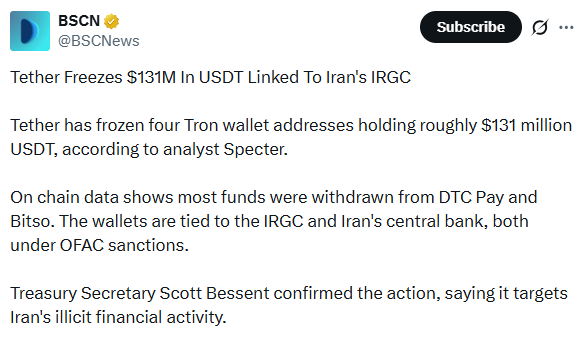 Source: X(formerly Twitter)
The action lands as the US military renewed strikes on Iran and the ceasefire that held briefly through June collapsed. This is not a standalone crypto enforcement event. It is part of a coordinated financial and military pressure campaign running simultaneously.
What Tether Froze and Who Confirmed It
The mechanism behind the Tether freezes USDT Iran action is specific and worth understanding clearly.
Blockchain investigator Specter pointed to on-chain data showing Tether froze four TRON wallets holding $131 million in USDT. Bessent confirmed on X that the wallets were tied to the Central Bank of Iran. "US Treasury is committed to disrupting and degrading Iran's illicit financial activities, including its abuse of digital assets," Bessent said. "We will continue to aggressively follow the money and deny the Iranian regime access to the proceeds of its illicit revenue schemes."
TRON has become the dominant rail for Iran-linked stablecoin activity — and the reason is simple. TRON transactions are fast, cheap, and deeply liquid in USDT. The same combination of speed and liquidity that drew legitimate users to TRON has drawn money launderers and sanctions evaders. The IRGC exploited that infrastructure.
The freeze itself works at the smart contract level. When OFAC designates a wallet address, Tether can blacklist it within its USDT contract — making the tokens permanently immovable from that address. No private key compromise is required. No court order is needed in real time. The stablecoin issuer activates a code-level restriction and the funds freeze instantly.
IRGC-associated addresses received more than $3 billion in on-chain funds in 2025, up from over $2 billion in 2024, according to Chainalysis. The Iranian rial has depreciated roughly 90% since 2018. Iran has long turned to cryptocurrency to ease economic pressure imposed by the United States and its allies — mostly through mining and stablecoin channels.
The on-chain data confirms the withdrawal path: funds moved through DTC Pay and Bitso — both legitimate crypto service providers — before reaching the four TRON addresses that Tether subsequently froze. That routing through mainstream platforms is a documented IRGC pattern, confirmed by multiple blockchain analytics firms.
The Bigger Iran Freeze Pattern Behind This Action
The $131 million action is the latest escalation in a documented campaign that has now frozen more than $475 million in Iran-linked USDT in 2026 alone.
In April 2026, Tether confirmed it had frozen more than $344 million at the request of US authorities. One Tron address held roughly $213 million and the other held about $131 million. Both were blacklisted at the smart contract level, making the tokens completely immovable.
In May, Bessent said the US had seized around $1 billion in Iranian crypto assets as part of a US financial pressure campaign against Iran known as Operation Economic Fury, which launched in March 2025.
The pattern is consistent. Iran's central bank has been trying to mask cross-border activity through the use of digital assets. The effort aims to stabilize the rial and keep trade flowing under sanctions. US authorities said government analysts, working with blockchain analytics firms, observed material links to the Iranian regime — including confirmed transactions with Iranian exchanges and flows routed through intermediary addresses interacting with Central Bank of Iran wallets.
This follows a series of escalations. In June 2026, Treasury leveled sweeping counter-terrorism sanctions against Nobitex, Iran's largest digital currency exchange, for processing hundreds of millions in stablecoins on behalf of the IRGC. Earlier, Tether and Circle blacklisted a hot wallet belonging to Iranian exchange Wallex.
Tether has now frozen $4.2 billion in USDT across more than 5,000 wallets linked to criminal activity and assisted the DOJ in seizing over $6 million connected to a Southeast Asian fraud scheme. The $131 million action confirms the frequency and scale of Tether's cooperation with US enforcement is accelerating — not slowing down.
The geopolitical context compounds the significance. The freeze arrived as the US announced a renewed blockade of Iranian ports and the US military's Central Command announced a new wave of strikes on Iran. Meanwhile, Iran's military claimed it carried out drone strikes against US military facilities at Jordan's Al Azraq Air Base. The financial and military pressure campaigns are running in parallel — not sequentially.
What the $131M Freeze Means for USDT Holders and Crypto
Three implications flow from the Tether freezes USDT Iran action for the broader crypto market.
For USDT holders — net neutral. This action does not affect any USDT held outside the four designated TRON addresses. The freeze is surgical — four specific wallets, specific OFAC designations, confirmed on-chain. Daniel Tannebaum, a senior fellow at the Atlantic Council, called the freeze "meaningful" but noted Iran has spent decades adapting to economic pressure. No redemption risk. No peg impact. Tether's reserves are unaffected.
For stablecoin legitimacy — net positive. Every successful OFAC cooperation action Tether completes strengthens the argument that USDT functions as a compliant financial instrument rather than an ungoverned one. For institutional investors evaluating stablecoin exposure, a stablecoin issuer that can rapidly freeze sanctioned addresses is a more credible counterparty than one that cannot.
For decentralisation advocates — the Monero contrast. The limits of centralised enforcement are visible in the numbers. Of the 134 addresses in the related ISIS-K action, 131 were on TRON and only three on Monero. Only the TRON balances were actually frozen. The three Monero wallets were blacklisted symbolically — because Monero has no corporate issuer and no centralised freeze capability. The designation is legally meaningful but operationally empty for privacy coins.
That split tells the entire story of crypto enforcement in 2026: centralised stablecoins can be frozen instantly; decentralised, privacy-preserving assets cannot. Regulators and exchanges are aware of this asymmetry, and the pressure on privacy coin listings at compliant exchanges is likely to increase as a direct result.
All data in this article is sourced from confirmed on-chain data, US Treasury Secretary Scott Bessent's public X post, and Chainalysis's published analysis. No guaranteed policy or price outcomes provided.
Conclusion
Tether freezes USDT Iran actions have now immobilised over $475 million in 2026 under Operation Economic Fury — and the $131 million action this week confirms the campaign is accelerating. Four TRON wallets. IRGC and Central Bank of Iran designations. Treasury Secretary Bessent confirmed. Funds routed through DTC Pay and Bitso before the freeze. No impact on USDT holders outside the designated addresses. For the broader market: stablecoin compliance just got its clearest stress test yet — and USDT passed.
YMYL Disclaimer
This article is for informational and educational purposes only. It does not constitute financial, legal, or investment advice. All details regarding the Tether USDT freeze, OFAC designations, and Operation Economic Fury are based on publicly available reporting, the confirmed X post from US Treasury Secretary Scott Bessent, and Chainalysis's published blockchain analytics as cited. The $131 million freeze affects only the four designated TRON wallet addresses — it has no impact on regular USDT holders or Tether's reserves. No guaranteed policy, legal, or price outcomes are provided. Always conduct independent research before making any financial decision.