UK Crypto Lending Tax Rules Give UK Lenders a Tax Deferral


UK Crypto Lenders Get New Tax Deferral From HMRC
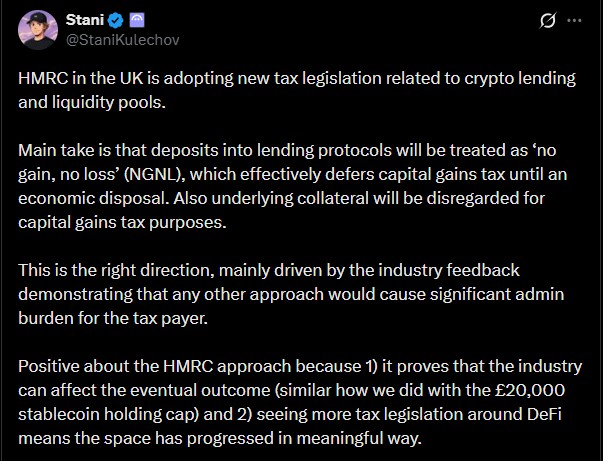
On July 13, 2026, HM Revenue & Customs (HMRC) introduced new UK crypto lending tax rules for crypto asset and liquidity pools. Under these rules, certain transactions involving these arrangements will now be treated as "no gain, no loss" (NGNL).
This simply means the transaction won't trigger an immediate liability bill or allow a liability loss claim at that stage. Instead, any capital gains tax is postponed until the token is actually sold or otherwise disposed of in an economic sense. This comes as the UK has been ramping up crypto tax enforcement more broadly, including new exchange reporting rules that started in January 2026.
Source: X Post
What's in the New Rules
policy paper covers three types of arrangements:
Single asset Lending Arrangements: Acquiring or disposing of an interest in one of these, for the same type of asset, is treated on a no-gain, no-loss basis. If you are investing in crypto, it is useful to understand how lending arrangements differ from a taxable disposal under the new rules.
Single Crypto asset Borrowing Arrangements: Borrowed assets count as acquired at market value, and any collateral put up is simply disregarded for capital gains tax purposes.
Automated Market Making Arrangements: This is the technical name for liquidity pools run through smart contracts. Deposits and withdrawals of the same quantity of asset are treated as no gain, no loss here too. Tax only kicks in if there's a difference between what went in and what came out.
Why This Matters
The measure amends the Taxation of Chargeable Gains Act 1992 and takes effect from April 6, 2027. HM Revenue & Customs says it's responding to stakeholder feedback: the earlier tax treatment, laid out in 2022 guidance was creating disproportionate admin burdens for people using lending protocols and liquidity pools. Basically, taxpayers were spending too much effort tracking gains and losses on transactions that weren't real economic events yet.
Who Does This Affect Most?
HMRC ran its own research back in 2021, and it found some groups are far more likely to hold asset and, therefore, more likely to feel this change.
Group | Share of UK Owners | Share of UK Adult Population |
Aged 16-44 | 76% | 46% |
Men | 69% | 51% |
Asian or Asian British background | 11% | 5% |
HMRC doesn't hold data on other protected characteristics, so it can't say whether other groups are affected.
Separately, HMRC doesn't expect any significant macroeconomic impact from this. Businesses and civil society organizations shouldn't feel it either, and there are no direct operational costs for HMRC in rolling the change out.
Official Details
Published by: HM Revenue & Customs (HMRC)
Publication date: July 13, 2026
Effective date: April 6, 2027
Law amended: Taxation of Chargeable Gains Act 1992
Who is affected: Individuals and trustees using asset loans and liquidity pools
Estimated people affected: About 700,000 individuals
According to HMRC, these rules didn't come out of nowhere. There was a call for evidence from July to August 2022, followed by a consultation from April to June 2023 and a summary of responses at Budget 2025. These steps form part of the UK's wider crypto regulation roadmap for digital assets.
Disclaimer
This article is for educational and informational purposes only and should not be considered financial or investment advice. Always conduct your own research before making investment decisions.
Also read:









