UK Crypto Regulations 2027: FCA Sets Final Deadline for Exchanges


UK Crypto Regulations 2027: FCA Deadline for Exchanges and Stablecoins
Every crypto exchange, custodian, and stablecoin issuer in the UK now has a hard authorization deadline staring them down. For traders and investors, this single regulatory shift could decide which platforms survive and which quietly disappear from the UK market.
So what exactly do firms need to prove before that deadline hits — and why did the FCA just soften one of its toughest capital rules?
What happened with UK crypto regulations
The Financial Conduct Authority has finalized its long-awaited crypto rulebook, locking in prudential, market abuse, and stablecoin requirements for firms operating in the UK. The framework was published as a set of final policy statements covering capital, market abuse, and stablecoin rules for cryptoasset firms.
The new regime does not arrive overnight. Exchanges, custodians, stablecoin issuers, and staking firms must secure authorization before the rules formally take effect on October 25, 2027.
Coverage is broad. The rules touch crypto trading platforms, dealing and arranging businesses, custodians, stablecoin issuers, lending and borrowing providers, staking firms, and certain decentralized finance projects that have an identifiable controlling entity.
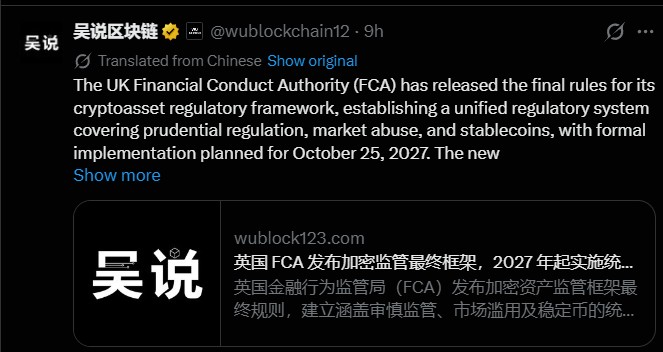
Source: Wu Blockchain
Why Deadline? For What?
The October 25, 2027, deadline marks when the FCA's full crypto regime officially takes effect. Before that date, every exchange, custodian, stablecoin issuer, lending and staking firm operating in the UK must apply for and secure FCA authorization. Existing Money Laundering Regulations registrations won't carry over automatically — firms need fresh approval to legally keep operating after the deadline hits.
Why does this matter for traders and investors?
If you're trading on a UK-linked platform, this changes how that platform must behave behind the scenes. UK qualifying trading platforms will now need to run due diligence, meet listing standards, and publish disclosure documents for assets before those assets can be traded. A previous loophole that let some tokens skip this disclosure step has been closed.
Market abuse protections are also getting sharper teeth. The new rules target insider trading and manipulation, while letting larger trading platforms keep an industry-led monitoring approach with narrower on-chain surveillance obligations.
Key details: capital, stablecoins, and deadlines
For stablecoin issuers specifically, the requirements now cover how reserves are backed, how customer funds are safeguarded, and how redemptions and disclosures must work. Issuers also no longer have to forecast redemptions for backing assets, can use limited intragroup custody under safeguards, and may hold up to 5% in excess reserve assets.
One of the biggest wins for the industry came on capital requirements. The FCA cut the K-SII capital coefficient tied to stablecoin issuance down to 1% from the previously proposed 2%.
Trading platforms also got a simplified capital structure. Cryptoassets admitted to UK platforms will now face a single 40% net risk position requirement alongside a 40% counterparty default volatility adjustment, replacing what was originally a two-tier classification system.

Source: Martini Guy X
What to watch next
Mark these windows now. Firms can submit authorization applications between September 30, 2026, and February 28, 2027, with the FCA also running pre-application support sessions starting in July.
Don't assume an existing license carries over. Current Money Laundering Regulations registrations will not automatically convert, meaning every firm in scope must apply fresh under the new framework. Until the regime fully kicks in, FCA oversight stays limited to financial promotions and anti-money laundering checks.
How the framework builds on earlier UK crypto law
This isn't a standalone rulebook. The framework builds directly on cryptoasset legislation the UK passed back in February 2026, extending that earlier groundwork into a full authorization regime rather than introducing rules from scratch.
That continuity matters for firms already tracking policy. It signals the FCA is refining and tightening an existing direction rather than reversing course, which gives compliance teams a more predictable target to build toward.
Industry and analyst reaction so far
Early reaction from crypto-market commentators has framed the announcement as one of the most significant regulatory developments of the year so far, with attention centered on the new capital, custody, and market abuse standards rather than any immediate price impact.
The recurring theme in that reaction: clearer rules don't promise higher token prices, but they do lower the barrier for larger institutions to enter the market. For traders watching liquidity and volume trends, that institutional-access angle may end up mattering more than the headline deadline itself.
Conclusion
After UK PM Keir Starmer resigned, FCA final framework gives crypto firms a clear runway — but a tight one — toward October 2027. With capital rules eased and authorization windows now locked in, the next 18 months will separate platforms that adapt from those that exit the market entirely.
Disclaimer: This article is for informational purposes only and does not constitute financial, investment, or legal advice. Cryptocurrency markets are volatile, and regulatory frameworks may change. Readers should conduct their own research or consult a licensed professional before making investment decisions.
Also read:
2 months ago
Mighty Hacker Recovery offers professional services in cybersecurity and digital recovery for individuals and businesses. Their services include data recovery, digital forensics, cybersecurity consulting, malware detection, and incident response. They promise experienced, confidential, and fast support while following ethical practices. Clients can contact them via their website https://mightyhackarrecovery.com/ or WhatSapp Canada +1 (343) 947-3496 for assistance. Additionally, the text poses various questions related to crypto recovery, including inquiries about stolen cryptocurrency, recovery experts, and their effectiveness. BITCOIN RECOVERY EXPERT AT MIGHTY HACKER RECOVERY USDT RECOVERY EXPERT AT MIGHTY HACKER RECOVERY ETH RECOVERY EXPERT AT MIGHTY HACKER RECOVERY CRYPTOCURRENCY FRAUD RECOVERY HACKER FOR HIRE AT MIGHTY HACKER RECOVERY WhatSapp Canada +1 (343) 947-3496








