Bitcoin Mining ETF WGMI Shifts 80% Assets to AI Power Firms

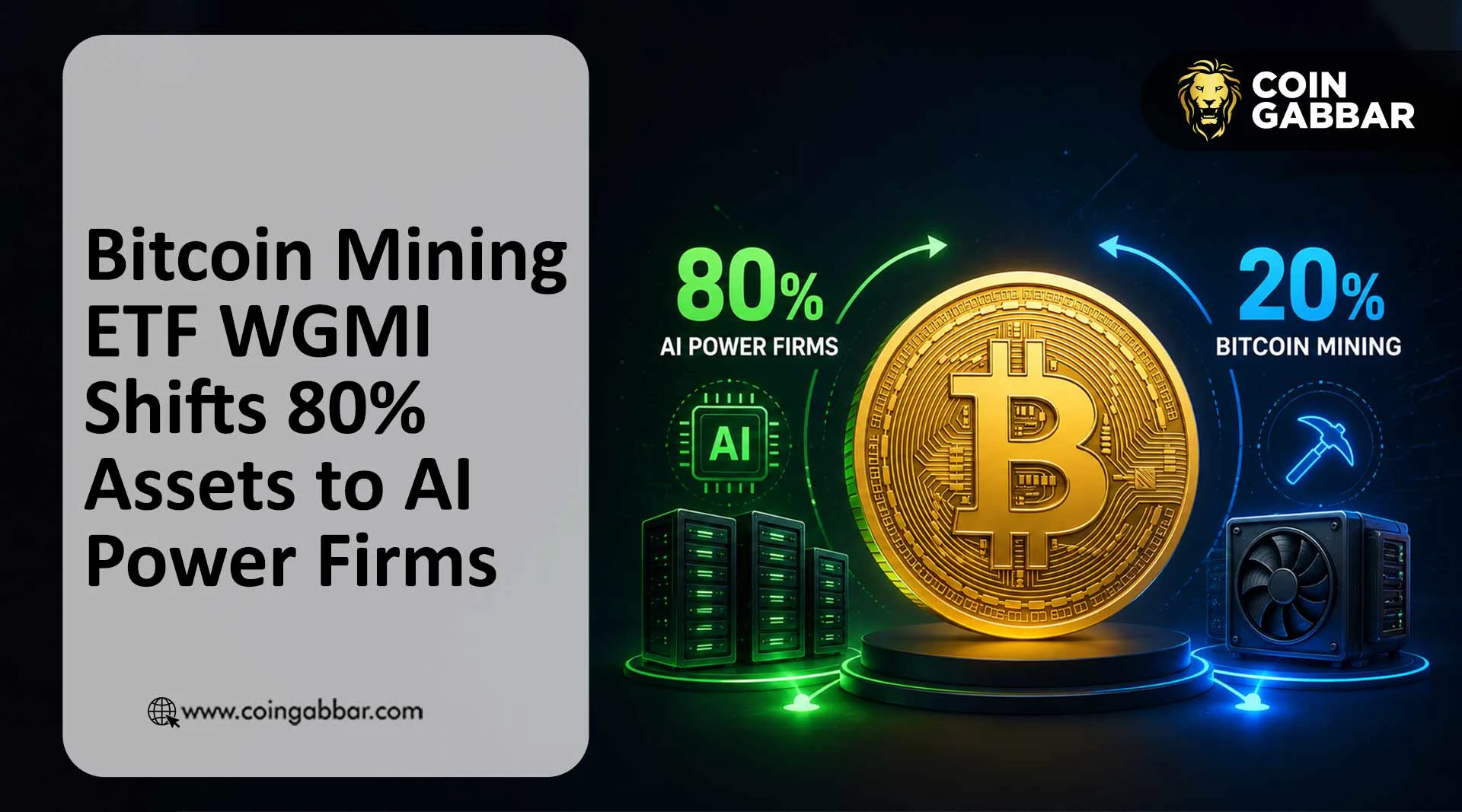
Bitcoin Mining ETF WGMI Shifts 80% of Assets to Digital Power
In Crypto news today, Bitcoin Mining companies are no longer just betting on block rewards.
CoinShares, the European digital asset manager behind the Bitcoin Mining ETF (WGMI), confirmed that the fund has redrawn its investment strategy to reflect a structural shift already underway across the mining industry, according to the company's own research note published on August 18, 2026, and its official announcement on X.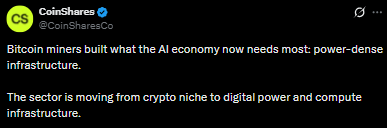
Under the revised strategy, WGMI now allocates at least 80% of its net assets to digital power companies, a category that has expanded well beyond traditional mining firms.
The scope now touches AI hyperscale data centers, semiconductors, power infrastructure and energy storage, high-performance computing (HPC), and quantum computing, as detailed in CoinShares' research and data insights page.
The remaining 20% may still go toward companies with broader or digital infrastructure exposure.
What the WGMI ETF Now Invests In
The eligible universe for the Bitcoin Mining ETF new investment strategy 2026 covers four broad categories.
| Category | What It Covers |
| Hyperscale data centers | Facilities built to support AI and other large-scale compute workloads |
| Semiconductors and components | Design, manufacture, or supply of hardware for data centers and AI applications |
| Power infrastructure and energy storage | Generation, grid equipment, and storage systems that keep data centers running |
| HPC and quantum computing | Technologies supporting AI workloads beyond conventional computing |
This is a deliberate rewrite of the fund's rulebook, not a minor tweak. It mirrors what CoinShares calls a shift from mining as a crypto niche to mining as one application inside a larger digital power and compute infrastructure theme.
Why Mining Firms Are Moving Into AI
The Bitcoin Mining industry AI transition of July 2026 did not happen overnight.
Mining companies spent years building large, power-dense facilities with secured grid connections, the exact assets that AI hosting firms now need and cannot build quickly.
CoinShares' research note on the mining-AI convergence points to several already-signed deals:
-
Core Scientific signed 12-year hosting agreements with CoreWeave worth $10.2 billion in total contract value.
-
IREN secured a five-year , $9.7 billion AI cloud contract with Microsoft.
-
TeraWulf has announced more than $12 billion in long-term HPC hosting contracts.
-
Hut 8 signed a 15-year lease reported at $9.8 billion for its Beacon Point campus.
These Bitcoin mining companies' HPC semiconductor deals show that AI hosting revenue is no longer a side experiment.
At TeraWulf, HPC leasing income overtook mining revenue for the first time in the first quarter of 2026, per the same CoinShares report.
The $70 Billion Figure Behind the Strategy Shift
CoinShares stated that , as of July 2026, cumulative AI and HPC contracts announced by publicly listed mining companies have crossed $70 billion.
WuBlockchain also reported that CoinShares cited the same $70 billion figure, highlighting the growing shift of mining companies toward AI and high-performance computing infrastructure.
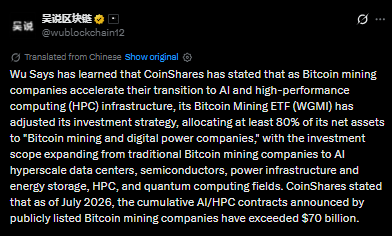
Source: Wublockchain Official X Post
That number, confirmed in CoinShares' official update shared on X, is the direct trigger behind the WGMI ETF Bitcoin Mining digital power allocation change.
For a sector whose combined annual mining revenue is far smaller than that figure, the scale of contracted AI business explains why CoinShares chose to redefine what counts as a mining company.
The latest crypto news also reflects a wider energy story as Mining stocks expand into AI infrastructure.
AI data centers want the same power but are priced for reliability rather than flexibility. Companies that control scalable power capacity can now serve both markets, along with grid demand-response programs, at once.
Analysts tracking the crypto mining ETF space note that this repositioning changes the risk profile of mining stocks.
Miners remain exposed to bitcoin price swings, but AI hosting adds customer concentration risk and multi-year construction commitments.
Even so, the Bitcoin miners AI shift gives the sector a broader, less bitcoin-dependent revenue base than it had two years ago, positioning WGMI's updated mandate as a bet on digital power infrastructure rather than bitcoin alone. More detail on the fund's product structure is available on CoinShares' corporate site.
Disclaimer: This article is for informational purposes only and is not financial or investment advice. Readers should do their own research and consult a qualified financial advisor before making investment decisions.






