
MemeToro ($MT) Presale
MemeToro Presale 2026: MT Price, Tokenomics and Risks
Reviewed: October 16, 2026. Data note: Price and Stage 8 funding figures below come from the dated snapshot described in the supplied draft. They were not independently reproduced in this review. The official page returned zero-value dashboard placeholders; these do not establish a zero price or zero funds raised.
Update in the supplied draft: Stage 8 funding rose by $4,272.20 between October 6 and October 16. The draft also describes a testnet funding trial announced on October 16. Its announcement, deployment and schedule still need direct source confirmation. A testnet trial does not establish a completed production launch.
The MemeToro presale offers MT, a token on BNB Smart Chain tied to a planned AI memecoin launchpad. The supplied October 16 snapshot records Stage 8 at $0.00528 per MT. This review explains the sale figures, token allocation, product plans and gaps buyers should check before taking part.
MemeToro Presale: Price, Stage and Sale Details
These figures reproduce the dated dashboard snapshot described in the supplied draft. They are not a live feed or independent confirmation of money received. The sale's final closing date has not been verified.
| Detail | Reported information |
|---|---|
| Project / Token | MemeToro / MT |
| Blockchain | BNB Smart Chain (BEP-20) |
| Sale status on October 16 | Stage 8 displayed as active |
| Stage 8 price | $0.00528 per MT |
| Amount raised in Stage 8 | $163,467.81 (project dashboard snapshot) |
| Stage 8 target | $176,896.90 |
| Total supply | 1,200,000,000 MT |
| Public sale allocation | 852,000,000 MT (71%) |
| Advertised future launch price | $0.05186 (project projection, not an exchange price) |
| Payment options shown | Card and cryptocurrency; guide mentions BNB, ETH and USDT |
| Presale closing date | Not independently confirmed |
| Exchange listing date | Not confirmed |
The displayed fundraising target concerns Stage 8. It must not be presented as the target for the whole sale. Check the purchase interface for a working quote and current terms before relying on this snapshot.
MT Price and Funding: Reading the Stage 8 Snapshot
The supplied draft records $159,195.61 for Stage 8. Its October 16 snapshot records $163,467.81, an increase of $4,272.20 across those two dated snapshots. The amount has not been reconciled with independently verified blockchain transactions. Readers should not interpret it as an audited funding total.
The $0.00528 rate is the observed Stage 8 presale quote. A separate tokenomics calculator has displayed a $0.0040 reference, which should not be mistaken for the purchase price. Likewise, the advertised $0.05186 future launch price is a project target and not evidence of future trading value. Investors comparing crypto presale projects should distinguish quoted token prices, stage targets, and confirmed exchange prices.
MT Tokenomics: Supply, Allocation and Vesting Terms
MemeToro reports 1.2 billion MT in total supply. The following distribution is based on the project's published tokenomics. It adds up to 100%, but these allocation amounts alone do not prove that funds or tokens are locked.
| Allocation | Share | MT tokens |
|---|---|---|
| Public sale | 71% | 852,000,000 |
| CEX reserves | 10% | 120,000,000 |
| Marketing partners | 7.56% | 90,720,000 |
| MemeToro trading | 5% | 60,000,000 |
| MT rewards | 4.44% | 53,280,000 |
| Team | 2% | 24,000,000 |
| Total | 100% | 1,200,000,000 |
The supplied draft describes 24-month vesting for marketing and partnership allocations and no vesting for presale purchases. These terms need a current document reference. The official homepage says purchased tokens are sent to the wallet straight away, while the draft also mentions claiming at launch. Confirm the applicable delivery rules, transfer restrictions and any claim fees before paying.
October Testnet Trial: Reported Terms and Open Checks
According to the supplied draft, the team announced on October 16 a mock funding round using BNB Smart Chain testnet. The exercise is intended to test contributions, withdrawals, funding locks and launch rules with free test BNB (tBNB). It is separate from the real-money MT token presale.
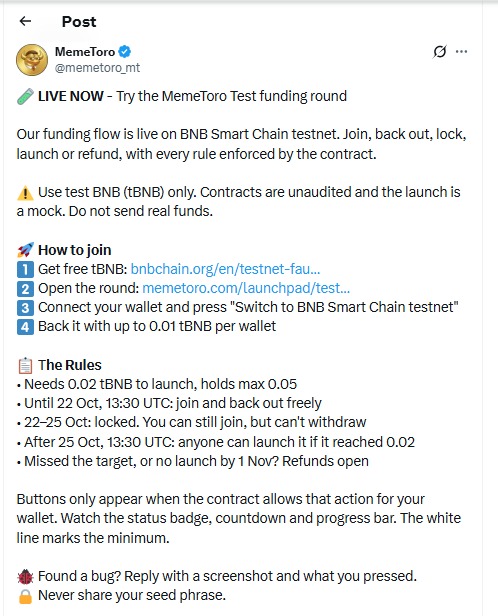
| Testnet condition | Announced terms |
|---|---|
| Network | BNB Smart Chain testnet |
| Test payment | tBNB, without real monetary value |
| Maximum per wallet | 0.01 tBNB |
| Minimum launch target | 0.02 tBNB |
| Funding cap | 0.05 tBNB |
| Open funding | Until October 22, 2026, 13:30 UTC |
| Locked funding period | October 22–25, 2026 |
| Launch trigger | After October 25, 13:30 UTC, if minimum target is met |
| Refund provision | November 1, 2026, if launch conditions are unmet |
These are the test conditions recorded in the supplied draft, not proof that each step has successfully executed on-chain. The official website states that launch contracts have not yet been independently audited. No real BNB should be sent to a testnet round. The trial does not establish that the mainnet platform is operational or secure.
How the Planned AI Memecoin Launchpad Would Work
The planned launchpad uses an AI agent to review news and social trends, suggest memecoin ideas and propose funding terms. Readers exploring similar early-stage projects can compare AI crypto presales listed by CoinGabbar. Project documents describe public rules for accepting contributions and deciding whether a proposed launch can go ahead. These features are intended uses, not proof of a complete production service.
The public MemeToro GitHub repository contains documents, AI-agent work and a funding escrow prototype with tests. The reported October trial needs a direct announcement link and deployment address before it can serve as verified delivery evidence. However, an independently checked testnet deployment, audited launch contracts and a fully working mainnet launch flow were not established in this review.
Token Contract Address and Audit Coverage to Check
The project publishes the MT token contract address 0x44412181b7eb66bff974c0a9a9e908e5bba8cfff on BNB Smart Chain. Check the full address against official records before interacting with a token or approval request.
MemeToro names Coinsult, BlockSAFU and SolidProof in its token audit claims. These claims should be assessed against the actual auditor-hosted reports and the precise contract version reviewed. The MT token contract, presale purchase contract, staking system and launchpad funding contracts may be different pieces of software. Check which deployed address, code version and software component each report covers.
Security scope: The official site names three token auditors but states that launch contracts have not yet been independently audited. This review did not validate auditor-hosted reports, deployed code or reward payouts. A token audit cannot establish that a separate staking or funding contract is safe.
MT Staking: Advertised APY, Utility and Withdrawal Rules
The project advertises staking rewards of up to 35% APY, alongside proposed MT uses for access, launch activity and community rewards. The APY is an advertised annual yield, not a guaranteed return. This review did not independently test reward payouts, withdrawals, staking contract security or the source of reward funding.
Users should confirm lock periods, fees, early withdrawal rules and the relevant contract before staking. Advertised use cases should be judged against features already working for real users, rather than assumed demand for the token.
How to Review Payment, Wallet and Token Delivery Terms
Before joining the MemeToro presale, read our crypto presale investing guide to understand token delivery, vesting, liquidity and wallet checks.
- Open the official domain directly and confirm the spelling.
- Use a compatible wallet and check the payment network.
- Match the token address with the project's official records.
- Review the purchase amount, approvals, fees and delivery conditions.
- Never share a wallet seed phrase or private key.
- Keep a transaction record and verify any later claim instructions independently.
Is MemeToro Legit? Evidence and Unresolved Questions
MemeToro provides tokenomics, a contract address and public development material. The supplied draft also describes an October 2026 trial. These facts make some of its claims easier to examine, but do not establish that investing is safe or that the platform will be completed.
Important unknowns include independently verified audit findings for each relevant contract, confirmed team identities, complete token claim terms, working mainnet launchpad features and an announced exchange listing. Readers should evaluate these gaps without treating them as automatic proof of fraud or as reasons to trust promotional return claims.
Main Presale Risks: Product Delivery, Liquidity and Claims
This early-stage token sale carries both market and execution risk. Key issues include the unfinished production platform, unaudited test launch contracts, uncertain token delivery timing, variable staking returns and incomplete independent verification of sale funds.
- A testnet funding round is not the same as a successful mainnet product launch.
- Stage-specific raised amounts must not be presented as whole-presale fundraising totals.
- Reported audit badges do not establish that every contract is reviewed.
- Projected launch prices do not guarantee trading prices or profits.
- Early tokens can lose most or all of their value.
For context, CoinGabbar also tracks meme coin presale listings. Compare project evidence, vesting and delivery progress rather than treating short-term price targets as a measure of quality.
Presale Glossary: Testnet, Vesting, APY and Escrow
The terms below clarify common sale and development language used in this review.
- Presale: A token sale held before wider trading availability.
- BEP-20: A token standard used on BNB Smart Chain.
- Testnet: A network for testing software without using real-value network assets.
- Escrow: A contract designed to hold and release assets under set conditions.
- Vesting: A schedule controlling when allocated tokens can become available.
- APY: An annual yield measure that includes compounding assumptions.
- TGE: Token generation event; it may differ from claim or listing dates.
Disclaimer
This article is for information and education only, not financial, investment, legal or tax advice. Crypto presales involve market, smart contract, custody and delivery risks, including total loss. Prices, funding figures and schedules may change. Verify all terms and contracts before taking any action, and never share your private keys.



2 months ago
Hi






