Ethereum News: FTX ETH Transfer, Whale Buys and Vitalik 5-Year Roadmap


Ethereum News Today: FTX/Alameda ETH Sale Risk and Vitalik New Roadmap
Ethereum saw a wave of large wallet activity on September 23, 2026, as a major legacy liquidation wallet moved tens of millions of dollars in ETH while a separate whale address expanded its holdings further.
Alongside these market moves, Ethereum co-founder Vitalik Buterin used his opening speech at 2026 Shanghai Blockchain Week to outline where the network's technology is headed over the next five years. Together, these developments offer a snapshot of both short-term trading behavior and Ethereum's longer-term roadmap.
At a Glance
-
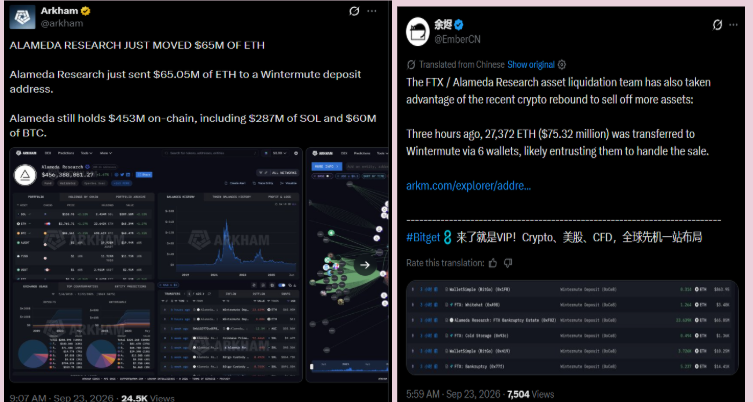
FTX/Alameda transfer: 27,372 coins (~$75.32M) sent to Wintermute via six wallets, likely for sale
-
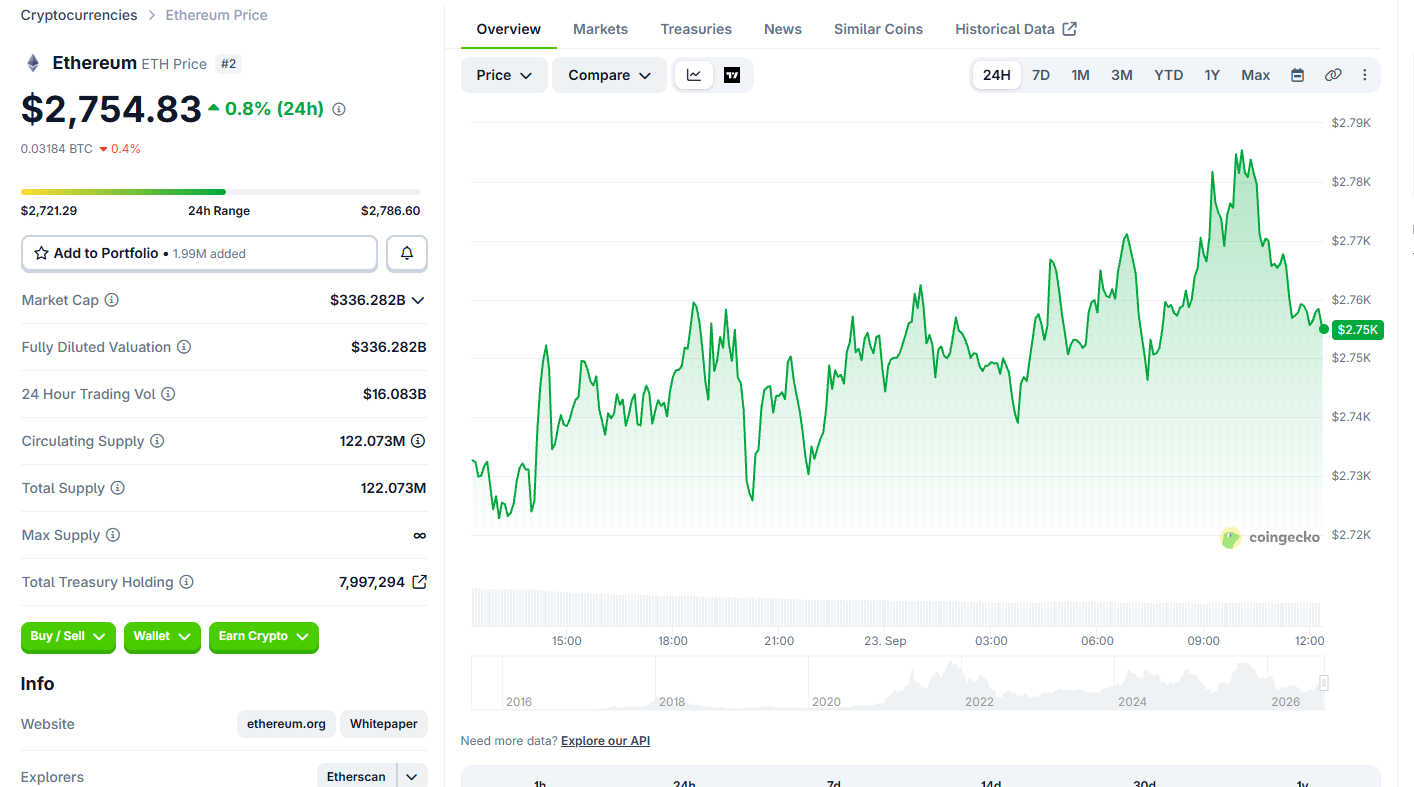
Whale purchase today: 15,000 coins bought at ~$2,751, worth ~$41.26M
-
Prior accumulation: 37,000 coins bought two months ago via Galaxy Digital OTC at ~$1,923 average
-
Total whale holdings: 52,000 coins (~$143M), average cost ~$2,161
-
Unrealized profit: Approximately $31.1M based on current pricing
-
Vitalik's roadmap: Ethereum targets 8-32 second finality within five years, down from ~16 minutes today
FTX/Alameda Moves 27,372 ETH to Wintermute for Potential Sale
According to on-chain tracking service Ember Monitoring, wallets tied to the FTX and Alameda Research asset liquidation effort transferred 27,372 tokens, worth roughly $75.32 million, to market maker Wintermute. The transfer moved through six separate wallets over a span of about three hours.
Ember Monitoring noted that this pattern of activity is typically associated with entrusting assets for sale rather than a simple internal transfer. Separate tracking from Arkham Intelligence put the transferred amount closer to $65 million and noted that the liquidation estate still holds an additional $453 million in assets on-chain, including sizable SOL and BTC positions.
The exact dollar figure differs slightly between trackers due to timing and price snapshots, but both confirm the same underlying movement of ETH toward a market maker often used to execute large sell orders in tranches.
Source: EmberCN Data and Arkham
Ethereum Whale Buys 15,000 ETH Worth $41.26 Million
In a separate development, an address identified by both Ember Monitoring and Lookonchain purchased 15,000 ETH for approximately $41.26 million at a price near $2,751 per token.
This is the same wallet that reportedly accumulated 37,000 ETH roughly two months earlier through Galaxy Digital's over-the-counter desk at an average price of about $1,923. Lookonchain's data also referenced a smaller add-on purchase of 4,500 ETH for about $12.38 million, suggesting the buyer has been accumulating in stages rather than a single transaction.

Source: EmberCN
Ethereum Whale Holdings and Unrealized Profit at a Glance
With today's purchase included, the wallet now holds a total of 52,000 ETH, valued at approximately $143 million. Its blended average cost sits around $2,161 per ETH, which, based on current market pricing, puts the position at an unrealized profit of roughly $31.1 million.
It is worth noting this figure reflects paper gains tied to current prices and is not a realized or guaranteed return, since on-chain data cannot confirm whether or when the holder intends to sell.
Why the 52,000 ETH Whale Purchase Matters
The pattern here, OTC accumulation followed by continued spot buying weeks later, is often read by on-chain analysts as a sign of longer-term conviction rather than short-term trading.
However, it remains an interpretation based on wallet behavior rather than a confirmed strategy, and market watchers should treat it as one data point among many rather than a directional signal on its own.
Vitalik Buterin Reveals Ethereum's 5-Year Technology Roadmap
Speaking at 2026 Shanghai Blockchain Week, Vitalik Buterin said cryptographic tools once seen as impractical, including fully homomorphic encryption, obfuscation techniques, and indistinguishability obfuscation, are advancing faster than expected.
He described a shift in blockchain's core function, moving from primarily settling "who can send what assets" toward systems that can programmatically govern "who can see what information."

Source: Wu Blockchain
Ethereum Targets 8-32 Second Finality Within Five Years
Buterin said Ethereum aims to shrink final transaction confirmation time from around 16 minutes today down to a range of 8 to 32 seconds within five years.
He linked this goal to a broader shift toward completing more computation in parallel, earlier in the transaction lifecycle, across user devices, the mempool, and block construction.
FOCIL Could Strengthen Ethereum Transaction Censorship Resistance
As an example of near-term progress, Buterin pointed to FOCIL (EIP-7805), a proposal under which 16 validators would jointly submit a list of transactions for inclusion.
The design is intended to reduce the ability of any single block builder to delay or exclude specific transactions, a step toward stronger censorship resistance at the protocol level.
Source: CoinGecko Data
What These Ethereum Moves Mean for Traders and Investors
Taken together, these Ethereum developments show two very different signals moving in parallel: a legacy estate preparing to potentially sell a sizable ETH position, and a separate large holder continuing to accumulate.
Neither movement by itself confirms a market direction, and the underlying technology roadmap points toward multi-year infrastructure goals rather than immediate price catalysts. Readers should treat all on-chain figures as directional estimates rather than confirmed trading intentions.
Disclaimer: This article is for informational purposes only and does not constitute financial, investment, or trading advice. Cryptocurrency markets are highly volatile, and readers should conduct their own research and consult a licensed financial advisor before making investment decisions.