Global Money Supply News: $103T Liquidity Surge Sets a New Record


Global Money Supply News: Why Is $103T Liquidity Surging So Fast?
Here's a striking piece of global money supply news that's got investors paying close attention.
The combined M2 money supply of the world's four biggest banks has just climbed to an all-time high of $103.66 trillion, after adding roughly $1 trillion in a single month.
For anyone tracking crypto news today, this kind of liquidity data matters because more money circulating through the financial system has historically tended to find its way into assets like stocks, gold, and Bitcoin.
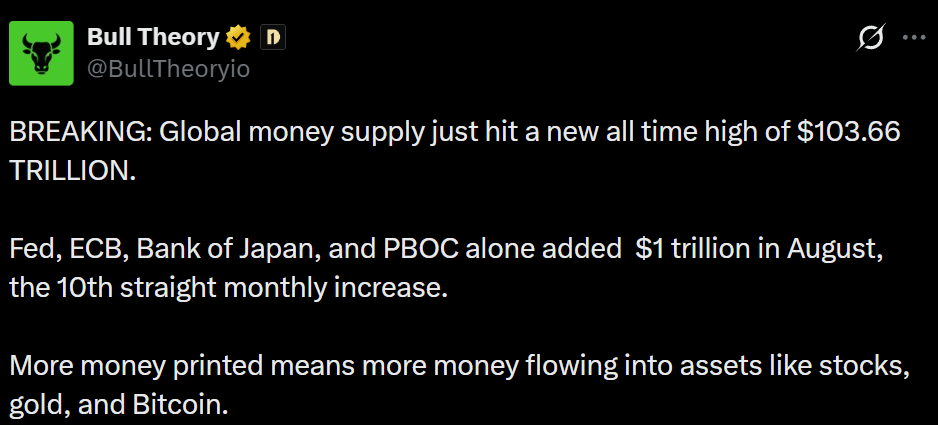
Source: X Post
The Numbers Behind This Record
According to MacroMicro's tracked data series, which combines M2 figures from the Federal Reserve, the European Central Bank, the Bank of Japan, and the People's Bank of China, global money supply reached $103.66 trillion in August.
A few key details behind this milestone:
-
The four central banks combined added roughly $1 trillion in August alone
-
This marks the 10th consecutive month of increases
-
M2 money supply covers cash, checking deposits, savings deposits, and other liquid, easily spendable funds
-
MacroMicro's comparison chart tracks all four central banks side by side to build this combined global figure
What M2 Actually Measures
It's worth understanding what this number actually represents before diving into why it matters.
M2 is considered a "broad" measure of money supply, meaning it goes beyond just physical cash and includes savings accounts, time deposits, and money that's still highly liquid but not sitting directly in a checking account.
When this figure climbs, it generally signals that central banks have been expanding the amount of money available within their economies, whether through monetary policy decisions, interest rate changes, or other mechanisms that increase liquidity.
Why 10 Straight Months of Growth Matters
A single monthly increase wouldn't be particularly newsworthy on its own, but a sustained ten-month streak is a different story.
This kind of consistent expansion suggests a genuine trend rather than a one-off data blip.
A few reasons this streak is significant:
-
Sustained M2 growth across multiple major economies simultaneously points to a broadly coordinated period of monetary expansion
-
Since 2020, combined M2 across these four central banks has climbed by roughly $36 trillion, averaging more than $5 trillion in growth per year
-
This scale of expansion has real implications for how much purchasing power each unit of currency actually holds over time
The Connection to Asset Prices
This is really the core reason this piece of global money supply news resonates so widely, especially among crypto and stock market watchers.
When central banks expand the money supply, that additional liquidity doesn't just sit idle, historically, a meaningful portion has flowed into financial assets as investors and institutions look for places to put growing cash balances to work.
Stocks, gold, and Bitcoin have all been cited as common destinations for this kind of liquidity, since each offers a way to preserve or grow value in an environment where the purchasing power of cash itself may be eroding.
What Each Central Bank Contributed
While the combined figure captures the overall trend, the four central banks don't move in perfect lockstep.
The Federal Reserve, ECB, Bank of Japan, and PBOC each operate under different domestic conditions, interest rate environments, and policy priorities, meaning the pace of expansion varies by region even as the combined total keeps climbing.
That's part of why tracking this data as an aggregate, rather than looking at any single central bank in isolation, gives a clearer picture of global liquidity conditions as a whole.
Conclusion
This latest reading confirms that global liquidity keeps expanding at a genuinely rapid pace, with the four major central banks now collectively responsible for $103.66 trillion in M2 money supply after ten straight months of growth.
Whether this continued expansion translates into further strength for stocks, gold, and Bitcoin remains to be seen, but the historical relationship between rising money supply and rising asset prices is exactly why this global money supply news is drawing so much attention right now.
Disclaimer
This article is for educational and informational purposes only and should not be considered financial or investment advice. Always conduct your own research before making investment decisions.