Best Crypto Card With No KYC in 2026: What Actually Exists

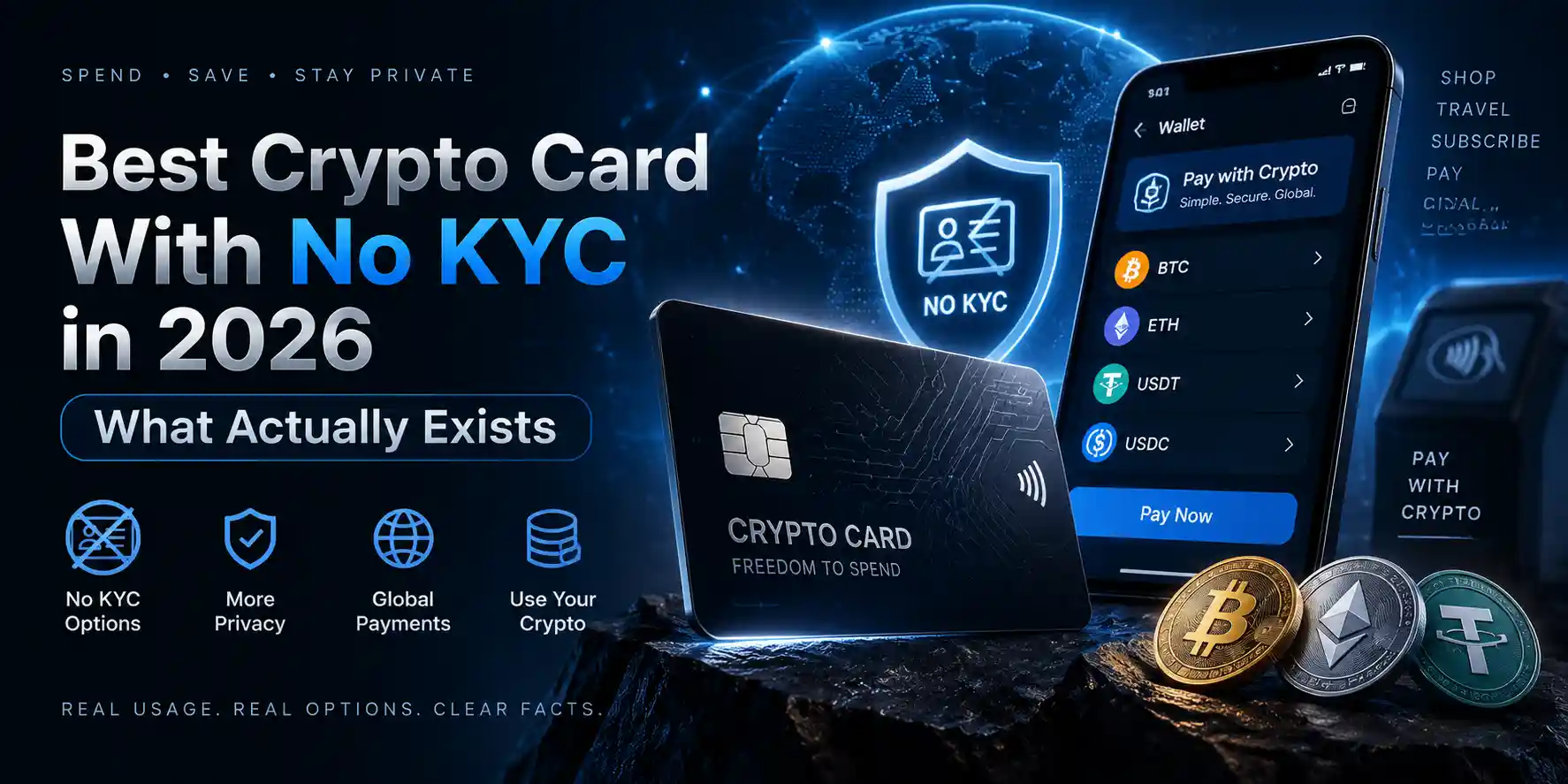
Search "no KYC crypto card" and you get the same five or six names on every listicle, copy-pasted from one affiliate site to the next. Half of them stopped issuing cards months ago. The other half quietly added identity checks after a regulator sent a letter. So what is the best crypto card with no KYC in 2026, actually, once you strip away the recycled lists?
The honest answer is uncomfortable for anyone hoping for a magic bullet: a fully anonymous crypto card that runs on Visa or Mastercard rails does not exist in 2026. It never really did. What exists instead is a spectrum of "low-KYC" or "KYC-light" cards that ask for less upfront - sometimes just an email - but still apply some form of screening once volumes or limits rise. This piece breaks down why that's the case, what low friction actually looks like in practice, and how to evaluate any card claiming to skip verification instead of trusting a headline.
Why "No KYC" Collides With How Card Networks Work
Card issuers don't operate in a vacuum. Every program that puts a Mastercard or Visa logo on a card runs through a licensed issuing bank or e-money institution, and those institutions answer to regulators. In the EU, MiCA and existing AML directives require identity verification from providers offering crypto-linked financial services. The card networks themselves layer their own compliance rules on top of that.
That combination is why a genuinely anonymous crypto card that clears real-world purchases doesn't exist as a legal, durable product in 2026. Cards that market themselves as fully anonymous either operate in a legal gray zone, cap spending so low they're impractical, or get pulled from app stores and payment rails within months. Chasing a truly no-verification crypto debit card no verification setup usually means accepting one of those trade-offs, whether or not the marketing admits it.
None of this means privacy is dead. It means the useful question isn't "which card has zero KYC" but "which card asks for the least friction while staying inside the rules that keep it operating next year too."
So What Is the Best Crypto Card With No KYC in 2026, Really?
Framed properly, what is the best crypto card with no KYC in 2026 usually turns into: which provider verifies the least, charges fairly, and keeps working without sudden shutdowns or frozen balances? That's a different filter than "zero ID ever," and it's the one worth applying.
A handful of names keep coming up in comparisons this year: KAST K Card, Jupiter Global, COCA Visa Card, MetaMask Virtual Card, and Bleap Mastercard are commonly cited as low-KYC options as of mid-2026. SolCard and Bing Card both still advertise a no-KYC entry tier for smaller balances. Some entry-level virtual cards in this category cap annual spending around $25,000 before deeper verification kicks in, which is a meaningful ceiling for casual users but tight for anyone running a business through the card.
Fees tell their own story. One widely cited virtual prepaid Mastercard bought with crypto charges roughly 3% plus $2 to issue, then $2.50 a month after the second month, plus $0.75 on every non-US purchase. That adds up fast for a card marketed as "free of KYC hassle." Coinsbee, registered in Stuttgart and operating under German oversight, is upfront that higher limits require identity verification - which is arguably more honest than options that hide the same requirement behind a support ticket.
| Provider | Entry KYC | Known limitation in 2026 |
| SolCard | No-KYC basic tier | Published fee schedule, lower limits without verification |
| Bing Card | No-KYC entry path | Limits scale with verification level |
| Coinsbee | Email/basic info | ID required past certain spend thresholds |
| CardUpNow | Low friction | $50 activation cost, better value at higher volume |
| Generic prepaid Mastercard (crypto-funded) | Minimal upfront | 3%+$2 issuance, $2.50/month, $0.75 per non-US purchase |
Notice the pattern: every card that markets itself as no-KYC is funded by sending crypto the user already holds, rather than buying crypto directly on the card. That's a workaround, not a loophole - it just shifts the AML burden to whichever exchange or wallet the funds came from originally.
What "Low-KYC" Actually Means in Practice
The phrase "no-KYC crypto card" gets misused constantly, and most providers using it still run some level of identity or AML screening behind the scenes. The real spectrum looks something like this:
-
Email-only onboarding: the card opens with an inbox, no ID upload, but usually caps limits and monitors for suspicious volume.
-
Tiered verification: small balances stay unverified, larger ones trigger a document check - this is the most common model in 2026.
-
Jurisdiction-based screening: the provider is registered somewhere with lighter requirements, but still blocks sanctioned regions and flags unusual activity.
-
Full KYC from day one: standard for regulated issuers in the US, UK, and EU, and increasingly the default even for "privacy-first" brands.
A privacy crypto card in 2026 generally sits somewhere in the first two categories - light enough that everyday spending doesn't feel like a bank application, but transparent that AML compliance still applies once volume grows. That's a meaningfully different promise than "anonymous," and providers that blur the line are usually the ones that disappear first.
A Checklist for Vetting Any "No-KYC" Claim
Before trusting a card that promises no verification, run it through a few practical questions:
-
Is the issuer named, and is it registered somewhere with actual financial oversight?
-
What's the real spending limit before ID kicks in - and is that limit published anywhere, or only discovered after a card gets frozen?
-
What are the total fees: issuance, monthly, top-up, and foreign transaction? Cards that skip KYC often make it up in fee stacking.
-
How long has the card actually been operating? A brand-new low-KYC card carries more shutdown risk than one that's survived a year or two of regulatory attention.
-
What happens to the balance if the provider does add verification later - is it refundable, frozen, or lost?
This checklist matters more than any ranked list, because "best" changes every quarter as issuers adjust policy. Anyone still asking what is the best crypto card with no KYC in 2026 six months from now should re-run this same list rather than trust a cached answer.
Practical Use Cases Most Roundups Skip
Freelancers paid in crypto and digital nomads moving between countries have different needs than someone just spending savings. A crypto card for freelancers usually needs three things: fast reloads across multiple coins, low friction for smaller, frequent top-ups, and a way to get paid without asking every client for a wallet address.
This is where the conversation shifts from "no-KYC" toward "low-friction, privacy-respecting." WaldenPay, for example, doesn't claim to be anonymous - it's upfront that use is subject to AML and regulatory requirements, same as any card on a real network. But it's built around minimizing friction where it can: virtual cards funded with 135+ cryptocurrencies across 35+ networks, issued in minutes, addable to Apple Pay and Google Pay, with top-up fees that start at 5% and step down automatically to as low as 3% based on 30-day card spend, no applications needed.
For freelance invoicing specifically, WaldenPay's Collect Payments feature lets someone create a fixed USD payment request between $1 and $10,000, share it as a link or QR code, and get paid in any of those 135+ crypto currencies without the payer needing an account at all. The creator receives the exact USD amount; the payer covers a small 0.2% conversion fee. Underpayments generate a fresh address for the remainder, and incomplete payments get refunded automatically - details that matter a lot more to a working freelancer than whether a card claims to be untraceable.
Send to Friend covers the other common friction point: paying back a co-founder, splitting a client invoice, or moving funds between two WaldenPay users. It's a zero-fee ledger transfer using just an email address, arrives in seconds, and shows a name preview before anything sends - useful for market vendors and P2P sellers who'd otherwise be juggling wallet addresses mid-transaction. More on how the balance and network side works is in the WaldenPay knowledge base.
Building a Real Framework, Not a Wishlist
Rather than chasing an anonymous crypto card 2026 fantasy, it's more useful to rank cards on four measurable factors: verification threshold, fee transparency, supported coins and networks, and actual uptime over the past year. A card without ID that dies in three months because it skipped AML compliance isn't a win for anyone - it's a frozen balance and a support ticket that never gets answered. Merchant acceptance matters too. A card only useful at a handful of crypto-native shops doesn't do much for someone who wants to spend where 150 million-plus merchants already take cards. That's a bigger practical filter than KYC threshold for most everyday users.
None of this is about maximum secrecy. It's about not handing over more data than necessary, not paying inflated fees for the illusion of anonymity, and picking a provider that will still be operating - and honoring balances - a year from now. That's a more durable definition of what is the best crypto card with no KYC in 2026 than any single name on a recycled list.
So the honest framework looks like this: expect some verification, expect it to scale with spend, and judge a low KYC crypto card on fees, coin support, and track record rather than a marketing headline promising something no card network actually allows.











.jpg)




