India Crypto News: SEBI’s Demat 2.0 Just Changed the Game


India Crypto News: Could Demat 2.0 Make Tokenized Bonds Mainstream?
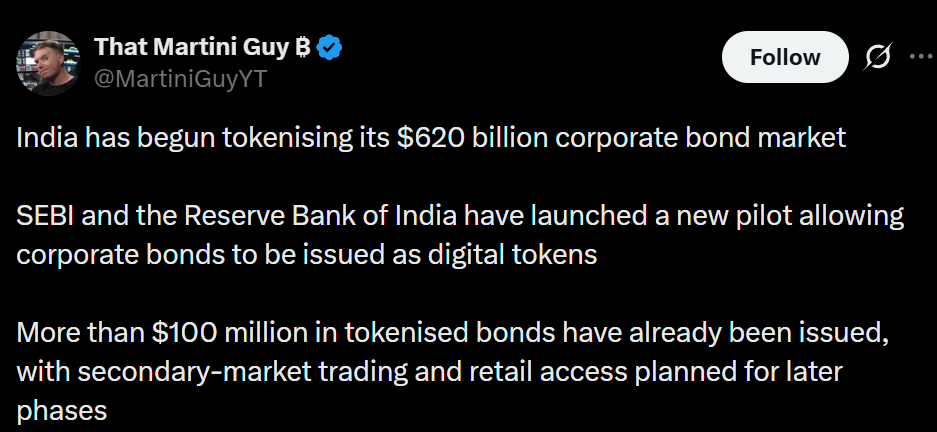
Here's a big piece of India crypto news that's been developing fast. SEBI, working alongside the Reserve Bank of India, has officially launched a pilot called Demat 2.0, testing what happens when corporate bonds are issued as digital tokens on blockchain technology instead of through the country's traditional recordkeeping system.
The pilot went live at the Global Fintech Fest in Mumbai, and in just its first few days, three companies have already raised over $107 million through tokenized bonds.
Source: X Post
What Demat 2.0 Actually Is
According to the official document by SEBI, Demat 2.0 is described as the next step in dematerialization, the process India already uses to hold securities electronically instead of on paper.
The key difference here is that instead of recording bond ownership through a conventional database, the corporate bond itself is issued as a native digital token on a private, permissioned blockchain network owned by the depositories.
As the document puts it plainly, the token is the bond, not a separate representation of it.
Importantly, this doesn't create a new type of security. A tokenized bond keeps the exact same ISIN, coupon rate, maturity date, credit rating, and legal rights as a regular bond.
Only the underlying technology used to track ownership changes.
The First Issuers: Who's Actually Using It
The pilot isn't just theoretical anymore; real money has already moved through it.
Per SEBI's own press release, three issuers have raised a combined ₹1,025 crore, roughly $107.2 million, through tokenized bonds so far:
| Issuer | Amount Raised | Date | Investors |
| REC Ltd. | ₹500 crore (~$52.3M) | September 7, 2026 | 18 |
| Larsen & Toubro | ₹500 crore (~$52.3M) | September 9, 2026 | 4 |
| IIFL Finance | ₹25 crore (~$2.6M) | September 9, 2026 | 1 |
REC was the very first issuer under the pilot, making it the company that effectively kicked off this entire experiment.
How Settlement Works Using Digital Rupee
One of the more technical but genuinely interesting parts of this India crypto news story is how payments actually settle.
The pilot connects tokenized bonds to the RBI's wholesale central bank digital currency, the e-rupee, for the funds side of every transaction.
Bonds and payments settle together through what's called atomic delivery-versus-payment, meaning both the bond transfer and the payment either happen together or not at all.
This removes the usual gap between a trade happening and it actually settling, along with the risk that one side pays without receiving the security in return.
SEBI has also noted this setup could let issuers access proceeds the same day after bidding, compared to the usual two-to-three-day wait under the existing process.
What Investors and Issuers Actually Need to Do
A big concern with any new financial infrastructure is whether it creates extra hassle for the people using it.
Based on the official FAQ, the answer is largely no:
-
Investors don't need a new demat account, just an extension of their existing one, called a Demat 2.0 account
-
No fresh KYC is required ; existing KYC carries over
-
Depositories hold the private keys on investors' behalf, so nobody needs to manage cryptographic keys themselves
-
Issuers continue using the same Electronic Bidding Platform they already use today
-
No new hardware, blockchain infrastructure, or specialized technology investment is needed from either side
The Three-Stage Rollout Plan
This isn't launching all at once. SEBI has laid out a phased approach for how the pilot will expand over time:
| Stage | What Happens |
| Stage I | Tokenized bond issuance through the existing bidding platform, institutional participation only |
| Stage II | With secondary-market trading enabled, retail investors gain access, with an interim peer-to-peer transfer option available before thisstage. |
| Stage III | Possible expansion to credit rating agencies, depository participants, and other regulated entities, plus new instrument types |
Right now, the pilot sits in Stage I, meaning issuance and institutional holding are live, while retail access and open secondary trading are still on the roadmap for later phases.
Conclusion
This round of India crypto news marks a genuinely significant experiment for one of the country's largest financial markets.
SEBI's Demat 2.0 pilot keeps corporate bonds legally unchanged while shifting the technology behind how they're issued, held, and eventually traded, using blockchain and digital rupee settlement under a controlled regulatory sandbox.
With REC, Larsen & Toubro, and IIFL Finance already raising over $107 million between them in the pilot's opening days, and retail access still to come, this could end up shaping how tokenization gets adopted more broadly across India's financial markets in the years ahead.
Disclaimer
This article is for educational and informational purposes only and should not be considered financial or investment advice. Always conduct your own research before making investment decisions.