CLARITY Act News: Final Bill Faces Ethics, Banking and State Concerns


CLARITY Act News: Senate Face 60-Vote Test as Ethics Fight Intensifies
Tuesday marks a pivotal moment for digital asset policy in Washington. The Senate is set to vote on whether to advance the CLARITY Act, the sweeping market structure bill meant to define regulatory jurisdiction over crypto assets.
The procedural vote requires 60 votes to succeed, and the outcome remains uncertain after a chaotic final 24 hours of dealmaking, public letters, and last-minute objections from multiple corners of Washington.
At a Glance
-
The Senate cloture vote on the CLARITY Act Tuesday afternoon, needing at least 60 votes to move forward.
-
Democrats, including Elizabeth Warren, Mark Warner, and Ruben Gallego, say new ethics provisions still contain loopholes.
-
Republicans, led by Senator Cynthia Lummis, argue the administration has already given significant ground and there is nothing more to offer.
-
Treasury Secretary Scott Bessent is backing the final text, while eight banking trade groups say a new deposit "circuit breaker" doesn't go far enough.
-
Eighteen state attorneys general, led by New York's Letitia James, are pushing back over concerns about state enforcement authority.
-
SEC Chairman Paul Atkins says crypto regulatory reform will continue with or without the bill's passage.
CLARITY Act News: What Is Happening Before Tuesday's Senate Vote?
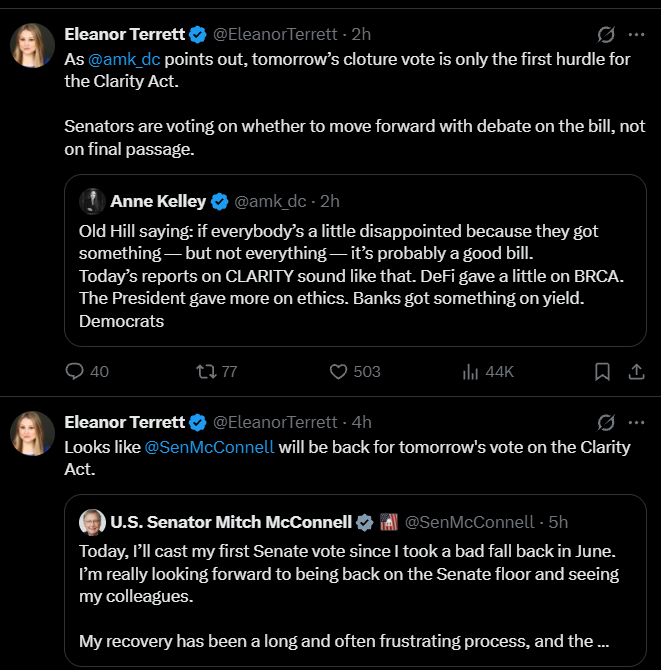
The vote scheduled for 2:15 PM ET Tuesday is a cloture vote, not a final passage vote. Cloture simply determines whether the Senate can proceed to formal debate on the bill.
Reaching that threshold requires support from at least 60 senators, meaning a meaningful number of Democrats would need to join Republicans for the measure to advance.
As one Washington observer put it, everyone walks away a little disappointed, which is often a sign that a compromise has genuinely been reached. Even so, clearing this hurdle would only open the door to further debate, not settle the bill's fate.
Democrats Say New CLARITY Act Ethics Rules Still Fall Short
Senator Elizabeth Warren, the top Democrat on the Senate Banking Committee, plans to speak against the Crypto bill 2026 on the floor. She argues the newly added ethics language, which bars the president and senior officials from issuing digital assets, still leaves major gaps, including limited enforcement power for regulators and no clear coverage of the Trump family's World Liberty Financial venture or its pursuit of banking licenses. Senator Mark Warner has echoed that view, saying the ethics provisions don't go nearly far enough.
Senator Adam Schiff added that the rules likely would not apply to the first family in their current form and contain too many carveouts. Senator Ruben Gallego is reportedly preparing a counterproposal, while Senator Angela Alsobrooks has withheld comment. Warren also intends to seek unanimous consent for a separate measure restricting senior officials and their families from holding banking licenses, though it is unlikely to pass a Republican-controlled chamber.
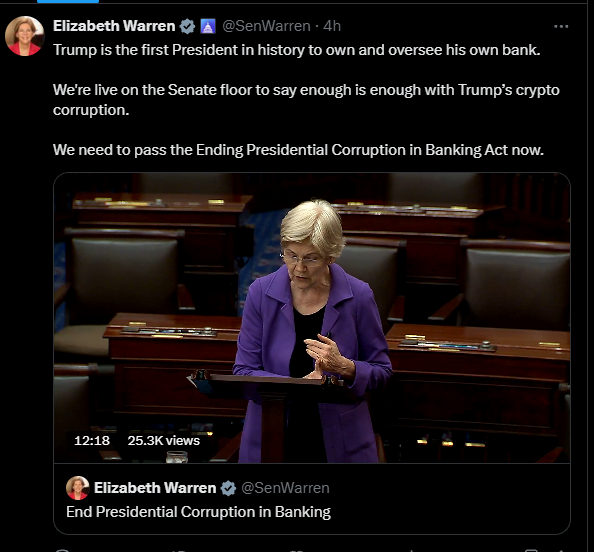
Source: Warren
Republicans Defend CLARITY Act as Lummis Accuses Democrats of Holding It "Hostage"
Senator Cynthia Lummis has pushed back sharply on Democratic objections, arguing that the administration already agreed to two significant ethics concessions that Democrats themselves requested.
Her position, shared by much of the GOP conference, is that further changes are unrealistic this close to the vote and that Democrats are using the ethics debate to stall the broader bill.
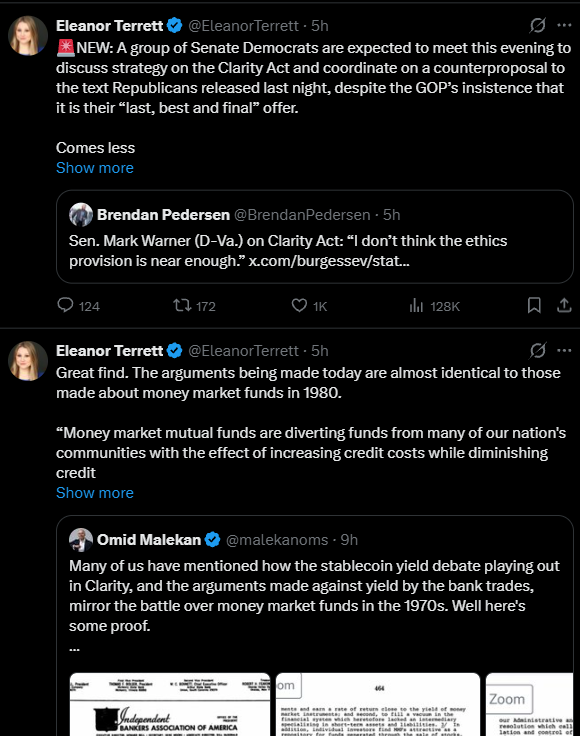
Source: Eleanor X
Scott Bessent Backs Final CLARITY Act Draft Over Stablecoin and Bank Concerns
Treasury Secretary Scott Bessent has voiced strong support for the current text, framing the CLARITY Act as essential to keeping stablecoin and broader crypto infrastructure development inside the United States, much as the GENIUS Act did for stablecoins specifically.
Bessent has highlighted new authority the bill grants Treasury to intervene if stablecoin growth begins to meaningfully pull deposits away from community banks, saying he would use those tools without hesitation if harm materializes.
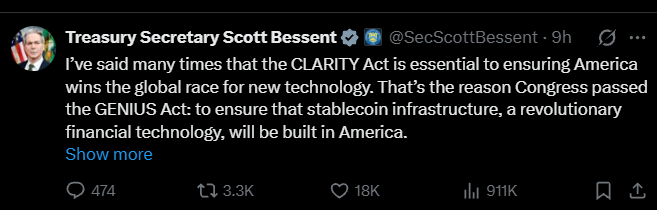
Source: Sec Scott Bessent
Banking Groups Reject CLARITY Act Deposit "Circuit Breaker"
Eight banking trade groups sent a joint letter to Senate leadership arguing that the new deposit-flight safeguard included in the revised text would only activate after substantial deposits had already left community banks, making it reactive rather than preventive.
The groups are also asking lawmakers to tighten language around stablecoin rewards, warning that current wording could still allow issuers to offer interest-like returns indirectly.
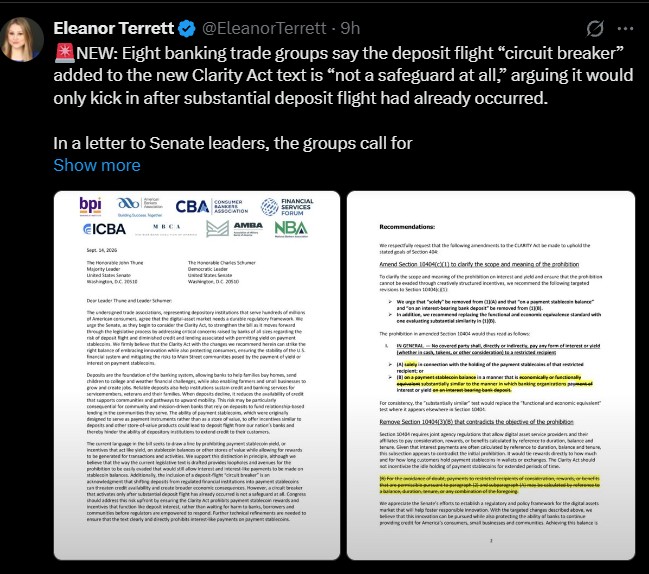
Source: Eleanor Terrett
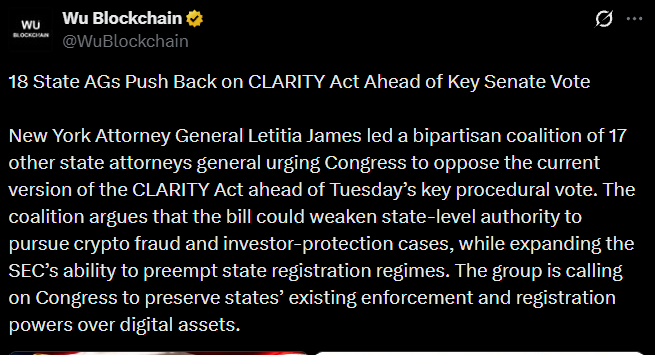
18 State Attorneys General Warn CLARITY Act Could Weaken State Crypto Authority
A bipartisan coalition of eighteen state attorneys general, led by New York's Letitia James, has urged Congress to reject the bill as written. Their central concern is that expanded SEC preemption authority could undercut states' existing power to pursue crypto fraud cases and enforce their own registration regimes, weakening consumer protections at the state level.
Source: Wu Blockchain
SEC Chair Paul Atkins Says Crypto Reform Will Move Ahead With or Without CLARITY Act
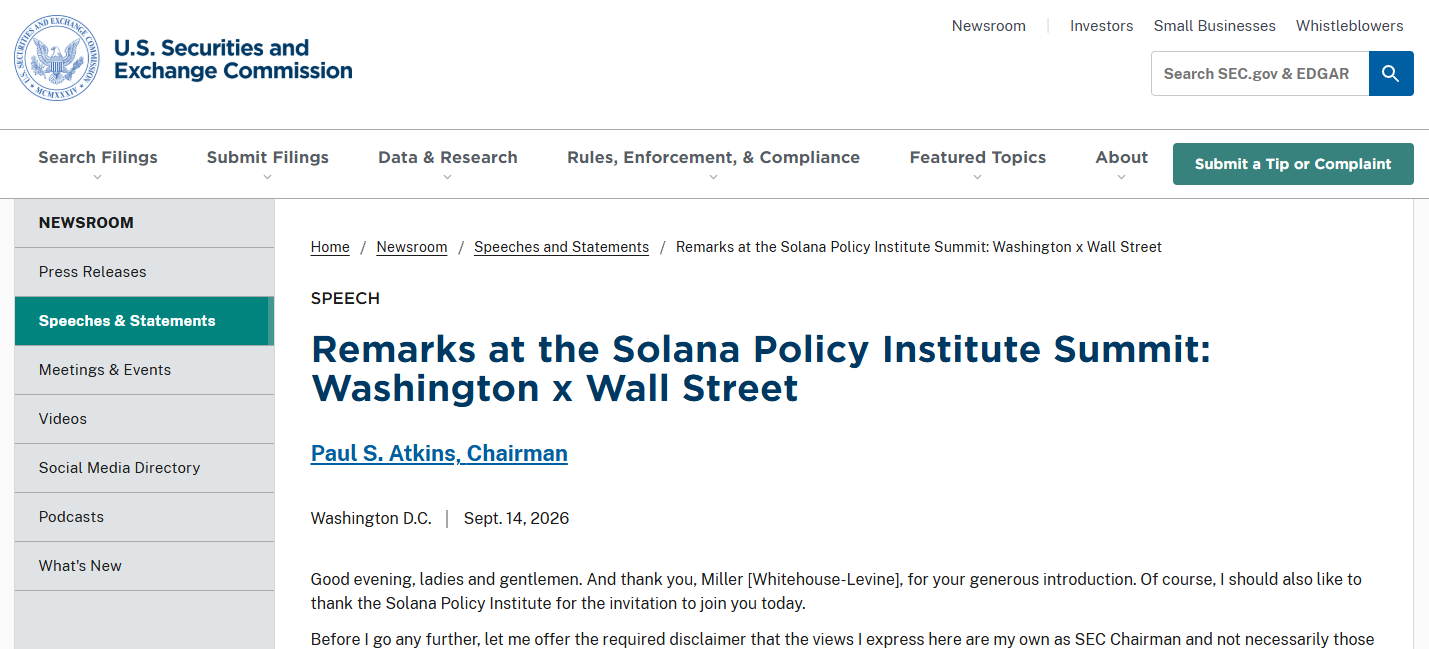
In remarks delivered September 14 at the Solana Policy Institute Summit, SEC Chairman Paul Atkins urged Congress to pass the CLARITY Act quickly, framing it as central to keeping the United States competitive in financial innovation.
He also made clear the SEC will continue advancing its own agenda regardless of the legislative outcome, pointing to three initiatives: a proposed Regulation Crypto Assets framework clarifying when a token offering stops being an investment contract, modernization of decades-old transfer agent rules to accommodate tokenized securities, and a new custody framework that would let investment advisers self-custody crypto assets or rely on state-chartered trust companies under specific conditions.
Source: US SEC Gov Speeches
What Changed in the Latest CLARITY Act Draft?
| Issue | Latest CLARITY Act Position | Main Opposition/Concern |
| Ethics rules | New restrictions on digital-asset activity by the president and senior officials | Democrats say loopholes may leave the first family and certain conduct insufficiently covered |
| State authority | State AGs would get enforcement authority under the revised framework | 18 state AGs warn federal rules could weaken existing state powers |
| Stablecoin deposits | Treasury gets added authority if stablecoins trigger harmful deposit flight | Banking groups say the "circuit breaker" may trigger only after major losses |
| Stablecoin rewards | Revised language addresses reward and yield concerns | Banking groups want stricter limits on interest-like payments |
| Developer protections | BRCA-related protections remain in the framework | Critics say reduced criminal-law protections weaken safeguards |
| Prediction markets | Recent changes affect prediction markets' DeFi exemption status | Tribal gaming groups say changes don't address sovereignty concerns |
| Crypto regulation | Clearer federal framework for regulators | Some worry about federal preemption and scope |
| Senate vote | Cloture needs 60 votes | Passing cloture only advances debate, not final passage |
Source: Eleanor X
CLARITY Act Timeline: From Revised Draft to the Senate Vote
-
September 14, 2026 – Republicans release the latest revised text with expanded ethics provisions.
-
September 14, 2026 – SEC Chair Paul Atkins urges swift passage while confirming the SEC will act independently if needed.
-
September 14-15, 2026 – Treasury Secretary Scott Bessent publicly endorses the final draft and its new deposit-flight authority.
-
September 14-15, 2026 – Eight banking trade groups criticize the circuit breaker mechanism and demand tighter stablecoin rules.
-
September 15, 2026 – Eighteen state attorneys general urge lawmakers to reject the current version.
-
September 15, 2026 – Democratic senators continue pressing for stronger ethics language and weigh counterproposals.
-
September 15, 2026, 2:15 PM ET – Senate cloture vote requiring 60 votes to advance.
-
After cloture – Further debate and amendments become possible; cloture is not final passage.
What Happens If the CLARITY Act Vote Passes or Fails?
If the bill clears the 60-vote threshold, it moves into a formal Senate debate period where further amendments and negotiation remain possible before any final vote. It would not automatically become law. If cloture fails, the bill stalls in its current form, though Chairman Atkins has signaled the SEC intends to keep pursuing crypto rulemaking under its existing authority regardless of the legislative outcome.
Conclusion
The CLARITY Act enters Tuesday's vote with backing from the Trump administration, Treasury, and the SEC, but it still faces resistance from Democrats over ethics loopholes, banking groups over deposit protections, state attorneys general over enforcement authority, and tribal gaming advocates over DeFi carveouts. Whether the bill clears its first major hurdle will depend on how many wavering senators are satisfied that the latest concessions go far enough.
Disclaimer: This article is for informational purposes only and does not constitute financial, legal, or investment advice. Cryptocurrency markets and related legislation are subject to rapid change; readers should conduct their own research and consult a qualified professional before making financial decisions.