Canton Coin Price Prediction: Relief Rally or More Downside?


Weeks of selling have left Canton Coin bruised, and the chart is now flashing the kind of oversold signals that usually get traders' attention.
The question shaping this Canton Coin price prediction is whether bears stay in control, or whether a relief rally is finally near, even as fresh corporate news gives the network a longer-term reason for optimism.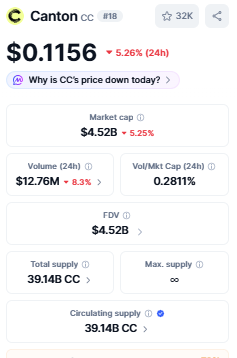
Data Source: coinmarketcap.com
Why Does the Gravitas Sale Matter for Canton Network?
Canton Strategic Holdings just trimmed its business down to a single focus.
The company sold its biotechnology subsidiary, Gravitas Life Sciences, to Gravitas Collective Corp, with the board-approved deal closing on July 17.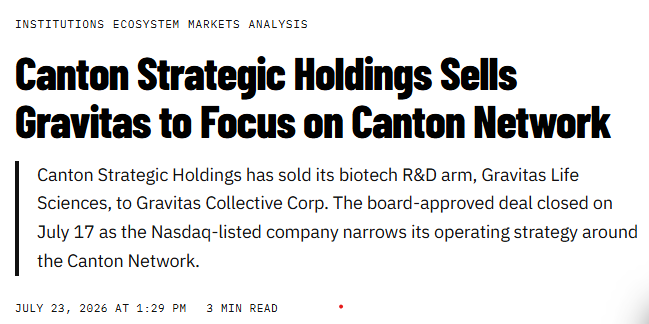
Stripping out a non-core unit like this is a classic corporate move, and in this case it points squarely toward Canton Network.
For investors, the signal is less about the sale price and more about intent.
A company narrowing its focus around institutional blockchain infrastructure suggests management believes that's where the real long-term value sits, not in biotech R&D.
That's a meaningful vote of confidence in Canton Network's roadmap.
What it isn't, though, is a demand catalyst. Selling a subsidiary doesn't put new buyers into the CC order book, and traders chasing this news for a short-term pop are likely to be disappointed.
The more accurate read is that this strengthens the ecosystem's foundation, while the token's price still has to earn its own recovery through market structure and flows.
What Does the Daily Chart Say About Canton Coin's Bigger Picture?
Step back to the daily timeframe and the structural story hasn't changed.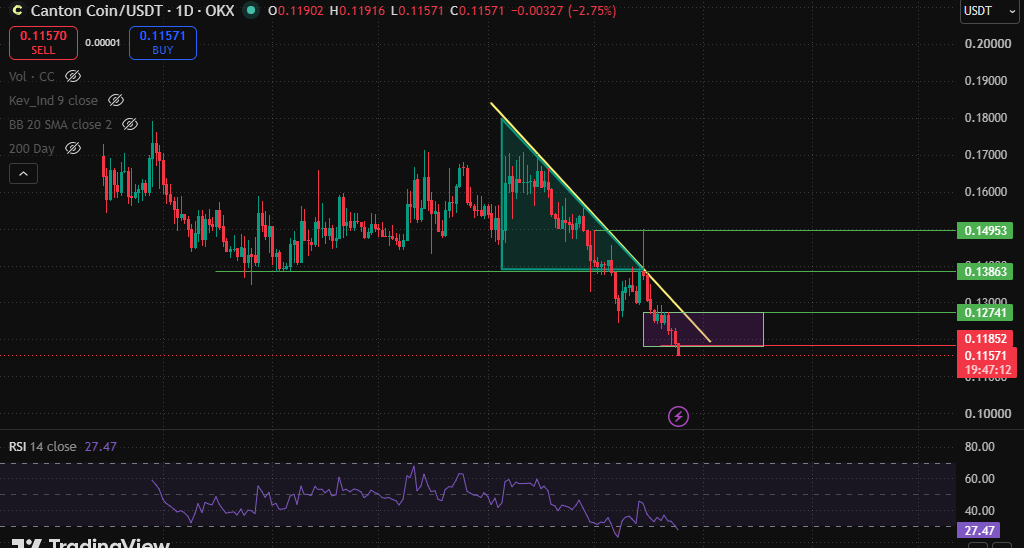
$CC remains locked in a well-defined downtrend, with sellers dictating the broader direction for weeks now.
Price recently pushed through a support level that had previously held, a sign the longer-term bias is still tilted firmly toward the downside.
Overhead, a descending trendline from an earlier chart pattern continues to cap any attempted recovery.
Every rally into that zone has been sold, which tells you buyers haven't yet found the conviction to flip control.
Daily RSI near 27 confirms the stretch, sitting deep in oversold territory, but that reading by itself proves nothing.
Oversold conditions can persist through extended downtrends, and the level that would actually change the long-term picture is a reclaim of resistance, not a bounce in an indicator.
Support on this timeframe sits near $0.115, with resistance stacked at $0.127, $0.138, and $0.149.
How Is Canton Coin Trading on the 4-Hour Chart?
Where the daily chart tells the structural story, the 4-hour chart shows how that story is playing out in real time.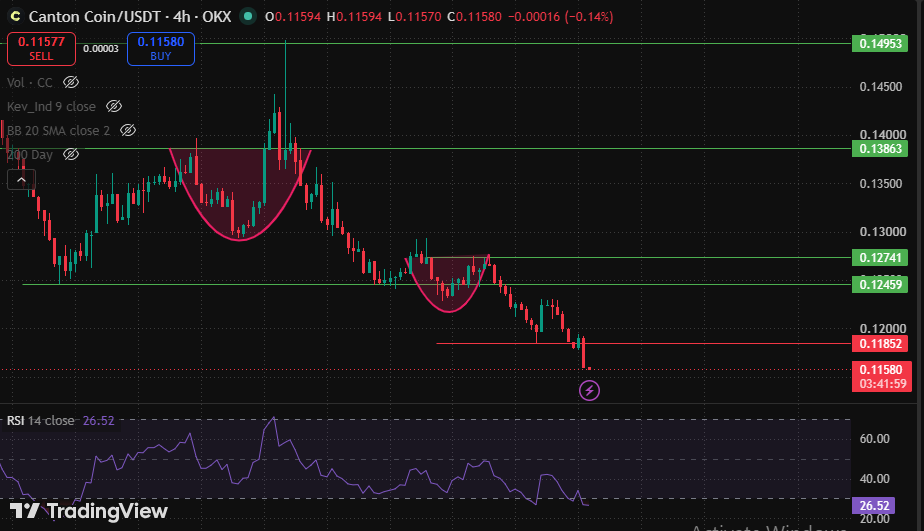
Every bounce over the past sessions has run into selling almost immediately, with buyers unable to hold gains for more than a few candles before momentum fades again.
That pattern of failed recoveries is itself informative. It suggests sellers are still active at the first sign of strength, rather than stepping back and letting price breathe.
Short-term RSI near 26 mirrors the daily reading, and with both timeframes this stretched simultaneously, the odds of a sharp, short-covering style bounce start to increase, even if the broader trend hasn't turned.
Whether that bounce becomes anything more will come down to whether buyers can finally hold ground above resistance instead of fading at the first push.
Data source: TradingView.com
What Are Canton Coin's Derivatives Metrics Signaling?
$CC trades at $0.1156, down 5.26% over 24 hours, on volume of $12.76 million.
Open interest has held steady near $32.4 million even as price fell, which usually means traders are keeping existing positions on rather than rushing for the exits.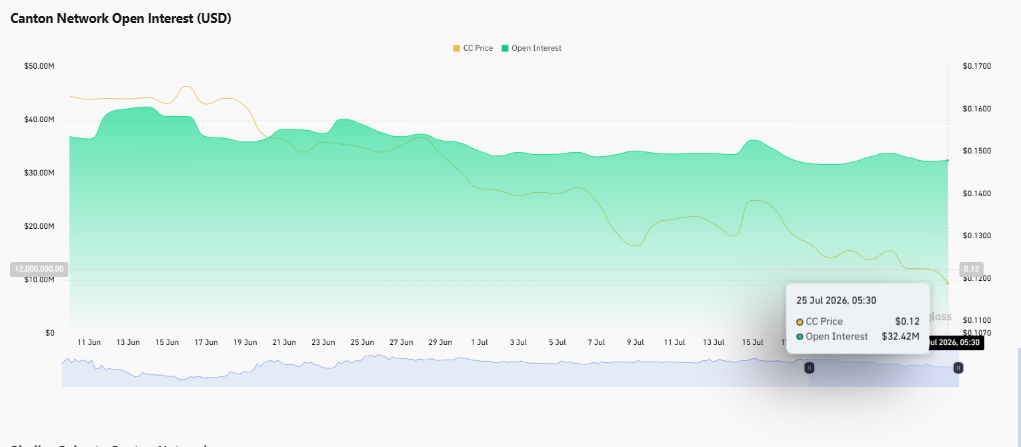
Funding has slipped slightly negative, meaning short sellers are currently paying longs to hold their positions, a mildly bearish tilt.
It hasn't gone deeply negative, though, and that distinction matters. Deeply negative funding tends to show up during panic phases, and this market isn't there yet.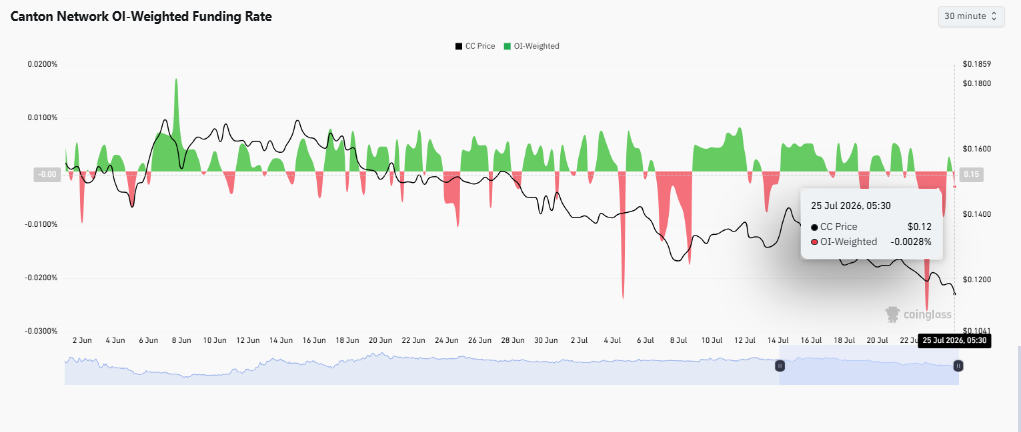
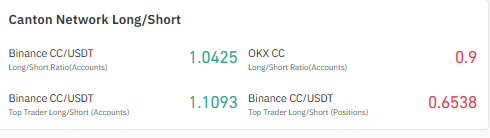
Positioning data backs that up. Binance accounts sit at a long/short ratio of 1.04, top traders at 1.10, and OKX at 0.90, numbers that describe a market without strong conviction in either direction.
Liquidations over the past 24 hours have hit longs far harder than shorts, at $36.4K versus just $515, confirming where the recent pain has landed.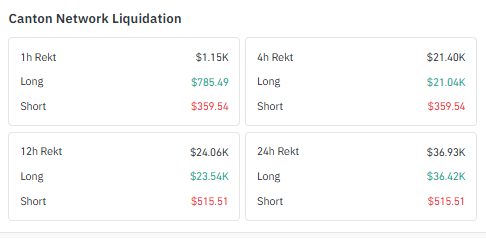 Trading activity remains concentrated on BingX, Binance, Bybit, and OKX, the venues carrying most of Canton Coin's current flow.
Source: Canton price on CoinGlass as of July 25, 2026. Figures may vary slightly across other tracking websites
How Has Canton Coin Performed Across Timeframes?
The damage isn't confined to a single bad day. CC is down 2.25% over four hours and 5.21% over the past 24, but the losses stretch out from there too, with a 9.71% drop over the past week and roughly 23% declines over both the 30-day and 90-day windows.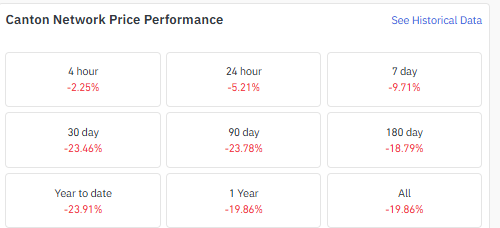 Year to date, the token is down 23.91%.This is a market that has been grinding lower consistently, not one shaken by a single sharp selloff.
What would change that?
A sustained close above the $0.127 resistance zone would be the first real evidence that demand is starting to outweigh supply.
Until that happens, expect the market to keep pricing technical weakness ahead of the longer-term institutional story, no matter how constructive that story looks on paper.
Canton Coin (CC) Price Prediction: What Happens Next?
As per CoinGabbar's analysis, A bullish case only opens up if CC closes above $0.127, with $0.138 and $0.149 as the next levels in play should that resistance give way. Anything short of that close keeps upside moves looking corrective rather than trend-changing.
On the downside, a break below $0.115 would likely send price hunting for the next psychological levels lower.
Given the balanced positioning data and the lack of a confirmed reversal signal, a neutral stance remains the most defensible read until the market picks a direction.
Conclusion
The real story here isn't the price action itself, it's the widening gap between what Canton Network is building and how CC is currently trading.
That gap won't close on sentiment alone. Watch the $0.127 level closely in the sessions ahead, because a decisive close above it is the one signal that would finally tell traders the bears have lost their grip.
Disclaimer: This article is for informational purposes only and should not be considered financial or investment advice. Cryptocurrency markets are highly volatile, and prices can change rapidly. Readers should conduct their own research and consult a qualified financial advisor before making any investment decisions.
Also read: