DoubleZero Price Prediction: Can $2Z Hold Its Kalshi-Driven Rally?


A dormant infrastructure token just woke up overnight, and traders who wrote it off months ago are suddenly scrambling back in. One partnership announcement flipped the chart, and now every DoubleZero price prediction thread wants to know the same thing. Does this rally have real legs, or does it fade just as fast as it came?
Key Takeaways
2Z trades near $0.0596 as of 08:00 UTC, August 14, 2026, up sharply in 24 hours after a Kalshi infrastructure partnership.
The daily chart shows a falling wedge breakout, with RSI climbing back to 54.83.
Resistance sits near $0.0756, support near $0.0473, with a deeper floor at $0.0350.
Top 10 wallets control 51% of supply, and whale-tagged addresses hold over 96%.
Base case DoubleZero price prediction: consolidation between $0.052 and $0.070 over the next few weeks.
A Quiet Infrastructure Token Became the Loudest Chart in Small Caps
A quiet infrastructure token just turned into the loudest chart in the small cap market, and every DoubleZero price prediction thread on social media is asking the same question tonight. Something moved fast here.
Traders who'd written this coin off after months of grinding lower suddenly had to pay attention again. But why now, and does it hold?
We've watched plenty of one-day pumps fade by the weekend. Is this one different, or just another green candle waiting to fold?
Why Is DoubleZero Price Moving Today
Here's the thing: this wasn't random. DoubleZero announced that Kalshi, the prediction market platform, is now streaming its live order book over DoubleZero Edge, a dedicated fiber network built off the public internet. That's a real, verifiable partnership, not a rumor, and it's the primary driver behind the move. You can check the original post directly on X.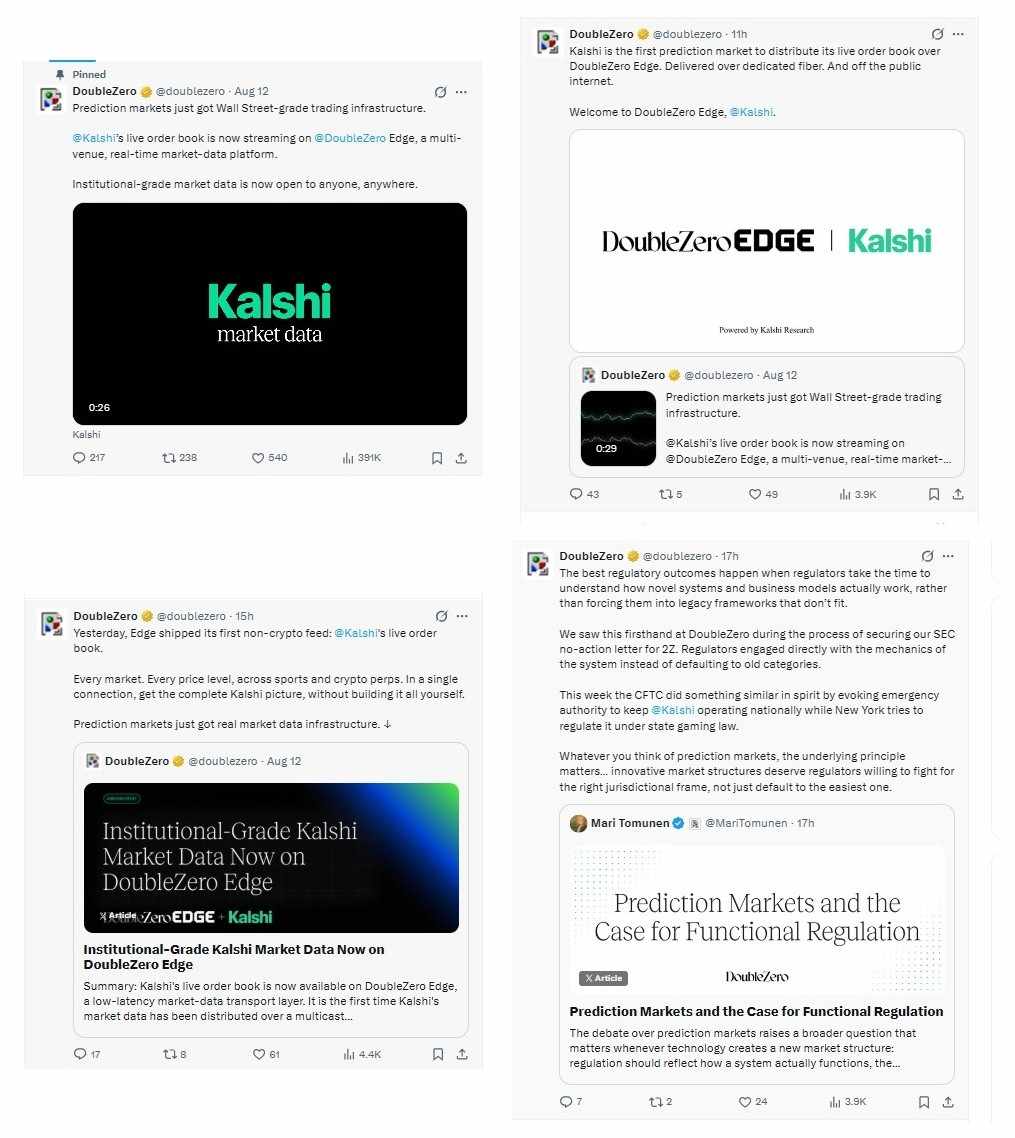
The announcement landed on August 12, 2026, and price reaction followed within hours. Turns out, infrastructure deals with an active, growing platform like Kalshi carry weight because they validate actual network usage, not just speculation.
No clear secondary catalyst showed up alongside it. This looks like coin-specific alpha, not a market-wide move, and that matters for how sustainable it is. For more on how listing news and partnership catalysts move altcoins broadly, this recent crypto news roundup is worth a read.
DoubleZero also published a separate thread on regulatory framing, tying its own SEC no-action letter process to the CFTC's emergency action keeping Kalshi operating nationally. That's a credibility signal for a token still building trust after a rough 2025. If a fresh exchange listing extends this narrative, tracking upcoming venues on the exchange listings page could matter.
Where Is DoubleZero Price Right Now
As of 08:00 UTC on August 14, 2026, $2Z trades around $0.0596, up roughly 24% in 24 hours per CoinMarketCap data. The 24-hour range ran from a low of $0.0473 to a high of $0.0584, and the all-time low was actually set just hours earlier, at $0.0473 on August 13, 2026.
Market cap sits near $207.5M on circulating supply, with a fully diluted valuation of about $597.8M. Volume over 24 hours hit roughly $19.2M. You can verify live numbers on CoinMarketCap directly.
Total supply is capped near 10B tokens, with 3.47B circulating and around 7,000 holders. Liquidation data from CoinGlass shows $71.49K in 24-hour rekt positions, split between $45.15K long and $26.34K short. Anyone tracking a coin event calendar for 2Z should bookmark the upcoming events tracker too.
Whale and Holder Snapshot
Top 10 wallets hold 51.02% of supply, worth roughly $290.83M. Whale-tagged addresses control over 96% of total value, and 97 wallets alone own 95% of everything. That's concentrated.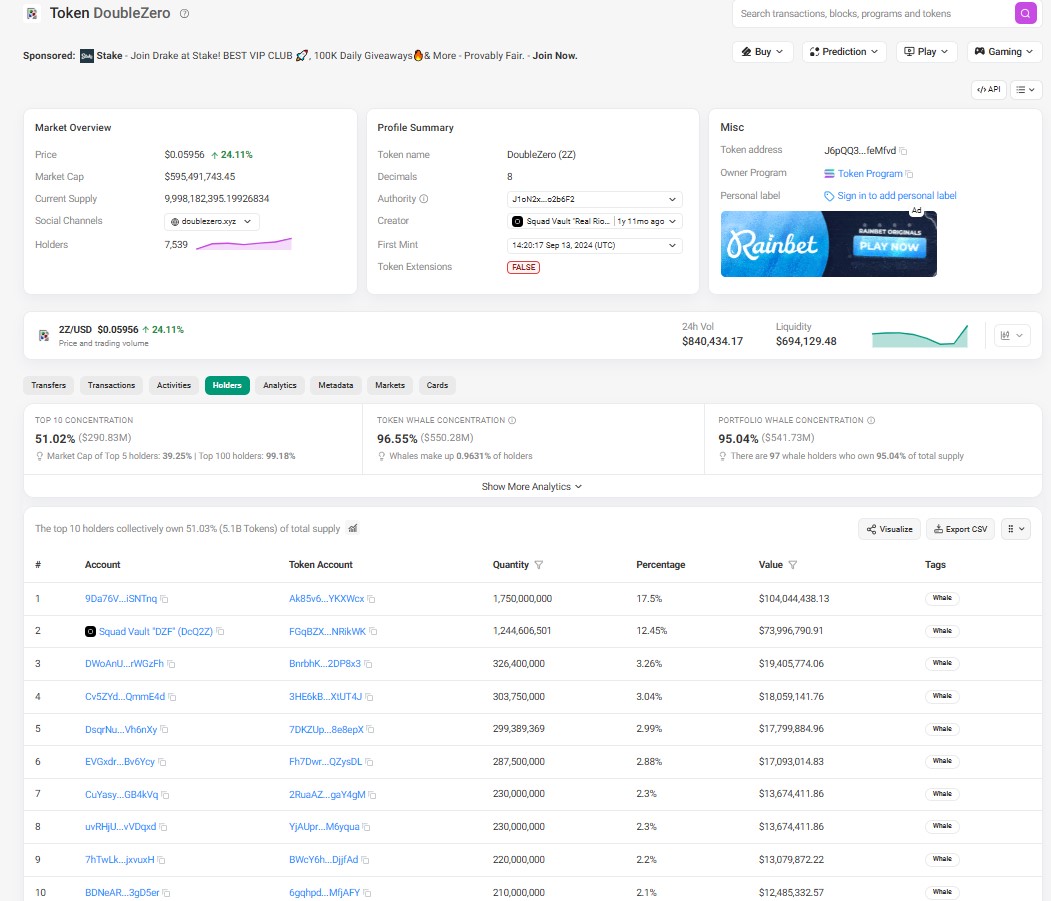
We pulled up the holder breakdown expecting a cleaner spread. It wasn't. The largest single wallet holds 17.5% alone, and a squad vault labeled "DZF" holds another 12.45%. Whale-driven markets can move fast in both directions, and that's a risk worth remembering before chasing this candle.
DoubleZero Price Prediction: Daily Chart and Technical Analysis
The 1D chart on TradingView shows $2Z breaking out of a falling wedge, a bearish-to-bullish reversal pattern where price gets squeezed between two converging downward-sloping lines before snapping upward. 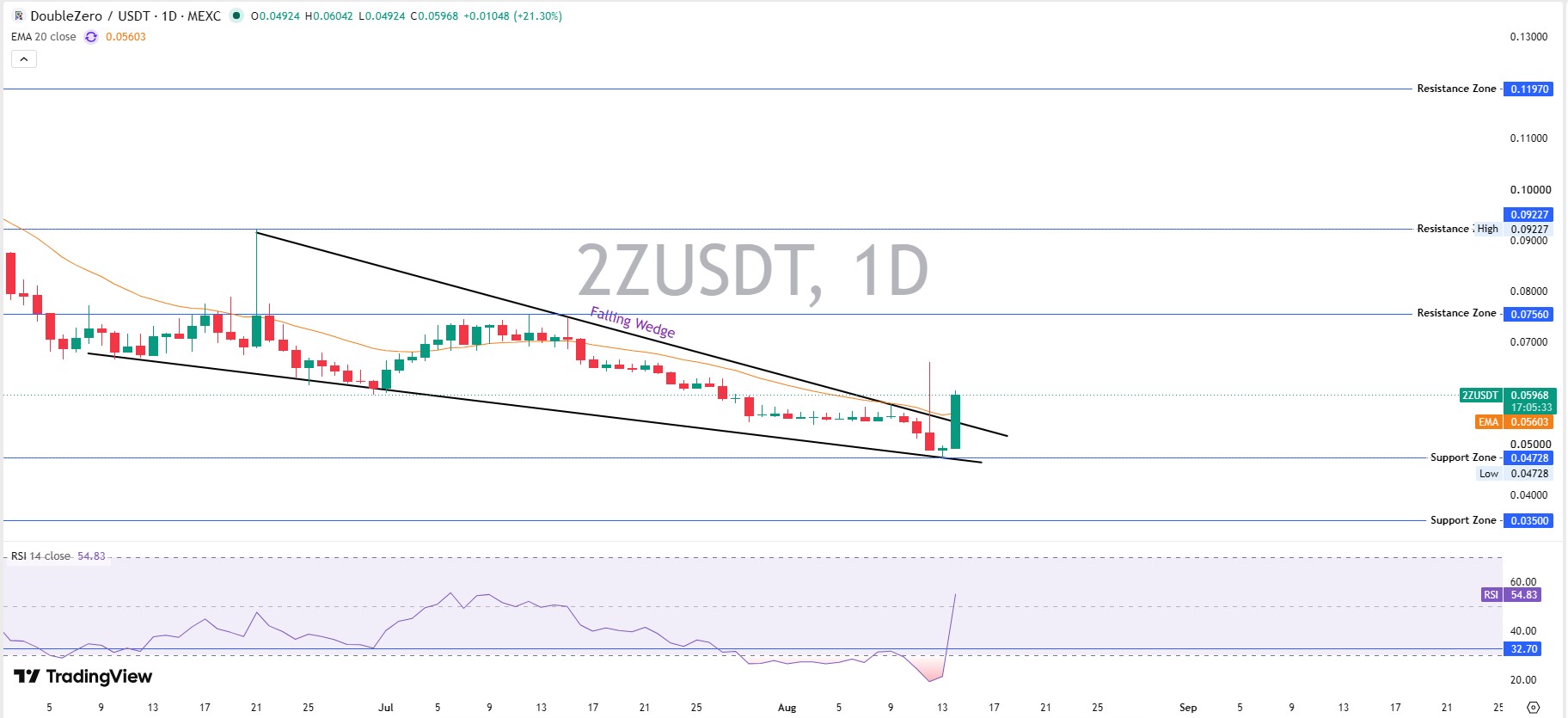
That's exactly what happened here, with a sharp green candle piercing through the upper trendline.
RSI (Relative Strength Index, a momentum gauge from 0 to 100) sits at 54.83, up from an oversold reading near 20 just days earlier. That's neutral-to-bullish territory, not overheated. The 20-day EMA (exponential moving average, a trend line that weights recent prices more heavily) reads $0.0560, and the price is trading above it again after weeks below.
Resistance zones stack at $0.0756, then $0.09227, then $0.1197 further out. Support sits at $0.0473, with a secondary floor near $0.0350 if momentum fails.
And here's the honest read: one green candle off a wedge doesn't confirm a trend reversal on its own. Volume needs to follow through above $0.0560 for a few sessions before this becomes more than a relief bounce. Broader market comparisons, like how Bitcoin's own outlook is shaping up, still matter for small-cap risk appetite.
DoubleZero as an Infrastructure Altcoin, Not a Meme Play
DoubleZero isn't a memecoin chasing hype cycles. It's positioned as network infrastructure, essentially dedicated fiber routing for latency-sensitive data like Kalshi's order books, sports feeds, and crypto perpetuals' pricing. That's a fundamentally different risk profile than a token riding social media momentum alone.
This altcoin category depends heavily on adoption metrics: how many platforms actually route data through the network and whether that usage grows. Compare that against smaller-cap ethereum-adjacent altcoin forecasts to see how utility-driven tokens typically trade versus pure sentiment plays like the ones covered in memecoin news.
CertiK rates the project 4.1 out of 5, and TVL (total value locked, meaning assets committed to the network) sits near $114.79M, giving a market cap to TVL ratio of 1.71. That's a reasonable anchor for valuation, though still speculative given the coin's short trading history since its steep fall from an October 2025 all-time high of $0.7502.
Bear, Base, and Bull Scenarios
Timeframe | Bear Case | Base Case | Bull Case | Probability | Invalidation |
7 Days | $0.0480 | $0.0550 - $0.0650 | $0.0750 | Bear 25% / Base 45% / Bull 30% | Daily close below $0.0473 |
30 Days | $0.0400 | $0.0520 - $0.0750 | $0.0920 | Bear 30% / Base 40% / Bull 30% | Weekly close below EMA20 ($0.0560) |
Early 2027 | $0.0350 | $0.0650 - $0.1100 | $0.1500 | Bear 30% / Base 40% / Bull 30% | Loss of support structure below $0.0350 |
This DoubleZero price prediction leans toward the base case for now. Momentum is real, but it's still early, and one catalyst rarely sustains a multi-week trend without follow-through volume.
Key Risks
Whale concentration above 96% means a handful of wallets can swing price hard in either direction. Liquidity is thin relative to market cap, so large sells could cut through support fast.
Macro conditions matter too. Broader risk sentiment tied to Fed policy, tracked in ongoing Federal Reserve coverage, can pull small caps down regardless of token-specific news.
Glossary
RSI: A momentum indicator measuring how fast and how far price has moved, scaled 0-100.
EMA: A moving average giving more weight to recent price action than older data.
Falling wedge: A chart pattern with converging downward trendlines, often resolving upward.
FDV: Fully diluted valuation, the market cap if all tokens ever minted were in circulation.
Whale concentration: The share of total supply held by the largest wallet addresses.
Conclusion
This DoubleZero price prediction rests on a confirmed catalyst, a technical breakout, and a still-fragile follow-through. The Kalshi partnership gave 2Z a real reason to move, and the chart backs it up for now.
But whale concentration and thin liquidity keep this a high-risk, high-volatility name. Policy shifts around prediction markets, covered in ongoing regulatory and market structure news, could add or remove momentum quickly. Watch $0.0473 support and $0.0756 resistance closely. Nothing here is financial advice.
Disclaimer: This article is for informational purposes only and is not financial advice. Cryptocurrency markets are highly volatile.
Also read: