Ethereum Price Under Pressure Faces Leadership Shakeup


Ethereum Price Outlook: Governance, Upgrades and Market Risks
Ethereum price greatest strength is its open, leaderless governance — is being tested for the first time. Eight senior exits, a delayed upgrade, and ETH trading near $2,100: the storm is real, and the community is watching.
Something that was supposed to be impossible has been happening, quietly and then all at once, at the Ethereum Foundation in 2026.
The people who built Ethereum's most critical infrastructure — protocol researchers, client team leads, the architects of the Beacon Chain — have been walking out the door in numbers that no one predicted at the start of this year. Eight high-profile departures in less than five months.
And the community, which has always prided itself on handling internal disagreements with philosophical grace, has run out of diplomatic language to describe what it is watching.
This is not a story about Ethereum dying. The network continues to process billions of dollars in transactions every day. Its DeFi ecosystem remains the most trusted in crypto. Developers still ship products on Ethereum that they could not build anywhere else.
But the human machinery that sits behind Ethereum's long-term roadmap — the researchers, the communicators, the governance architects — is visibly under strain. And in a system where trust in process matters as much as the technology itself, that strain has consequences.
The Foundation moved quickly to fill some of the gaps. Will Corcoran, Kev Wedderburn, and Fredrik were named as new co-leaders of the Protocol Cluster—the team most directly responsible for Ethereum's base-layer development.
Wedderburn will lead the zkEVM initiative; Fredrik takes on protocol security, including the "Trillion Dollar Security" project designed to harden Ethereum's defenses as the total value it secures continues to grow.
These are serious people taking on serious roles. But the speed of the transition and the number of experienced hands who left within a compressed window have left the community asking questions the Foundation has not fully answered.
Major Ethereum Foundation Exits — 2026
Tomasz Stańczak, Co-Executive Director, stepped down Feb 2026, less than 1 year in role
Tim Beiko, Protocol Coordinator — ran All Core Devs calls, key upgrade architect
Barnabé Monnot, Mechanism Design Researcher — PBS, MEV research
Alex Stokes, Protocol Researcher—on sabbatical
Josh Stark, Communications / Operations lead
Trent Van Epps, Protocol Guild, community coordination
Julian Ma, Researcher — censorship resistance, cross-layer bridges (4 yrs)
Carl Beek, Beacon Chain designer—final day May 29, 2026 (7 yrs)
The Foundation moved quickly to fill some of the gaps. Will Corcoran, Kev Wedderburn, and Fredrik were named as new co-leaders of the Protocol Cluster—the team most directly responsible for Ethereum's base-layer development.
Wedderburn will lead the zkEVM initiative; Fredrik takes on protocol security, including the "Trillion Dollar Security" project designed to harden Ethereum's defenses as the total value it secures continues to grow.
These are serious people taking on serious roles. But the speed of the transition and the number of experienced hands who left within a compressed window have left the community asking questions the Foundation has not fully answered.
Glamsterdam: The Upgrade That Got Pushed Back
Against this backdrop of personnel upheaval, Ethereum's technical roadmap has also slipped.
The Glamsterdam upgrade — originally expected to hit mainnet in June 2026 — has been pushed to the third quarter of the year.
The delay stems partly from the results of the Interop conference in Svalbard, where client teams tested key features and found that some components needed more time. It also reflects, at least in part, the reality of losing experienced coordinators during a phase when upgrade timing requires precise cross-team choreography.
Technical analysis
Support:
$1,850
$1,650
$1,500
Resistance:
$2,500
$3,000
$4,800
Key Breakout Zone
Bullish Breakout:
$2,600
Bearish Breakdown:
$1,850
Long-Term Targets
Target 1: $3,500
Target 2: $4,800
Target 3: $5,800 – $6,000
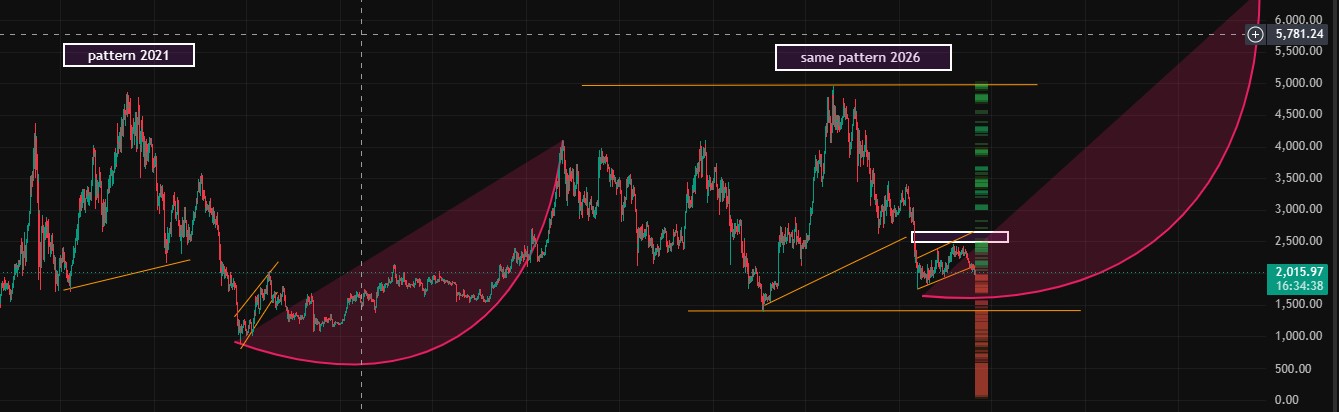
Short-Term: Ethereum is forming a potential bull flag / higher-low accumulation pattern near the $1,900–$2,100 zone, suggesting a possible rebound toward $2,500–$2,800 if support holds.
Long-Term: The chart is showing a structure similar to the 2021 post-crash recovery pattern, where a rounded bottom formed before a major rally, raising speculation that ETH could target the $4,500–$6,000 region if history repeats.
Technical models place ETH's May 2026 range between roughly $2,254 and $2,657. A monthly close above $2,420 is widely cited as the threshold that would confirm early bullish momentum. CoinCodex's algorithmic model has ETH at $2,788 by early June and $2,929 over a six-month horizon.
A September 2026 peak near $2,917 appears in several analyst frameworks, with year-end projections ranging from $2,663 to $3,069 across conservative scenarios. Polymarket, which aggregates real-money prediction market positioning, puts a 25.5% probability on ETH reaching $3,500 by the end of 2026 — not a bet most traders are making right now, but not an extreme fringe view either.
Ethereum Price Pattern Name:
Short-Term: Bull Flag + Higher Low Formation
Long-Term: 2021 Recovery Fractal / Rounded Bottom Pattern
Ethereum Price at $2,100: The Price of Institutional Uncertainty
Ethereum's price has been one of the most debated topics in crypto since the start of 2026. ETH hit an all-time high of approximately $4,950 in late 2025. By May 2026, it was trading around $2,100 to $2,200 — roughly 55% below that peak. The drawdown is sharper than what Bitcoin experienced over the same period, continuing a pattern of ETH underperformance relative to BTC that has frustrated long-term holders who built their thesis around Ethereum's utility growth driving token appreciation.
The reasons for the gap are layered. A significant portion of ETH activity has migrated to layer-two networks, which was always part of the architectural plan but has reduced the direct fee pressure — through EIP-1559 burning — on the ETH supply. Ethereum's spot ETF products in the United States, approved but slower to attract capital than Bitcoin's, have not generated the institutional inflows that bull-case models assumed.
And hovering over all of it, the governance questions of 2026 have not helped. Institutional buyers who were already weighing Ethereum's relative merits against a simpler Bitcoin narrative now have one more complication to factor in.
On-chain data offers a more nuanced picture than the headline price suggests. Roughly 37 million ETH — about 30% of circulating supply — is currently staked, removing a structurally significant portion of liquid supply from the market.
Whale wallets accumulated over 140,000 ETH in just four days in early May, a pattern that analysts watching on-chain flows described as a historically strong accumulation signal. Long-term holder cohorts have not capitulated in any meaningful way. The price decline, in other words, looks more like a confidence drought than a fundamental collapse.
ETH is not broken. But the narrative that made it easy to buy has gotten more complicated.
Investors like clarity, and right now Ethereum is making people work for it.
Disclaimer: This article is published for informational and educational purposes only. Nothing contained here constitutes financial, investment, or legal advice. Cryptocurrency markets are highly volatile and speculative. ETH price data referenced is approximate and sourced from public market trackers as of late May 2026. Past performance does not predict future results. Always conduct your own research and consult a qualified financial adviser before making any investment decision.
Also read: