LAB Price Prediction: LAB Down 90%, Beats BTC and ETH in Liquidations


LAB has fallen 90.4% over the past 7 days, and in one recent hour, liquidations on the token actually exceeded the combined liquidations of Bitcoin and Ethereum.
This LAB Price Prediction covers what's driving the continued selling, what the liquidation data shows, and where the chart stands after this week's collapse.
LAB describes itself as an all-in-one trading ecosystem built around faster execution, low fees, and a community incentive layer powered by the LAB token, according to the project's own materials.
LAB Price Prediction: Market Overview
Metric | Value |
Current Price | $0.2405 |
7d Change | -90.4% |
24h Range | $0.2244 – $0.3305 |
Market Cap | $77.636M |
Fully Diluted Valuation | $240.701M |
24h Trading Volume | $102.408M |
Circulating Supply | 322.543M $LAB (32% of max) |
Total / Max Supply | 1B $LAB |
Source: Data from CoinGecko
Why LAB Keeps Falling: Liquidation Cascade
This decline traces back to heavy insider selling that began weeks ago, when a team-linked wallet transferred 18.4 million $LAB tokens to a decentralized exchange and began selling. Since then, the situation has escalated sharply. 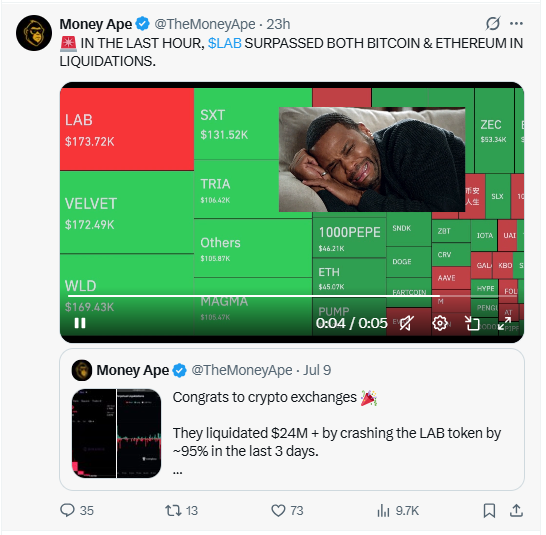
According to a crypto commentator on X, $LAB crashed roughly 90% in just 3 days earlier this month, a move that alone triggered more than $24 million in liquidations across exchanges.
More strikingly, a separate post from the same account showed that in a single one-hour window, $LAB liquidations reached $173.72K, higher than the combined liquidations of both Bitcoin and Ethereum during that same hour.
That's an unusual, specific signal: it means leveraged traders are still being forced out of $LAB positions at a scale disproportionate to the token's size, well after the initial crash.
This lines up with what Arkham on-chain data has previously shown for $LAB, where the top six wallets, mostly flagged as Gnosis Safe proxy addresses typically used by teams and insiders, control close to 78% of circulating supply.
That level of concentration means a small number of wallets can still move this market heavily whenever they choose to sell.
Latest Update: $LAB Team Launches Staking Incentives
The official $LAB account posted a new staking program aimed at giving holders a reason to lock up tokens instead of selling. 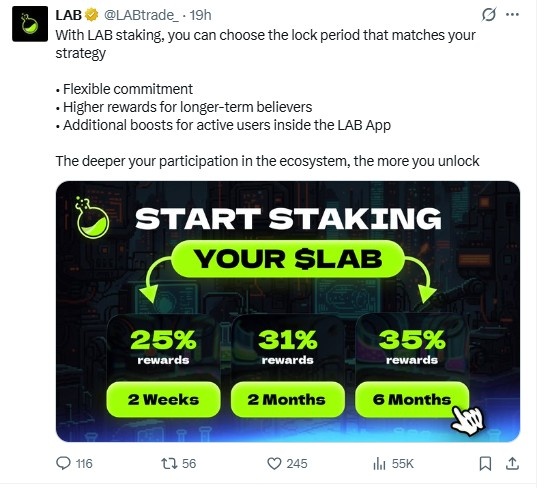
Source: Data From X
Rewards scale with lock-up length: 25% for a 2-week lock, 31% for 2 months, and 35% for a 6-month commitment.
The timing, arriving in the middle of this liquidation cascade, suggests the team is actively trying to reduce circulating sell pressure.
LAB Tokenomics: Unlock Pressure Behind the Selling
LAB's total supply is capped at 1 billion tokens, with 322.543 million currently circulating, about 32% of the total, according to CoinGecko.
The gap between $LAB's $77.636 million market cap and its $240.701 million fully diluted valuation shows that roughly two-thirds of LAB's total value is still tied up in tokens not yet in circulation.
A meaningful overhang that keeps pressure on price as more supply becomes available over time.
LAB Price Prediction: How These Levels Were Read
The levels shown are based on the 1-hour $LAB/USDT chart, using EMA (20, 50, 100, and 200) and RSI (14) to identify the short-term trend, momentum, and key support and resistance zones.
Since $LAB still has a relatively low circulating supply, price swings can be sharper than those of more established cryptocurrencies.
LAB Price Prediction: $LAB Chart Analysis: Trendline Break and Consolidation
$LAB had been climbing inside a short-term rising trendline before breaking below it, and the price is now consolidating in a tight range just above a marked demand zone. 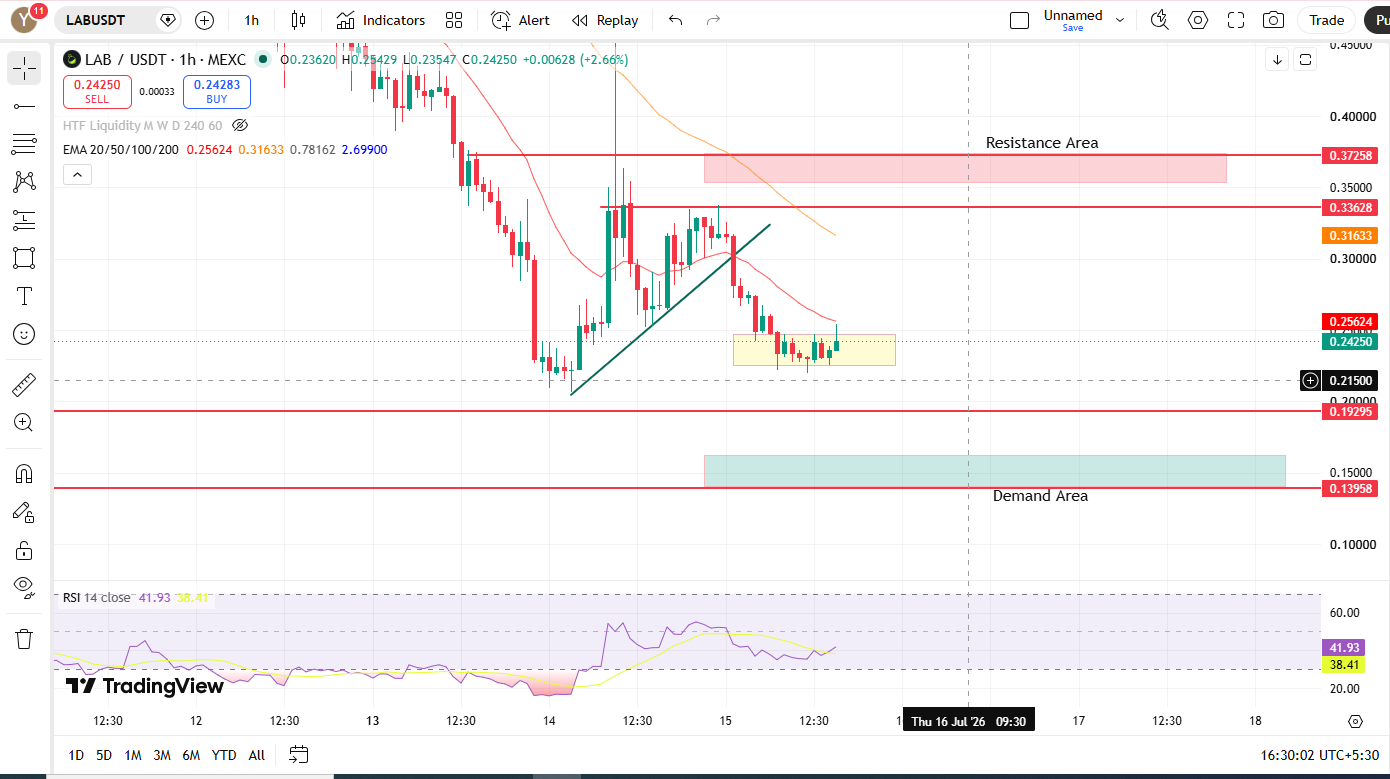
Price is trading below the EMA 50 ($0.31633), EMA 100 ($0.78162), and EMA 200 ($2.69900), though currently just below the EMA 20 ($0.25624) as well, reflecting how far $LAB has fallen from its earlier levels on every timeframe measured.
The RSI is at 41.93, just above its moving average level of 38.41, which is more of a neutral-to-soft reading than a clearly oversold one.
1-Hour Key Levels
Support | Resistance |
$0.19295 | $0.33628 |
$0.13958 – $0.15000 (Demand Area) | $0.37258 |
LAB Price Prediction: Expert View Outlook
According to CoinGabbar analysts, $LAB's broader trend stays bearish while price remains below its key EMAs, and the scale of recent liquidations shows this selling pressure hasn't fully worked itself out yet.
The new staking incentives could help slow the pace of selling, but a genuine trend change would need a reclaim of $0.33628 followed by $0.37258.
Losing $0.19295 would open the door toward the $0.13958-$0.15000 demand zone.