Mirex Network Price Drops Below MRX Presale! Are Buyers Trapped?


MRX price is trading at $1.53 on PancakeSwap a meaningful distance below the $1.92 presale entry price that early buyers paid before the September 1 TGE.
With sell volume outpacing buy-volume, liquidity sitting at just $107K, and the market cap at $41.3M, the core question is straightforward: are Mirex Network buyers trapped, or does MRX have a realistic path back above the presale price?
This update works through what the confirmed on-chain data shows, what the chart levels say, and what a recovery would actually require.
MRX Live Market Snapshot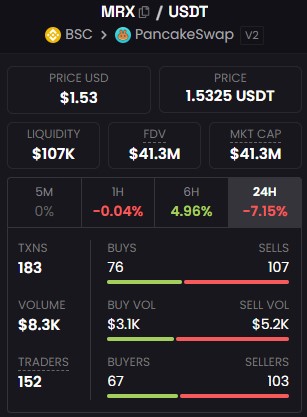
Source: DEXScreener MRX/USDT on PancakeSwap, captured September 4, 2026
Metric | Value |
Current Price (USD) | $1.53 |
Current Price (USDT) | 1.5325 USDT |
Presale Price | $1.92 |
Gap Below Presale | -$0.39 (~20.3% underwater) |
Liquidity | $107K |
FDV | $41.3M |
Market Cap | $41.3M |
24H Price Change | -7.15% |
1H Change | -0.04% |
6H Change | +4.96% |
24H-Volume | $8.3K |
Buy-Volume (24H) | $3.1K |
Sell-Volume (24H) | $5.2K |
Total Transactions (24H) | 183 |
Buyers (24H) | 67 |
Sellers (24H) | 103 |
Traders (24H) | 152 |
Exchange | PancakeSwap V2 (BSC) |
Key flag: Sellers (103) are outnumbering buyers (67) by a ratio of roughly 1.5:1, and sell volume ($5.2K) is nearly 68% higher than buy volume ($3.1K).
The 6H bounce of +4.96% is the only near-term positive signal in this snapshot; everything else points to continued sell pressure.
Are Mirex Network Buyers Trapped? Doing the Math
The presale price was $1.92. MRX is currently trading at $1.53. That is a gap of $0.39, meaning anyone who bought at the presale price is currently sitting approximately 20.3% underwater at the time of capture.
Trapped is the right word for this situation, but with an important nuance: being underwater post-TGE is common for presale tokens in their first weeks of trading.
The question is not whether buyers are down right now; they clearly are, but whether MRX has the liquidity, volume, and demand structure to close that gap.
At $107K in liquidity and $8.3K in 24H volume, the honest answer is that meaningful recovery requires a significant shift in buyer-to-seller ratio that is not visible in today's data.
$MRX Chart Levels: Where Price Sits and What It Needs to Clear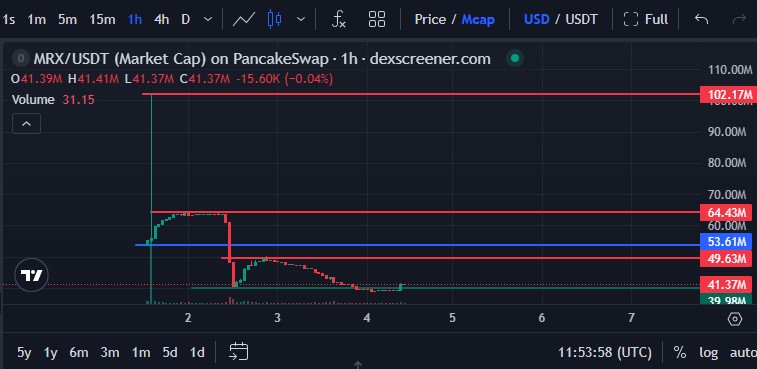
Source: DEXScreener MRX/USDT, captured September 4, 2026
The chart tells a clear post-launch story. MRX peaked near the $64.43M market cap level shortly after launch, then sold off sharply and has since been consolidating in the $39.98M–$53.61M range.
Level | Market Cap | Significance |
Major Resistance | $102.17M | Post-launch peak zone very distant from current price |
Resistance | $64.43M | Launch-day high first meaningful ceiling to clear |
Resistance | $53.61M | Mid-range level, near where price consolidated before sell-off |
Resistance | $49.63M | Nearest overhead resistance above current price |
Current Price Zone | $41.37M | Where $MRX is trading now, near recent lows |
Support | $39.98M | Closest support floor below current price |
To reclaim the $1.92 presale price, MRX's market cap needs to recover toward the $49.63M–$53.61M resistance band, a roughly 20–30% move from current levels.
That is achievable in principle but requires sustained buying pressure that today's volume does not yet support.
What Mirex Network's Official X Post Shows
The most recent official post from Mirex Network is a community engagement question asking followers which crypto influencers and creators the project should collaborate with as it enters the next stage of the Mirex journey.
Source: Official Mirex Network X account (@mirex_network), captured September 4, 2026
What this confirms: The team is actively building community presence and is focused on influencer outreach for the next phase. This is a marketing-layer signal, not a product or liquidity announcement.
What this does not confirm: Any buyback program, liquidity injection, exchange listing upgrade, or price support mechanism. A social media engagement post is community activity, not a recovery catalyst. Treating it as one would be a misread of the signal.
For buyers currently underwater, what matters more than influencer collaborations is whether the project announces concrete liquidity additions, a CEX listing, or product milestones none of which are confirmed in available data at the time of capture.
Why $107K Liquidity Is the Real Story Here
This number deserves its own section because it explains almost everything else in this snapshot.
At $107K in total liquidity on PancakeSwap, MRX is operating in an extremely shallow market.
In a pool this thin, relatively small sell orders can move price significantly downward, which is exactly what the -7.15% 24H move reflects. Conversely, a modest surge in buying could also push the price up sharply, which explains the +4.96% 6H bounce.
The double-edged reality of thin liquidity: it makes both crashes and recoveries faster and more extreme than they would be in a deeper market. MRX does not need enormous capital to recover, but it does need sustained, consistent buying pressure rather than sporadic spikes.
$MRX Price Prediction: Near-Term Scenarios
All Mirex Network price predictions below use $1.53 as the current anchor and $1.92 as the presale reference. No additional confirmed data points exist beyond what is shown in the dashboard. All ranges are pattern-based estimates.
Scenario | MRX Price Range | Key Driver | Invalidation |
Bear Case | $1.10 – $1.40 | Sell pressure continues, liquidity thins further, no new buyers enter at current levels | A sustained close above $1.55 challenges this |
Base Case | $1.50 – $1.92 | Buyer/seller ratio gradually improves, volume picks up, MRX slowly works back toward presale price | Price falling below $1.30 and holding there |
Bull Case | $1.92 – $2.50 | Community momentum + influencer reach drives volume spike, presale price reclaimed and held as support | Requires sustained volume well above current $8.3K daily average |
Mirex Network Price Prediction 2026: Recovery Path Scenarios
Stage | MRX Price Target | What Needs to Happen | Invalidation |
Presale Price Reclaim | $1.92 | Buy volume consistently outpaces sell volume; liquidity grows above $500K | Sellers remain dominant at current levels |
Post-Recovery Consolidation | $2.00 – $3.00 | $MRX holds above presale price for 2+ weeks; CEX listing or product milestone announced | Failure to hold $1.92 after reclaiming it |
Expansion Phase | $3.00 – $5.00 | Tier-2 CEX listing + real utility adoption + broader BSC ecosystem attention | Thin liquidity persists; no exchange upgrade |
Expert View: Post-TGE Dips and What They Usually Mean
Post-launch sell-offs on DEX listings are among the most common patterns in small-cap crypto.
When a token lists on a decentralized exchange without a prior CEX announcement, early presale buyers who are in profit or who simply want liquidity tend to exit quickly, especially in the first 72 hours. The result is almost always a drop below launch price in the first week.
What separates temporary post-TGE dips from prolonged underperformance is usually one of three things: a CEX listing announcement that brings fresh capital, a product milestone that gives holders a reason to accumulate rather than exit, or a liquidity injection from the team or ecosystem fund that tightens the spread.
For $MRX, none of those three catalysts are confirmed in publicly available data as of this update.
Disclaimer
This article is for informational purposes only and not financial advice. MRX data is sourced from DEXScreener. The $1.92 presale price is an article benchmark and not independently verified here. Price scenarios are estimates, not guarantees. Crypto trading carries significant risk; conduct your own research before investing.
1 month ago
HOW TO GET A PROFESSIONAL RECOVERY EXPERT IN CANADA, UNITED STATES, MEXICO, INDIA, CHINA META TECH RECOVERY PRO META TECH RECOVERY PRO is a trusted, independent cyber-intelligence and digital recovery firm. We investigate and remediate sensitive information incidents across multiple blockchain and financial environments, including Bitcoin, USDT, USDC, Ethereum, and other widely used digital assets. Our mission is to help clients regain control, protect data, and restore integrity after unauthorized access, fraud, personal information exposure, or inappropriate online content. WhatsApp +1 469 692 8049 Using disciplined digital forensics and risk analysis, we provide end-to-end recovery support: tracing suspicious activity, identifying likely sources of cyber incidents, reconstructing event timelines, and performing secure data recovery when feasible. We also assist with consent-free exposure removal or erasure, including confidential records, private images, doxing-related content, and other materials that violate privacy standards. Contact them via Metatech@Writeme.Com Our method is professional and structured: each engagement begins with an assessment of incident scope, impacted platforms or accounts, and available indicators. We then apply targeted techniques such as digital footprint analysis, linkage evaluation across online identifiers, and verification of transaction or account trails to determine the most effective recovery and mitigation path. We operate under a NO UPFRONT fee model until completion, ensuring accountability, aligning incentives with client objectives, and reducing financial uncertainty. Clients typically seek help with hacked wallets or compromised accounts, suspicious crypto transfers, identity exposure, unlawful posting of private content, impersonation, online harassment, and other forms of digital wrongdoing. We deliver actionable outcomes, including enhanced protection measures, targeted takedown support, and recovery strategies designed to minimize recurrence. If your personal data has been leaked, your accounts compromised, or inappropriate content has appeared online, we can investigate promptly and pursue resolution with discretion, accuracy, and professionalism.Reach out to them via - Telegram:@metatechrecoveryproteam - - WhatsApp: +1 4 6 9 6 9 2 8 0 4 9 - - Metatech@Writeme.Com -

1 month ago
HOW TO GET A PROFESSIONAL RECOVERY EXPERT IN CANADA, UNITED STATES, MEXICO, INDIA, CHINA META TECH RECOVERY PRO META TECH RECOVERY PRO is a trusted, independent cyber-intelligence and digital recovery firm. We investigate and remediate sensitive information incidents across multiple blockchain and financial environments, including Bitcoin, USDT, USDC, Ethereum, and other widely used digital assets. Our mission is to help clients regain control, protect data, and restore integrity after unauthorized access, fraud, personal information exposure, or inappropriate online content. WhatsApp +1 469 692 8049 Using disciplined digital forensics and risk analysis, we provide end-to-end recovery support: tracing suspicious activity, identifying likely sources of cyber incidents, reconstructing event timelines, and performing secure data recovery when feasible. We also assist with consent-free exposure removal or erasure, including confidential records, private images, doxing-related content, and other materials that violate privacy standards. Contact them via Metatech@Writeme.Com Our method is professional and structured: each engagement begins with an assessment of incident scope, impacted platforms or accounts, and available indicators. We then apply targeted techniques such as digital footprint analysis, linkage evaluation across online identifiers, and verification of transaction or account trails to determine the most effective recovery and mitigation path. We operate under a NO UPFRONT fee model until completion, ensuring accountability, aligning incentives with client objectives, and reducing financial uncertainty. Clients typically seek help with hacked wallets or compromised accounts, suspicious crypto transfers, identity exposure, unlawful posting of private content, impersonation, online harassment, and other forms of digital wrongdoing. We deliver actionable outcomes, including enhanced protection measures, targeted takedown support, and recovery strategies designed to minimize recurrence. If your personal data has been leaked, your accounts compromised, or inappropriate content has appeared online, we can investigate promptly and pursue resolution with discretion, accuracy, and professionalism.Reach out to them via - Telegram:@metatechrecoveryproteam - - WhatsApp: +1 4 6 9 6 9 2 8 0 4 9 - - Metatech@Writeme.Com -
1 month ago
I thought I had finally found a legitimate government program that could help me with my student loan debt. The website looked official, the information seemed convincing, and I believed I was taking the right steps toward financial relief. Instead, I was deceived. After providing my personal information, I was persuaded to pay approximately $45,000 to scammers who promised to resolve my student loan debt. What followed was months of stress, confusion, and the realization that I had fallen victim to a sophisticated fraud scheme. That was when I sought help from TechY Force Cyber Retrieval. Their team reviewed the circumstances surrounding the fraud, helped document the evidence, and explained the recovery process clearly. Most importantly, I finally felt that someone was taking my situation seriously. W.W.W.techyforcecyberretrievals.com WhatsApp https://wa.link/b470op This experience taught me an important lesson: never assume a website or program is legitimate simply because it looks official. Always verify government programs through trusted official channels before sharing personal information or sending money. If you believe you have been targeted by a similar scam, act quickly, preserve all communications and payment records, and report the fraud to the TechY Force Cyber Retrieval.
1 month ago
Good day everyone, My name is Rayan I was once a victim of $300,000 btc investment scam. I was so devastated at that point because the police won’t look into the matter. I made different enquiries on what to do to recover my lost bitcoin. A friend referred me to this recovery firm who was able to retrieve my stolen bitcoin. I contacted them on (recoverydarek @gmail com) and they came through in less than 24hrs after contacting them, to deliver my funds back to me.