SpaceX Stock Falls 3.86% Below $150 After 319 Million Share Unlock

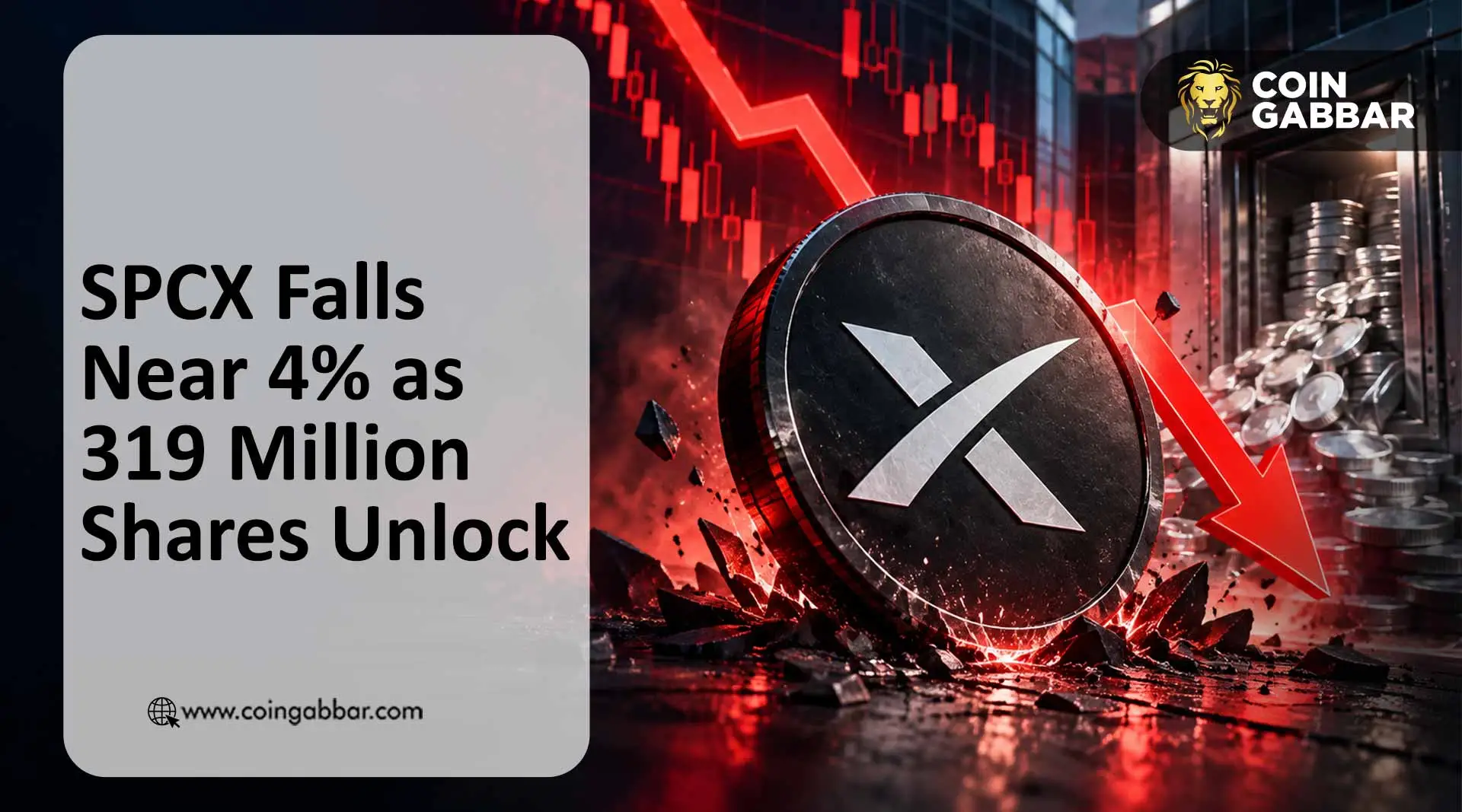
SpaceX stock slid nearly 4% on Wednesday, closing at $147.55 after a fresh batch of 319 million shares became eligible for trading. This marks the third major unlock event to hit SPCX stock since its June IPO, and traders are watching closely to see if the pattern from the last two rounds repeats itself.
The SpaceX share price had climbed above $150 on Tuesday, closing at $153.47. That gain didn't last. Once the new supply of shares hit the market on Wednesday, SPCX stock fell $5.92, or 3.86%, and slipped back below a key technical level.
This article breaks down what happened, why it happened, and where SpaceX stock price could head next.
Why Is SpaceX Stock Going Down?
The main reason is simple. SpaceX's IPO agreement lets small batches of locked-up shares unlock every few weeks.
Wednesday was the 90-day mark since the June IPO. That released up to 319 million Class A shares for possible sale.
This is not the first time this has happened. A similar 319 million-share unlock happened on August 20, and the stock also fell about 4% that day. It then bounced back the next session.
Trading volume also jumped. About 120.4 million shares changed hands on Wednesday, up roughly 40% from the 85.8 million shares traded the day before.
That said, eligible to sell doesn't mean all shares were sold. The unlocked block was worth close to $47 billion at Wednesday's price, but total volume that day was only about 38% of that share count.
What Is the SPCX Technical Analysis Today?
Looking at the 4-hour chart, the stock has moved from a sharp downtrend in July into a slow, rising channel since early August.
Price has been printing higher lows, and it is now trading above its 20, 50, and 100-day EMAs. That is generally seen as a sign of underlying strength, even with Wednesday's drop.
It is currently sitting near the 0.382 Fibonacci retracement level, around $151. This is viewed as a key pivot area for where the SpaceX stock price goes next.
Level | Price | What It Means |
Resistance 1 | $150–155 | First hurdle for bulls |
Resistance 2 | $158–160 | Needs a clean break above $150 |
Resistance 3 | $165 | Lines up with 0.5 Fib level |
Support 1 | $140–142 | First pullback zone |
Support 2 | $133–135 | Deeper downside zone |
Key Level | $150 | Most important level to watch |
What Is the SPCX Price Prediction for 2026?
Bullish path: If the stock holds above $150 with strong buying, the next stops could be $155, then $160, and potentially $165 if the channel breaks upward.
Bearish path: If it gets rejected near $150–155 and loses its rising support trendline, a pullback toward $142–140 becomes more likely, with $133–135 as a deeper downside target.
This is a technical read of the chart pattern, not a guarantee of where the share price will actually go.
Is SpaceX Stock Overvalued?
At $147.55, SpaceX carries a market value of about $1.94 trillion, based on 13.176 billion shares outstanding.
That works out to roughly 62 times its annualized second-quarter revenue. For context, SpaceX's Q2 revenue nearly doubled year over year to $7.81 billion, and its net loss narrowed to $541 million from $1.01 billion.
The company's Space segment is still losing money, with a $205 million adjusted EBITDA loss last quarter. Its AI and Connectivity (Starlink) segments are the ones carrying profits right now, at $1.15 billion and $2.60 billion respectively.
SpaceX also holds a large cash pile, $93.52 billion in cash plus $6.49 billion in short-term securities, against $38.43 billion in debt. Liquidity isn't the worry here. The worry is whether growth keeps up with the price tag.
SpaceX Unlock Schedule: What's Coming Next
The SpaceX unlock schedule isn't finished. More shares are set to become eligible in the coming weeks.
Up to 59.1 million affiliate-held shares unlock Thursday
Roughly 328 million more shares unlock around September 24
Additional 7% tranches unlock at the 105, 120, and 135-day marks
Up to another 28% of shares may unlock after SpaceX reports its next earnings
Founder Elon Musk's shares are under a longer 366-day lockup, so none of these recent drops involve founder selling.
What Is the SpaceX Stock Price Target From Analysts?
Wall Street has stayed mostly upbeat despite the unlock-driven dips.
Wells Fargo analyst Ken Gawrelski trimmed his 12-month price target slightly to $212 from $215, but kept a Buy rating.
Pivotal Research analyst Jeffrey Wlodarczak started coverage with a Buy rating and a $220 price target, saying the roughly $2 trillion valuation depends heavily on SpaceX making its Starship rocket quickly reusable.
What Should SpaceX Investors Watch Next?
Three things stand out going forward:
Whether trading volume stays high after the unlock, which would show demand is absorbing the new supply.
SpaceX CFO Bret Johnsen speaking at the Goldman Sachs Communacopia and Technology Conference on Thursday.
The Starship Flight 14 launch, which prediction markets currently put at about 85% likely to happen by September 30.
A successful Starship splashdown would support the bull case tied to reusability. A delay or failure could add more pressure to an already volatility-heavy stock.
Where Is SpaceX Stock Headed Next?
SpaceX stock remains one of the most closely watched names on the market right now, partly because of its size and partly because of its unusual staggered unlock schedule.
Wednesday's drop looks more like a supply test than a shift in the company's underlying story. Whether the share price holds the $150 level or slides toward $140 may come down to how the market absorbs the next few unlock dates.
As always, price predictions are not guarantees, and this stock can move sharply in either direction.
Disclaimer: This article is for informational purposes only and does not constitute financial, investment, or trading advice. Prices and price predictions discussed here are based on technical chart patterns and publicly available data at the time of writing, and are not guarantees of future performance. Always do your own research and consult a licensed financial advisor before making any investment decisions.