Strategy MSTR Crashes 83%, STRC All-Time Low: Will Saylor Sell Bitcoin


Strategy's stock has collapsed to $85.33, down over 83% from its all-time high of $457, as its preferred shares crater to record lows and $BTC slides to a 21-month bottom — raising hard questions about whether Michael Saylor's "never sell" pledge can survive a $1.5 billion annual dividend burden.
MSTR Drops 83% From ATH as Bitcoin Falls to 21-Month Low
MSTR touched $85.33 on Thursday, marking an 83% decline from its November 2024 peak of $457.
Volume surged to 45.36 million shares as the daily RSI collapsed to 24.42 — one of the most oversold readings in the past 12 months.
$BTC triggered the sell-off, plunging nearly 5% in under 30 minutes to briefly touch $58,326 before a partial recovery to $59,740. The daily RSI on Bitcoin sits at 30.74, deep in oversold territory.
Because Strategy is structurally a leveraged Bitcoin vehicle, not a software company, MSTR amplifies every BTC move — down as well as up.
STRC Preferred Stock Crashes 25% Below Par Value to $73 Intraday Low
Strategy's Variable Rate Series A Perpetual Preferred Stock (STRC) hit a fresh all-time low of $73.62 intraday Thursday, settling near $75.69 — roughly 25% below its $100 par value at launch in 2025. The daily RSI on STRC has fallen to just 11.75. The timing is critical. The reset date on STRC falls on June 15, 2026, with the deal ratio date set for June 30 — both now within days.
IS STRC THE NEXT LUNA? Short answer - not quite.
Arkham Intelligence data shows Strategy holds approximately $1.4 billion in cash allocated for dividend coverage, though CryptoQuant has flagged that this represents only 14 months of runway, down from seven years at the start of 2026.
Strategy's annualized dividend obligations have nearly quadrupled this year to approximately $1.2 billion, following the large-scale issuance of STRC preferred stock, which carries an 11.5% yield.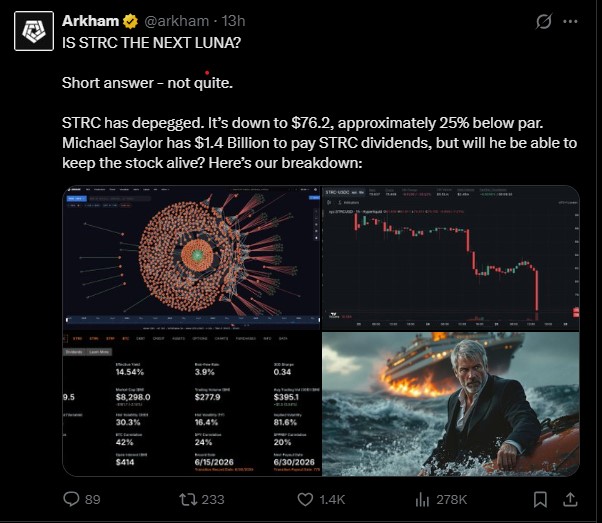
Has Strategy Started Selling Bitcoin to Cover Dividends?
For five years, "never sell" was the defining principle of Strategy's Bitcoin strategy. That principle may now be under pressure.
Multiple market reports suggest that Strategy has begun liquidating portions of its Bitcoin holdings to meet preferred dividend obligations.
Michael Saylor acknowledged on a May earnings call that selling was a possibility, telling The Wolf of All Streets podcast: the company's credit rating agencies expect Bitcoin to function as a real asset — and assets, by definition, can be sold.
Strategy currently holds 847,363847,363 BTC, representing close to 4% of all BTC that will ever be mined.
As the largest single buyer in recent Bitcoin market history, Saylor's accumulation helped sustain a price floor. A shift to consistent selling removes that floor entirely.
Stress Test: MSTR Could Fall to $1.01 in Worst-Case Scenario
As per WuBlockchain, MSTR Stress Test Says No “Death Spiral,” but BTC Per Share Could Collapse.
Analyst Adam Livingston published a three-year stress model for MSTR that assumes Bitcoin drops to $26,611 within six months and capital markets close to new Strategy issuance.
Under that scenario, the mNAV falls below 0.50x, and the claim ratio rises from 41.5% to 96.7%. BTC per share of common equity collapses from 138,161 satoshis to 7,884 satoshis. The modeled share price: $1.01.
Cash runs out by month nine. At that point, Strategy would need to sell 115,727 BTC over three years to service senior debt.
Crucially, even at the end of the three-year model, Strategy still holds 731,636 BTC with mNAV recovering to 1.40x. Livingston's conclusion: the primary risk is "compression in common equity BTC per share," not an outright insolvency spiral.
Bitcoin's $47,000 Support Zone Comes Into View If $58,000 Breaks
Bitcoin's Break of Structure level sits near $58,000 on the daily chart. A confirmed close below that level with volume would remove the last clearly defined technical floor before the $47,000 range.
Analysts are increasingly flagging $47,000 as the next major demand zone — not a base case, but the area the chart structure points toward if selling pressure continues, particularly if Strategy becomes a regular seller rather than a consistent accumulator.
Key Technical Levels: MSTR Support at $70, Resistance Stacked to $199
Level | Price | Type |
Immediate support | $70.11 | Daily structure low |
Current price | $85.33 | -9.35% Thursday |
Near resistance | $102.92 | Prior breakdown |
Major resistance | $199.26 | Gap fill zone |
For MSTR to stabilize, Bitcoin needs to reclaim and hold above $62,000 on a closing basis. Until that happens, both the common stock and preferred instruments remain in technically vulnerable territory with no confirmed floor.
DISCLAIMER: This article is for informational and educational purposes only. Nothing in this content constitutes financial advice, investment guidance, or any solicitation to buy or sell any asset. Cryptocurrency markets and stocks are highly volatile and speculative in nature. Always conduct independent research and consult a licensed financial advisor before making any investment decisions.