XRP Price Flare Strengthens DeFi With New $4.88M Liquidity Move


The $4.88M Rollover — Why It Matters Beyond the Dollar Figure
XRP Flare Network DeFi is gaining attention as automated liquidity infrastructure begins addressing one of the biggest challenges in fixed-term yield markets.
A $4.88 million rollover on Flare's Spectra Finance protocol shows how XRP-backed liquidity can move between maturing pools without requiring individual liquidity providers to manually redeploy their capital.
For abroader outlook, see XRP price prediction 2026 analysis
On the surface, $4.88 million moving between two liquidity pools sounds routine. In fixed-term DeFi, it is anything but. Every time a fixed-term yield market expires, liquidity providers face a binary choice: manually withdraw their capital and manually redeploy it into a new pool, or let it sit idle. Both options carry friction. Manual migration is slow, gas-intensive, and operationally demanding. Idle capital means dead yield.
The June 5 event on Flare's Spectra Finance protocol demonstrated something different.
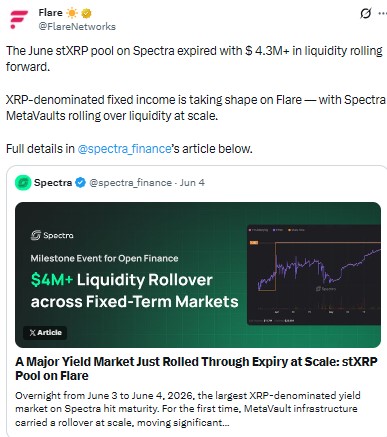
When the largest stXRP pool on the network expired, the GamiLabs FXRP MetaVault executed an automated migration of the full $4.88 million position — routing it into two successor fixed-term pools without pausing trading, without fragmenting liquidity, and without requiring a single LP to touch a wallet.
Will Procheska, DeFi Analyst covering the event, framed the technical achievement directly: as the largest stXRP pool on Spectra Finance expired on June 4, approximately $5 million in XRP-backed liquidity rolled directly into a new XRP market through the GamiLabs FXRP MetaVault.
In his view, liquidity providers who historically faced friction during expiry events were completely insulated from operational risk in this instance.
The maturing pool had not been a small test case. Over its four-month lifespan, the stXRP pool recorded more than $25 million in lifetime trading volume. By May, it was delivering double-digit fixed rates — a metric that reflects genuine, sustained demand for XRP yield exposure, not promotional incentive chasing.
Technical Breakdown: 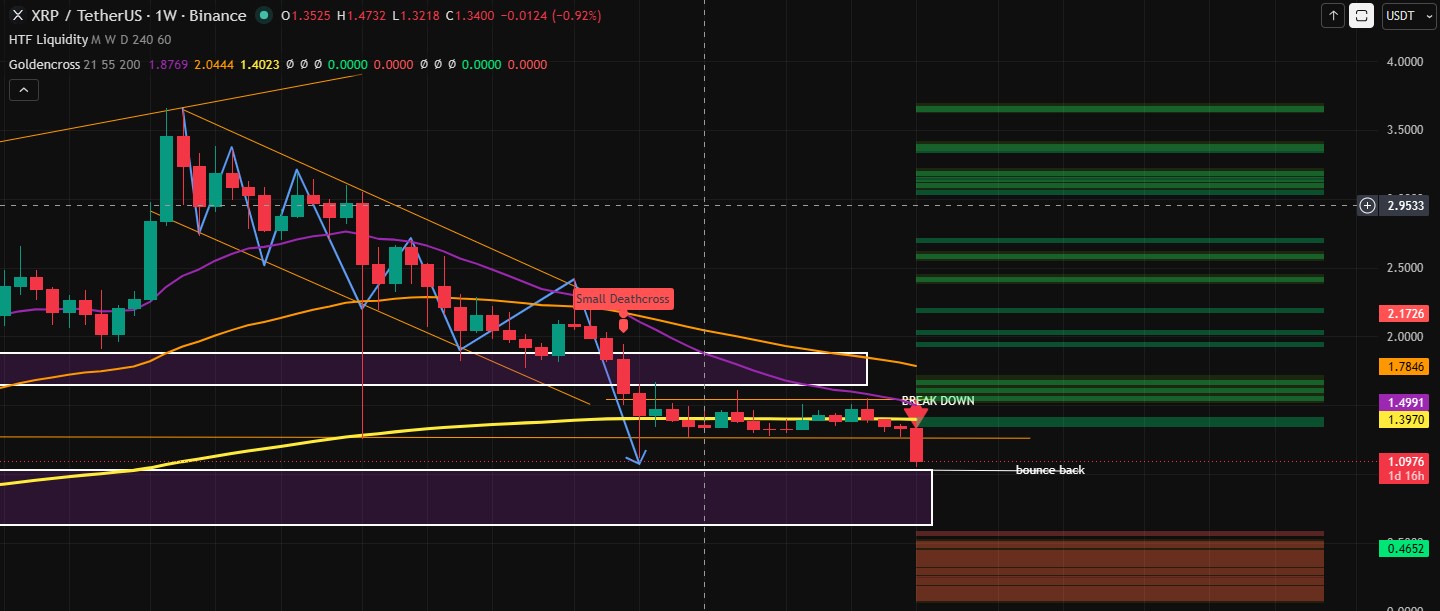
Support
- $1.10
- $1.00
- $0.90
Resistance
- $1.40
- $1.50
- $1.78
- $2.17
These XRP support and resistance levels provide a technical framework for assessing whether the current trend could stabilize or extend lower.
Short Term: XRP remains bearish after breaking below key weekly support, with downside pressure likely to continue unless buyers reclaim the $1.40 zone.
Long Term: XRP is testing a major demand area near $1.10; holding this region could support a recovery toward higher resistance levels, while a breakdown may open the door to deeper declines.
XRP Price Forecast Model: Key Indicators
The XRP price outlook in this article is based on acombination of technical and market indicators, including RSI for momentum, moving averages such as EMA for trend direction, trading volume for confirmation, and broader market positioning.
MVRV can also provide a valuation-based view of whether XRP holders are sitting on historically high or low unrealized profits.
These indicators are used as supporting signals rather than as a guaranteed price-prediction formula.
Bull/Base/Bear Table — TechnicalSection Ke Baad Add Karo
| Scenario | XRP Target | Probability | Invalidation |
| Bear | $0.90–$1.00 | 25% | Sustained break below $0.90 |
| Base | $1.40–$1.78 | 50% | Weekly close below $1.00 |
| Bull | $2.17+ | 25% | Failed breakout above $1.50 |
These scenario probabilities are illustrative estimates based on the technical framework discussed above and should not betreated as guaranteed outcomes.
The Expiry Cliff Problem in Fixed-Term DeFi
Fixed-term yield tokenization allows users to lock assets for a defined period in exchange for a predictable yield. The structural weakness of this model has always been the expiry event.
When a pool matures, TVL metrics collapse overnight as capital exits. Market depth disappears. Any LPs who forgot to migrate face zero yield on idle assets. Any trader trying to access that market finds no counterparty.
This 'expiry cliff' has prevented institutional capital from committing to fixed-term DeFi at scale. The uncertainty around continuity makes the product structurally inferior to traditional fixed-income instruments, where roll mechanisms are built into the product design from day one.
GamiLabs MetaVault: The Infrastructure Fix
GamiLabs introduced the FXRP MetaVault in February 2026 as a direct technical answer to the expiry cliff.
The core architecture is a single smart contract that monitors expiry timelines across active fixed-term pools, selects successor markets based on predefined on-chain rules, and routes capital automatically when an expiry condition is met.
Under this model, liquidity providers deposit assets once. They receive a vault token representing their position.
From that point, the vault handles every subsequent rollover selecting the next market, migrating capital, and maintaining yield continuity — until the LP decides to exit. No manual intervention required. No gas fees for migration. No missed yield windows
Traditional Fixed-Term DeFi | With GamiLabs MetaVault |
Manual withdrawal at expiry | Automated — vault handles expiry |
TVL cliff at pool maturity | Zero TVL disruption observed |
Gas-intensive LP management | Single deposit, perpetual yield |
Trading pauses during transition | Continuous trading throughout |
Institutional barrier — operational risk | Institutional-grade continuity |
Fragmented liquidity post-expiry | Liquidity preserved and extended |
Flare Delegation APY: What XRP Users Should Know
Flare delegation and yield opportunities can vary basedon the product, validator, market conditions, and reward structure.
Investors should check the latest official APY or reward rate before committing XRP or FXRP, as advertised yields are not guaranteed and may change over time.
Spectra Finance's Role
Spectra Finance operates as the open yield-trading protocol layer on Flare, and has emerged as the network's most active yield marketplace. It supports structured yield products denominated in FXRP — Flare's trustless, overcollateralized representation of XRP.
FXRP is minted through the FAssets framework, which underwent a significant upgrade on May 27, 2026 (v1.3) enabling one-transaction minting for the first time. Spectra's role in the June 4 event was providing the market infrastructure that MetaVault routed into: both the expiring pool and the two successor pools running on Spectra's protocol rails.
XRPFi: Flare's Bigger Play for XRP's $57B Dormant Capital
The June 4 rollover is one data point within a significantly larger thesis.
Investorsexploring how to earn on XRP via Flare can look at the ecosystem's yield markets, FXRP infrastructure, and automatedliquidity products, while also considering smart-contract, market, andliquidity risks.
Flare CEO Hugo Philion has been explicit about the strategy: the network's purpose is to convert XRP from a passive holding asset into an active DeFi participant.
The numbers behind the opportunity are substantial — XRP commands a market cap regularly exceeding $50–70 billion, and the vast majority of that supply historically sits in wallets earning nothing.
Philion outlined the XRPFi growth roadmap in a June 1 AMA: secure stablecoin liquidity as the foundation, attract institutional partners with XRP treasuries, and expand into real-world asset tokenization using Flare's data oracle infrastructure.
The first major institutional proof point is already in motion — Nasdaq-listed VivoPower is set to deploy $100 million worth of XRP into the Flare network. That single commitment, if executed, would represent the largest corporate XRP-in-DeFi deployment on record.
FAssets v1.3: One-Transaction FXRP Minting
The May 27 FAssets v1.3 upgrade removed the most significant operational barrier to FXRP adoption. Previously, minting FXRP required multiple transactions, which created friction for new users and limited the addressable market for XRPFi products. The v1.3 upgrade collapsed the minting process to a single transaction.
With approximately 150 million FXRP already minted and DeFi lockups growing, the upgrade arrives at the right moment to support the next phase of ecosystem scaling.
What Comes After FXRP: Bitcoin and Confidential Compute
Flare's FAssets roadmap extends beyond XRP. The team has confirmed FBTC as the next asset to be wrapped — bringing Bitcoin holders into Flare's EVM-compatible DeFi ecosystem without requiring third-party bridges.
An exact 2026 launch window has not been confirmed, but the architecture is being built. Separately, confidential compute integration is on the 2026 roadmap, which would allow privacy-preserving smart contract execution — a feature that meaningfully expands Flare's institutional use case surface area.
Disclaimer — For Informational Purposes Only
This report is produced by CoinGabbar for informational and educational purposes only. Nothing in this document constitutes financial advice, investment advice, trading advice, or any other form of recommendation. All data cited reflects publicly available on-chain and market information as of June 4–6, 2026. Cryptocurrency and DeFi assets are highly volatile. Price predictions from third-party analysts are speculative and do not guarantee returns. Readers should conduct independent research and consult a qualified financial advisor before acting on any information in this report. CoinGabbar, its authors, and its reviewers hold no liability for financial losses arising from the use of this content.
Also read: