Saudi Arabia mBridge Exit: Why It Just Shook De-Dollarization Bets


Saudi Arabia mBridge Exit Signals Cracks in Dollar Alternative Plan
Saudi Arabia has withdrawn from mBridge, the China led digital currency platform designed to let central banks settle cross border payments without routing through the US dollar system.
According to the Financial Times, the Saudi Central Bank, known as SAMA, completed its planned proof of concept on May 13, 2025, and stopped being a participating member of mBridge soon after.
The Saudi Arabia mBridge exit was not made public until now, and SAMA describes it as the end of a testing phase rather than a sudden policy shift.
For anyone tracking crypto news today, this is one of the bigger bank digital currency stories of the week.
What Is mBridge and Why Did SAMA Join?
mBridge started in 2021 as a joint effort between the Bank for International Settlements, the People's Bank of China, the Hong Kong Monetary Authority, the Bank of Thailand, and the Central Bank of the UAE.
The mBridge China CBDC platform runs on distributed ledger technology and lets participating central banks move digital versions of their own currencies directly, cutting out layers of correspondent banks that typically slow down cross border payment settlement.
Saudi Arabia joined mBridge as an observer in 2023, then became a full participant in June 2024 under a wider digital currency pilot program, a move Reuters reported at the time, according to an official BIS press release.
The BIS itself stepped back from the mBridge project in October 2024, handing day to day control to the member central banks.
mBridge Saudi Arabia FT report 2025 timeline
Year | Development |
2021 | mBridge launched by BIS with China, Hong Kong, UAE and Thailand central banks |
2023 | Saudi Central Bank joins as an observer |
June 2024 | SAMA becomes a full participant |
October 2024 | BIS exits, hands control to member banks |
May 2025 | SAMA completes its proof of concept |
2026 | Financial Times reports the Saudi Arabia mBridge withdrawal |
Why Did Saudi Arabia Leave mBridge?
According to the Reuters coverage of the kingdom's original entry and the more recent Financial Times report on its exit:
Source: https://www.reuters.com/technology/saudi-arabia-joins-bis-led-central-bank-digital-currency-trial-2024-06-05/
SAMA says the Saudi Arabia mBridge exit followed the completion of a proof of concept it had planned from the start, not a change in strategy
A person familiar with the matter said it would be wrong to read a wider political motive into the decision
Another source said Riyadh's role in the China led digital currency platform was always limited, and it still engages with mBridge more quietly even after formally leaving
What This Means for the De-Dollarization Narrative
The Saudi Arabia China digital currency exit has often been framed as one piece of a broader push toward a SWIFT alternative system that reduces dollar dependency in trade, particularly for oil exporters like Saudi Arabia.
The kingdom's currency remains pegged to the dollar, and its financial exposure to Washington stays significant, so this de-dollarization news, tied directly to the Saudi Arabia mBridge exit, does not signal a broader break with the dollar system. The platform keeps expanding elsewhere too.
The Monetary Authority of Macao joined as a new member and activated its connection to mBridge in mid 2026, even as Saudi Arabia stepped away.
Saudi Arabia mBridge news today spread quickly across crypto and mainstream finance channels alike after the Financial Times report surfaced.
Crypto commentary channel Coin Bureau also covered this crypto news in a tweet citing the Financial Times report on the Saudi Arabia mBridge exit.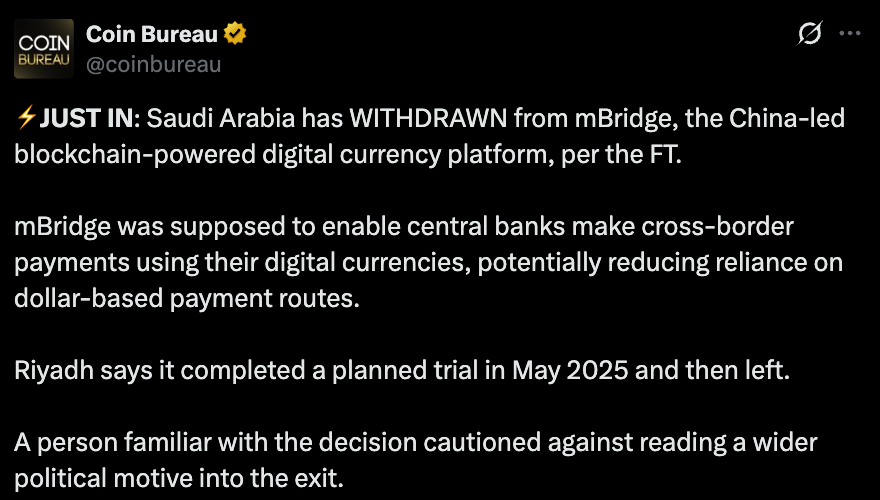
Expert Opinion
Analysts tracking cross border digital payments note that Saudi Arabia's limited role in mBridge, an observer for two years before a short stint as a full participant, made its exit less disruptive than a founding member's departure would be.
The bigger signal, they argue, is that a major oil economy chose not to stay in a China led digital currency platform once its own testing goals were met, which could shape how other central banks weigh mBridge proof of concept work against staying invested long term.
Saudi Arabia's de-dollarization mBridge role now looks smaller than initial headlines suggested, and the broader debate around such CBDC platforms is expected to continue as more central banks pilot cross border payment settlement tools alongside existing dollar based systems.
Disclaimer: This article is for informational purposes only and does not constitute financial or investment advice. mBridge is a central bank infrastructure project, not a tradable asset, and any broader market interpretation should be treated as analysis, not certainty.