US Senate Pass Federal Reserve CBDC Ban Till 2030: Will Trump Sign It?


US Senate Votes 85–5 to Block Federal Reserve CBDC Until End of 2030
The US Senate just buried a Federal Reserve digital-dollar ban in a housing bill — and passed it 85-5. If this clears the House and lands on Trump's desk, every crypto investor's biggest regulatory fear gets shelved until 2031 — but the fight isn't over yet. Here's what most reports aren't telling you about the fine print that could still change everything.
US Senate Passes CBDC Ban Through 2030 in 85–5 Vote
On June 22, 2026, the US Senate passed the 21st Century ROAD to Housing Act with an overwhelming 85–5 bipartisan vote. Tucked inside this housing supply bill is a provision that prohibits the Federal Reserve and all Federal Reserve Banks from issuing, creating, or indirectly facilitating a central bank digital currency (CBDC) — or any substantially similar digital asset — until December 31, 2030.
The bill was advanced jointly by Senators Tim Scott and Elizabeth Warren, an unusual bipartisan pairing that signals how broadly opposition to a government-controlled digital dollar runs across party lines.
The bill now heads to the House of Representatives for consideration, with House Financial Services Committee Chairman Rep. French Hill publicly stating he "looks forward to the House moving quickly to advance this bill to President Trump's desk."

Source: WatchGuru X
Why This CBDC Ban Matters for Crypto Investors?
The Surveillance Concern Behind the Ban. Republican lawmakers have long positioned CBDCs as surveillance tools — instruments that could let the government monitor every transaction, restrict spending, or freeze funds without court oversight. This ban directly addresses those concerns by removing the Fed's legal pathway to a retail digital dollar for the next four years.
Importantly, the ban targets retail CBDCs specifically. Wholesale CBDCs used for interbank settlement and private stablecoins remain untouched — a detail that matters for DeFi and institutional crypto players.
Bitcoin and Crypto Sentiment Gets a Boost
A government-issued digital dollar would have been a direct competitor to decentralized alternatives like Bitcoin. With the Fed's hands tied through 2030, the regulatory environment tilts further in favour of decentralised cryptocurrencies and private stablecoins.
This development is broadly bullish for Bitcoin, which thrives on narratives of financial sovereignty and limited government control over money.
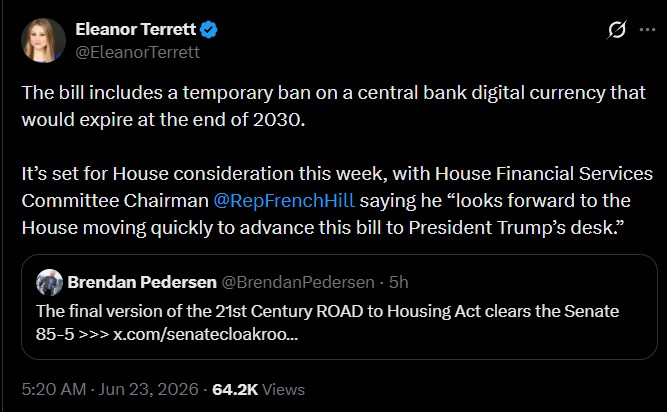
Source: Eleanor X
Key Details Traders Need to Know
What the Ban Actually Prohibits?
The Federal Reserve cannot directly or indirectly issue or create a CBDC
The blocks covers any "substantially similar digital asset" — closing loopholes
The prohibition runs until December 31, 2030
This aligns with Trump's January 2025 executive order already blocking federal CBDC promotion
What the Ban Does NOT Cover?
Wholesale CBDCs (used between financial institutions)
Private stablecoins like USDT or USDC
Future legislation after 2030 — the door remains open
What to Watch Next?
The crypto bill 2026 moves to the House this week. Chairman French Hill's supportive stance signals likely passage, but amendments remain possible — and the CBDC prohibition could face pushback or modification in the House version. If the House passes it unamended and Trump signs it, the ban becomes federal law by mid-to-late July 2026. Watch for:
House vote date — expected within days
Any CBDC-specific amendments added in the House
Bitcoin price reaction on signing day
Stablecoin legislation potentially accelerating as a result
Conclusion
The Senate's 85–5 vote is one of the clearest signals yet that a US retail CBDC is politically dead for this decade. With bipartisan support, Donald Trump alignment, and House momentum, this bans is likely to become law soon. For crypto investors, the message is straightforward: the digital dollar threat is shelved — but the post-2030 window is already on the horizon.
Disclaimer: This article is for informational purposes only and does not constitute financial or investment advice. Cryptocurrency investments carry significant risk. Always conduct your own research before making any financial decisions