SpaceX Sets Launch Date for Starship Flight 14, SPCX Stock Pops 5%


Shares of Space Exploration Technologies Corp., the parent of SpaceX, rose 5.15% Wednesday, adding roughly $7.39 to close at $150.88, after the company set a firm target date for the next test of its Starship rocket.
The advance lifted SpaceX's market capitalization to about $1.989 trillion, according to Wednesday's closing data, and extended gains into after-hours trading, where shares changed hands at $152.33.
The catalyst was confirmation that Starship Flight 14, the vehicle's first attempted orbital mission, is targeted for September 22.
The stock's reaction underscores how closely SpaceX shares now track the company's launch calendar, roughly three months after its Nasdaq debut in June.
Why Is SpaceX Stock Up Today
SpaceX stock traded higher for two reasons. The company confirmed a launch window for Starship Flight 14, and it separately carried out a classified national-security mission for the U.S. Space Force.
Shares opened at $144.85 and traded in a range of $144.36 to $153.00 during the session, according to the data, before closing at $150.88, up from Tuesday's close of $143.49. Volume came in at 108,357,393 shares, above the stock's average volume of 95,831,898.
SpaceX Stock Price: Key Figures at a Glance
Metric | Value |
Close price | $150.88 (+5.15%) |
After-hours price | $152.33 (+0.96%) |
Previous close | $143.49 |
Day's range | $144.36 – $153.00 |
52-week range | $104.83 – $225.64 |
Market cap | $1.989 trillion |
Volume | 108,357,393 |
Average volume | 95,831,898 |
EPS (TTM) | -1.16 |
1-year target estimate | $222.42 |
Earnings date (est.) | Nov 3, 2026 |
Even after Wednesday's advance, the SpaceX share price remains well below its 52-week high of $225.64, though it has recovered substantially from a low of $104.83.
What Starship Flight 14 Means for the Stock
Starship Flight 14 is scheduled to be the first mission in which the vehicle attempts to reach a stable orbit rather than following the suborbital trajectories used in earlier tests.
The mission plan calls for the rocket to complete approximately six orbits over roughly 10 hours and to deploy Starlink V3 satellites, marking the first time the upper stage would carry an operational payload into orbit.
Analysts and investors view the flight as a test of whether Starship can transition from a developmental program to a vehicle capable of generating recurring revenue, a distinction that has weighed on the stock since its debut.
Classified Falcon 9 Launch Adds to the Backdrop
Separately, SpaceX launched a Falcon 9 rocket carrying the classified USSF-259 mission for the U.S. Space Force from Vandenberg Space Force Base on September 16, a day after a prior attempt was scrubbed before fueling.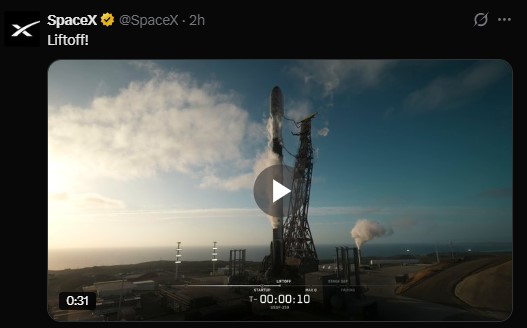
The mission used booster B1097, flying for the 13th time. The payload's purpose has not been disclosed, though it may be connected to SpaceX's Starshield satellite platform, which serves national-security customers.
Cathie Wood's SpaceX Stock Price Prediction
Ark Invest founder Cathie Wood has projected that Starship could generate as much as $10 trillion in annual revenue by the end of the decade, built primarily on Starlink connectivity rather than launch fees. On that basis, Wood has characterized SpaceX's $1.75 trillion initial public offering valuation as undervalued.
The projection rests on an implied revenue of roughly $1 billion per launch at a cadence of about 10,000 flights annually, a pace SpaceX has not approached. It also assumes nearly every flight carries paying Starlink capacity.
For context, a $10 trillion annual figure would exceed the yearly economic output of every country except the United States and China, underscoring the scale of the assumptions involved. Investors weighing the forecast should treat it as a long-term scenario rather than a near-term target.
SpaceX Stock Price Prediction: Technical Levels to Watch
On the four-hour chart, SPCX stock price is holding a gradual uptrend defined by higher lows, with shares consolidating between roughly $150 and $152. The 0.382 Fibonacci retracement level, near $150.98, is functioning as a near-term pivot for support and resistance.
A sustained close above $152 to $153 could open a path toward $165.24, followed by the $170 to $172 zone implied by the pattern's measured move, with the 0.618 Fibonacci level at $179.49 marking the next significant resistance.
On the downside, a failure to hold the rising trendline, along with a break below roughly $145, could bring a retest of $140 and, further out, $133.34, where the 0.236 Fibonacci level provides a more significant support zone. These levels reflect technical positioning only and are not projections of future performance.
Is There a SpaceX Tesla Merger
There is no SpaceX Tesla merger, and the two companies continue to operate as separate, independently traded entities. The comparison that periodically surfaces in searches stems from valuation, not corporate structure: SpaceX's market capitalization has traded near, and at times above, Tesla's since SPCX began trading on Nasdaq in June 2026.
What to Watch in SpaceX Stock News
Beyond Flight 14, investors are monitoring upcoming SpaceX stock unlock and share unlock dates, which could introduce additional supply and weigh on the SPCX stock price.
The company's next earnings report is expected around November 3, 2026, and is likely to inform the next round of SpaceX stock price prediction and SPCX price prediction discussion. For now, SPCX news remains centered on the countdown to Flight 14.
Disclaimer
This article is for informational purposes only and should not be taken as financial or investment advice. Stock prices are volatile and can move sharply in either direction. Past performance and analyst projections, including price targets and Fibonacci levels, are not guarantees of future results. Always do your own research and consult a licensed financial advisor before making investment decisions.








