US-China AI Race: What the $3T Data Center Forecast Means


US-China AI Race: Why Are AI Data Centers Getting Costlier?
Is the US-China AI race now the biggest story in tech? President Trump just raised the stakes again. He posted on Truth Social this week, calling AI "bigger than the Industrial Revolution, or the Internet."
His post lands days before he hosts Chinese leader Xi Jinping in Washington for a state visit. AI and trade sit at the center of those talks.
A fresh forecast adds more weight to the moment. Global data center spending is now on track to reach $3 trillion by 2030.
What Did Trump Say This Week?
Trump's post covered five points, all aimed at China. Here's what he said, in short:
Claim | What Trump said |
On winning | Whoever wins AI, wins |
On China | America leads, and he plans to keep it that way |
On scale | AI will be bigger than the Industrial Revolution, or the Internet |
On safety fears | Warnings that AI could harm humanity are a hoax |
On policy | He will only encourage AI, or Super Intelligence |
He compared AI safety warnings to old climate predictions that never came true. He pointed to Russia and Ukraine as the real disasters instead.
He said the Department of Justice would step in only if needed. He does not want to slow AI growth down.
Why Is CapEx Heading to $3T?
This rivalry isn't just words. It shows up in hard spending numbers too.
Global data center capital spending is set to top $3 trillion by 2030, according to Dell'Oro Group. That outlook has nearly doubled since its January 2026 forecast.
Three forces are driving that jump, per the report:
Hyperscale cloud spending, which keeps rising each quarter
Power capacity needs, since AI chips draw far more electricity than normal servers
Rising construction costs for new data center sites
High-end AI accelerators, the chips that train and run AI models, will likely take the largest single share of that spending. Dell'Oro named these chips the main growth driver through 2030.
The top four US hyperscalers alone could account for roughly half of global capex by 2030, per the same report.
That single data point puts a number on a rivalry most headlines only describe in words.
US-China AI Race: Who Holds the Edge Right Now?
So who's ahead today? Recent capex data points to a wide spending gap between the two countries.
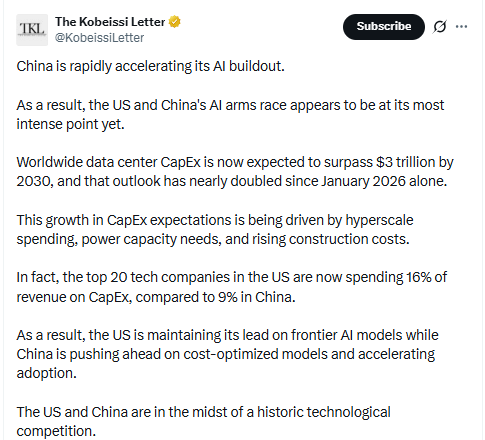
The top 20 US tech firms now put about 16% of revenue into capex, market data shows. Chinese peers put in roughly 9%. That gap alone tells part of the bigger story.
The US keeps its lead on frontier AI models, the largest and most capable systems
China is pushing cost-optimized models instead, built to run cheaper and spread faster
China is accelerating adoption, rolling AI tools out across its economy at speed
China's own security chief recently warned that falling behind in AI poses a direct risk, per state media reports. The US has also tightened chip export rules aimed at China in response.
This US-China AI race, then, isn't only about who builds the biggest model. It's also about cost, speed, and who runs out of patience first.
Trump's Xi meeting this week may add another data point to that picture, though no outcome is confirmed yet.
All figures here rest on assumptions and market sources. This article gives no exact or guaranteed outcome.
Conclusion
The US-China AI race just got louder, not clearer. Trump's post sets the tone ahead of his meeting with Xi. The $3 trillion capex forecast sets the scale. Whether spending buys a lasting lead is still an open question. This race will keep testing that answer for years.
YMYL Disclaimer
This article is for information only. It isn't financial, investment or trading advice. All figures rest on assumptions and market sources as of Sept 22, 2026. We provide no exact or guaranteed outcome. Markets and policy positions can shift fast. Verify details with official sources before you act on them.










