US Nonfarm Payrolls: America’s Job Engine Is Suddenly Stalling


US Nonfarm Payrolls: Why Is America’s Job Market Losing Momentum?
The United States is a global economic powerhouse, yet hiring nearly stalled in September.
CoinDesk reported that the economy added just 29,000 jobs while the unemployment rate sits at 4.2%.

This breakdown of the latest US nonfarm payrolls report explains what the numbers mean, who is feeling the pressure, and why a rich country can still feel stuck.
What Did the September Report Actually Say?
The Bureau of Labor Statistics (BLS) reported that payroll employment rose by only 29,000 in September, and it called the change small.
In plain words, US nonfarm payrolls count how many paid positions the economy added or lost in a month, excluding farm work.
-
Payroll change: +29,000
-
Unemployment rate: 4.2%
-
People unemployed: 7.1 million
-
Average over the prior 12 months: +45,000 a month
-
Report date: October 2, 2026, according to BLS
Imagine a shop that normally hires 45 people a month but hired only 29. It is not a collapse, but it is clearly slower than usual.
Did Unemployment Really "Rise" to 4.2%?
The headline says "rising," but the BLS wording is more careful. It says the rate changed little and has stayed in a narrow 4.1% to 4.3% range since March. The BLS also does not name one single cause for the move.
So the real story is not a sudden spike. It is a labor market that looks stuck. And that raises the next question: if the rate is stable, why does it feel so much worse for people searching for work?
Why Are People Still Struggling to Find Work?
The BLS does not give one reason, but its data points to several clues:
-
Hiring is weak everywhere: employment in all major industries changed little.
-
Even health care slowed: it added 17,000 positions, against a 33,000 monthly average over the prior 12 months.
-
Finance is shrinking: financial activities are down 129,000 since May 2025, mostly in insurance carriers (-90,000).
-
Revisions hurt: July was revised down to -10,000 and August to +133,000, leaving the two months 60,000 lower combined.
-
Long searches: 1.9 million people have been jobless for 27 weeks or more, which is 27.1% of all unemployed people.
-
Part-time by necessity: 4.5 million people work part-time because their hours were cut or they could not find full-time work.
Pay is still growing. Average hourly earnings reached $37.81, up 3.0% over 12 months, so the pressure shows up mainly in hiring speed rather than wages.
Who Is Feeling It Most?
The BLS says the jobless rate for Black workers increased in September, while the other groups below showed little change.
| Group | Unemployment rate |
| Black workers | 7.0% (increased) |
| Teenagers | 14.5% |
| Hispanic workers | 4.7% |
| Adult men | 3.9% |
| Adult women | 3.6% |
| White workers | 3.6% |
| Asian workers | 2.9% |
The labor force participation rate was 61.8%, and the employment-population ratio was 59.2%. Both changed little in September.
A Roller-Coaster Year: 2026 Month by Month
The latest US nonfarm payrolls data fits a bumpy pattern.
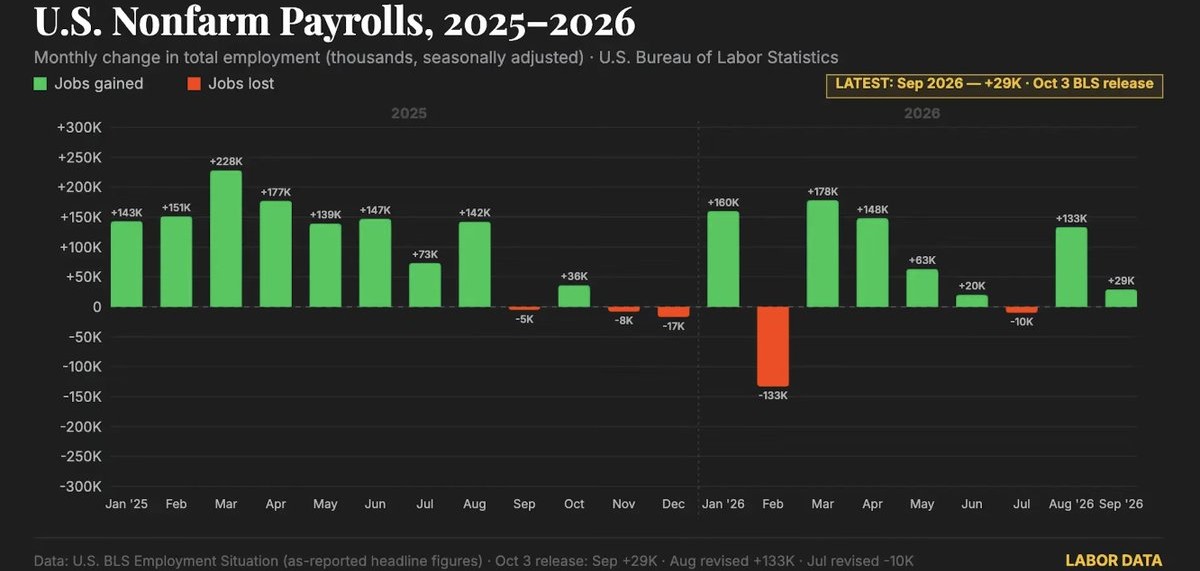
Gains were strong in March and April, then cooled sharply from May. Two months were negative.
The chart uses as-reported headline figures, so later revisions can change individual months. For readers of crypto news today, this report is a macro background.
It shows how the American job market is doing, but it does not tell us how crypto prices will move.
Conclusion
The September US nonfarm payrolls report shows a labor market that is not collapsing but is clearly stuck: only 29,000 new jobs, a 4.2% unemployment rate that the BLS calls little changed, and downward revisions to two earlier months.
The next report, for October, is due on November 6, 2026, at 8:30 a.m. ET, according to the BLS.
Disclaimer
This article is for educational and informational purposes only and should not be considered financial or investment advice. Always do your own research before making investment decisions.






