Why Natural Gas Prices Remain Difficult to Predict

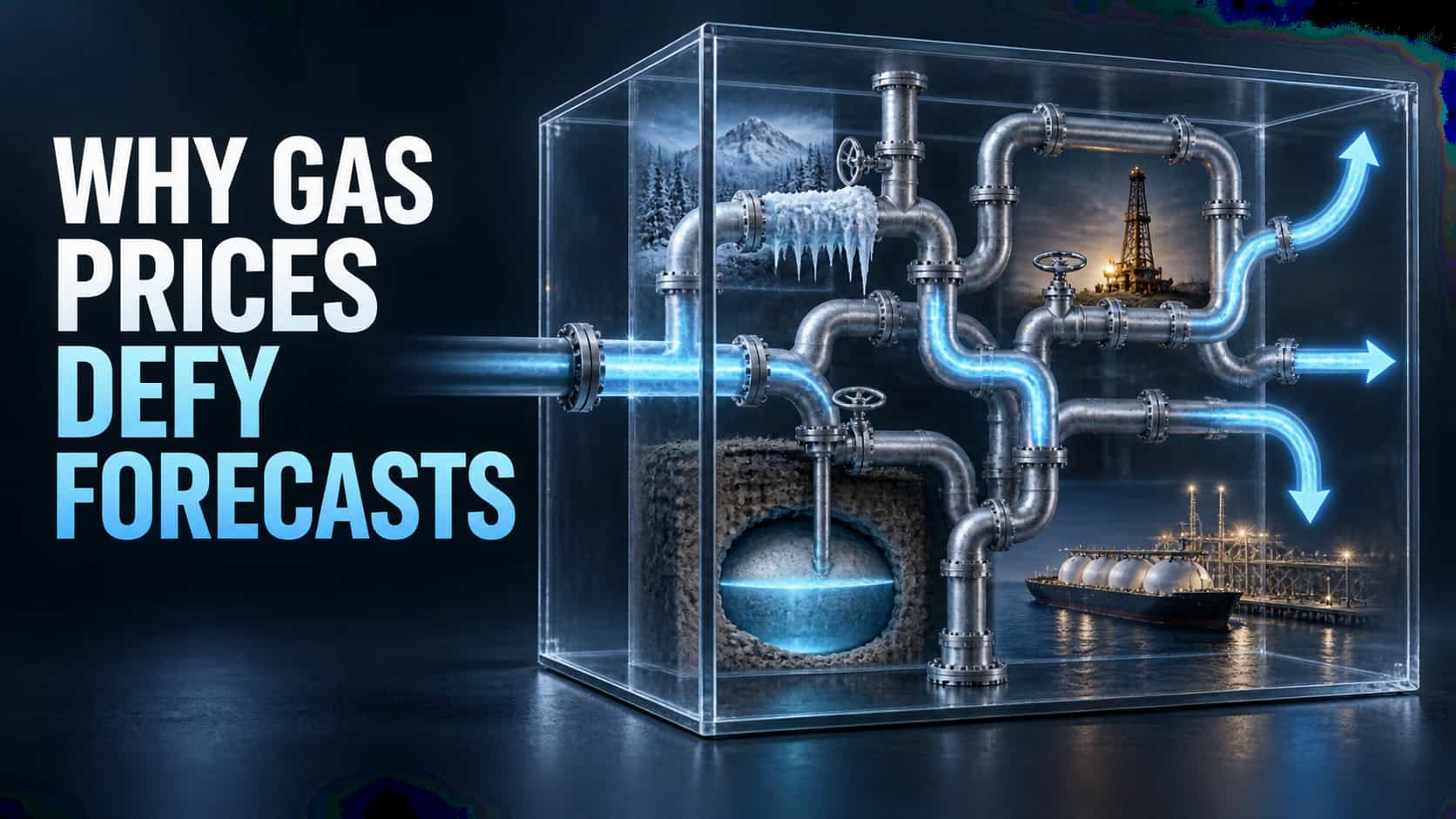
On Sunday evening, a weather model can turn colder. By Monday morning, a natural gas price prediction that looked sensible on Friday may already be stale. Nothing physical has changed yet: no extra furnace has been switched on, and no storage cavern has been tapped. Still, traders have repriced the possibility that both could happen. That gap between today's gas system and tomorrow's expectations is where forecasting gets messy.
The Market Never Sits Still for the Forecast
TTF is in Europe, JKM is in Asia, and Henry Hub in the U.S. are all subject to various pipeline networks, storage locations, rules, and weather. LNG is bringing those markets together, but it won't be eliminating the differences between them.
This means a forecaster is solving several smaller puzzles at once. How much gas is available locally? Can it reach the place that needs it? What will buyers do if the price changes?
Weather Changes Faster Than Gas Can Move
In winter, cold conditions mean heating is needed more. During the summer, the amount of air conditioning grows and may cause gas-fired power stations to operate at higher levels.
A chillier forecast for a sparsely populated region will likely stir only slight interest from a national perspective. Shift the same cold towards a large city or a pipeline bottleneck and the price response can be sharp. Timing counts too.
One Storm Can Hit Both Sides
Severe weather does not simply increase consumption. It can freeze wells, interrupt processing plants, or restrict pipeline operations while demand is rising. The US Energy Information Administration's market guide notes that short-term supply losses or demand gains may produce large price changes when infrastructure is constrained, and consumers cannot switch fuels quickly.
Forecast models improve as an event approaches, but prices do not politely wait for certainty.
A Storage Total Can Hide the Important Part
Weekly inventory numbers attract attention because storage bridges the gap between steady supply and uneven demand. Yet one national total can conceal a lot.
Gas stored in one region may not help another region if pipelines are full. Operators also need enough pressure and withdrawal capacity to move gas at the required rate.
Traders compare the published change with the number they expected. Suppose stocks fall by 80 billion cubic feet. That sounds bullish, but the price may fall if the market had prepared for a 95 billion cubic foot withdrawal. The surprise, rather than the sign of the number, often drives the first reaction.
Production Answers Slowly and Unevenly
A higher price can encourage drilling, although not on command. Producers need crews, equipment, permits, processing space, and a route to market. In some basins, gas arrives as a by-product of oil drilling, so an oil decision changes gas supply even when the gas price itself is weak.
The reverse lag matters as well. When prices drop, existing wells do not vanish. Output may remain strong until natural decline catches up with fewer new completions.
LNG Carries Surprises Across Oceans
LNG has made regional markets more connected, but the connection introduces fresh variables. A liquefaction plant can trip. A vessel can be delayed. A European terminal may enter maintenance just as Asian buyers start bidding for winter cargoes.
The pace of change can be abrupt. The International Energy Agency's Q1 2026 review found that global LNG output rose almost 7 percent in 2025, with roughly three-quarters of that growth arriving in the second half. A forecast built around first-half tightness needed more than a minor update.
An Outage May Push Prices in Opposite Directions
Consider a US export terminal that suddenly stops operating. Fewer cargoes reach overseas buyers, which can lift European or Asian prices. Meanwhile, gas intended for liquefaction remains in the domestic network, putting downward pressure on the local hub. One incident, two price signals.
Power Markets Add Another Layer
Gas competes with coal, nuclear power, hydropower, wind and solar. Plant availability and fuel-switching limits determine how strong that competition really is. A wind lull may lift gas burn; heavy rainfall may improve hydropower and reduce it. A nuclear outage can matter more than the day's temperature.
These relationships change by hour and location. Solar output can suppress daytime gas demand, then leave fast-ramping plants to cover the evening. Looking only at daily averages can miss the hours when pipelines or generators come under the greatest strain.
Prices React to What Traders Already Believe
Markets price expectations before official data confirm them. If almost everyone expects cold weather, much of the buying may occur before the first cold day. A later forecast that is still cold, but less severe, can send prices lower. The headline and the price move may appear contradictory because the comparison point is yesterday's expectation.
Positioning can magnify that move. When many traders hold a similar bet, a modest surprise may trigger stop-loss orders and hurried exits. Liquidity can thin during holidays or outside active hours, allowing a small flow of orders to move the market farther than usual.
Reading a Natural Gas Price Prediction Sensibly
A useful natural gas price prediction is a set of conditional paths, not a lone number dressed up as certainty. Readers should ask which weather case, storage level, production trend, and LNG assumption support the central estimate. They should also look for the events that would break it.
For a business buying gas, scenario ranges are often more practical than a precise target. A buyer can plan one response for mild weather, another for prolonged cold, and a third for a supply interruption. Updating those ranges is not backtracking. It is what responsible forecasting looks like when the inputs keep moving.
Conclusion
Predicting natural gas falls prey to the mismatched clocks of weather, infrastructure, storage, production, and global trade. Prices change first, then physical conditions, and one place can be better off, while another is worse off. Good forecasting cannot remove that uncertainty. It can make the assumptions visible, test the weak points, and show what deserves attention next in real markets.